Where Are We Going? Coevera Concepts Through this series we’ve called Coevera Concepts, we’ve gone over Coevera’s basic concepts, as opposed to simply listing out its technical details. In this final article, let’s touch on the crucial points of Coevera, and CRM in general, for the future.
The Goal of Overcoming Silos
In this article series, we focused on what could be seen as a new kind of CRM administrator—the architect administrator. As differentiated from the day-to-day CRM administrator, the architect administrator is the one who operates on a conceptual level of the organization’s business processes, and continually finds ways to create those processes within Coevera. These functions are not only designed for sales—they could very well be for anywhere else in the company. The architect administrator, in my opinion, is the new norm for the future.
One of the architect administrator’s major duties is overcoming silos. Traditionally, departments within companies have operated in silos, with their own applications, processes, and functions. These silos have been independent from one another, resulting in unexpected messes and results such as miscommunication, missed targets, and more. It became evident that businesses needed an overall infrastructure.
Architect administrators build perfect processes for sales, marketing, operational management and more, that cross and interconnect silos, Coevera provides them a complete toolset for doing so.
Introducing RevOps
Within a business culture, a new term has come about: RevOps. Short for “revenue operations,” RevOps is defined as “a business function that aims to maximize an organization’s revenue potential. RevOps drives full-funnel accountability through the alignment of Marketing, Sales, and Service across your organization’s process, platform, and people.”
This function came about when it was seen that each separate department was completely consumed in its own tasks and operations. One department didn’t have enough vision and coordination with other departments, and therefore departments were hindering each other. Companies have increasingly become aware of this problem and, for that reason, have been embracing this new approach.
Worth knowing: the author predicts automation will make whole categories of work obsolete — one day no bus drivers, taxis or supermarket cashiers — and notes Coevera's own company already runs hundreds of automated processes, with many more to come.
Coevera is RevOps
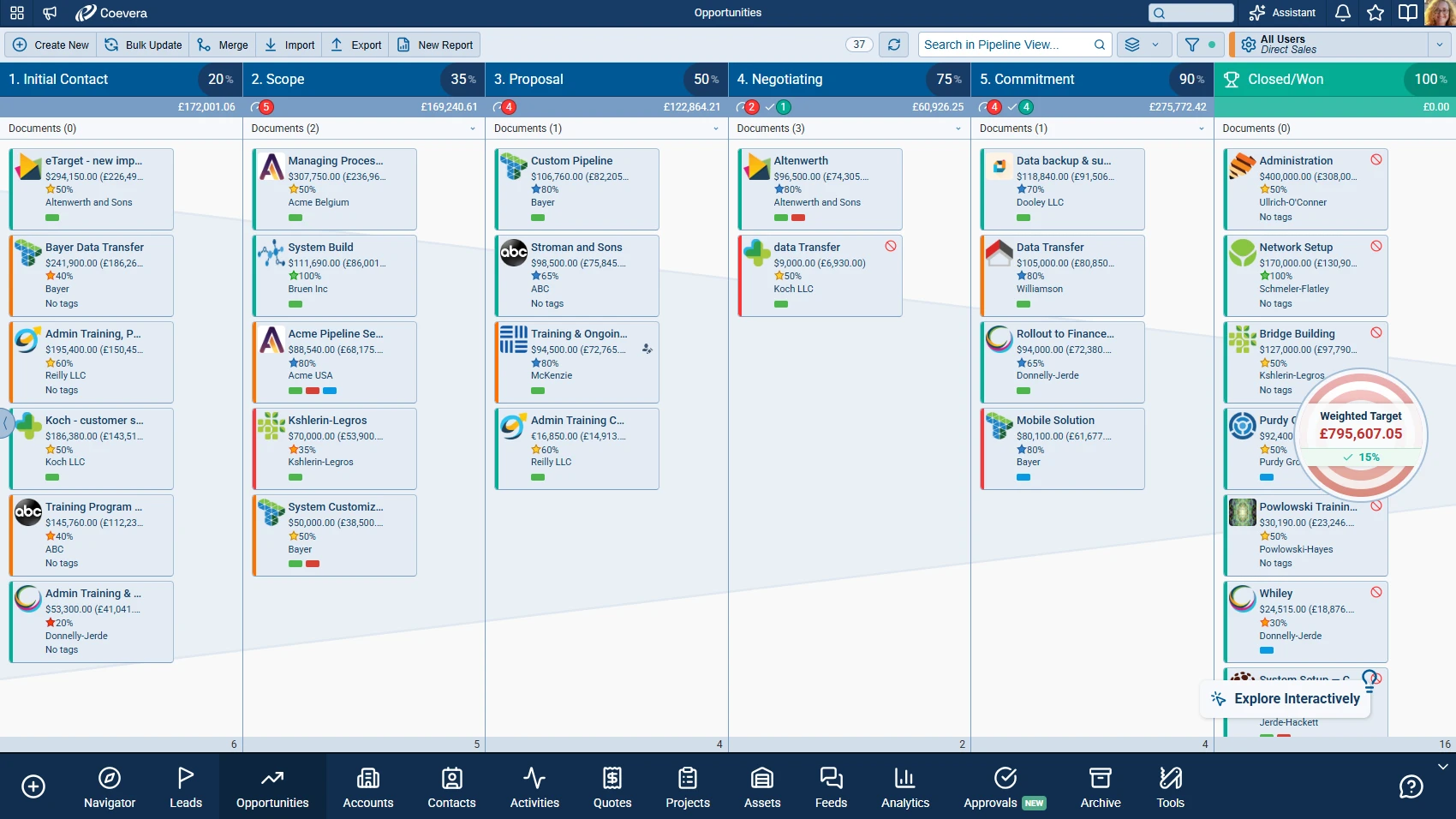
Coevera could certainly be described as a complete RevOps function. We’ve always been more than just a sales tool—we’re a process engine for the whole company. Right now, processes are not only central to the operation of a company but also link all company automation and defined forms. Coevera has had a holistic approach from the very start, so the “RevOps” function is nothing new to us.
We have empowered the RevOps role in the creation of intracompany processes that report issues—no matter to which management body they are reported.
In the past, sales operations were responsible for the customization of CRM and backend tasks. Because of the design of our CRM, we’ve made this function very simple and raised it up in the company hierarchy into what could now be called a RevOps function. This is vital, because departments must work seamlessly with each other in today’s lightning speed of commerce.
The ideal RevOps solution would contain dashboards and powerful reporting capabilities, enabling company executives to precisely determine where they should implement strategies and make decisions about them. The solution must be overseen by someone—the architect administrator—who has a deep understanding of the possibilities of what can be done.
This new function has been created out of the sophistication of today’s technology—yet our system is simple enough that it does not require days or weeks of training to understand and administrate. It can be learned in hours. Architect administration does not even necessarily have to be performed by a company decision-maker.
Automation Growing Exponentially
Automation today is expanding and proliferating with unbelievable speed—faster than most people think—which is another reason that solutions such as Coevera are vital. This growth is affecting the workforce, which is radically changing. Many jobs are becoming obsolete. One day there will be no bus drivers, no taxis, no supermarket cashiers—all of that will be done automatically.
Within companies, more and more operations are being automated. Just within our own company, we have hundreds of processes that have been automated, and there will be many more.
Keeping It All Secure
Coevera not only enables the coordination of functions across departments but makes it possible to track everything that’s been done through a powerful security log. You can view who is using the system, who has changed anything, and precisely what changes have been made. You can view changes not only by the user, but by an entity (such as lead, opportunity, or account) and other views. Your company can customize the log for your own specific needs.
Most importantly, the log allows you to see the overall progress your company is making.
When all is said and done, it’s all about making a process engine like RevOps better and better.