Ask a sales leader why the CRM is out of date and you will usually hear something about discipline. Ask the reps and you get a different answer, and a better one. They are not avoiding the system because they are careless. They are avoiding it because, on most days, it takes more than it gives.
The real reason reps avoid the CRM
Start with what the research says about the seller's day, because it reframes the whole problem. Gartner surveyed 1,026 B2B sellers and found 70% of sellers overwhelmed by the number of technologies required to do their work, and 72% overwhelmed by the number of skills their roles now demand.
That is the context every CRM request lands in. Your reps are not weighing "log this call" against "do nothing." They are weighing it against a stack of tools that already feels like too much. In a separate survey of 501 sellers, Gartner found 77% say they struggle to complete their assigned tasks efficiently.
Then there is the tax nobody budgets for. Validity's 2025 report, based on 602 CRM users and administrators across the US, UK, and Australia, found staff spend an average of 13 hours a week hunting for basic information in the CRM. That is time spent inside the system, looking for things it was supposed to make easy to find.
So when the CRM asks for one more update, reps see a cost and not a benefit. They keep the real pipeline in a spreadsheet, an inbox, or their head. The official system falls behind, and the forecast you take to leadership gets built on whatever survived.
What kills CRM adoption
A few patterns show up on almost every team that works around its CRM. Count how many match yours.
- Data-entry burden. If logging one call takes five clicks and three dropdowns, reps will skip it. That friction repeats across every activity, all day long.
- No payoff for the rep. When the CRM only feeds reports for management, reps get nothing back for keeping it current. It serves the boss, not the seller.
- Poor workflow fit. If the CRM does not match how your team actually sells, reps route around it and live somewhere else instead.
- Too many tools. The CRM rarely competes with nothing. It competes with every other system a rep was told is essential this quarter.
- Managers who skip it too. This one is quiet and fatal. If deal reviews run off a spreadsheet a rep exported that morning, the CRM is not the source of truth and everyone knows it.
Notice the pattern. Reps do not resist software for sport. They resist work that costs them time and hands them nothing back.
How to fix CRM adoption
You raise CRM adoption by making the system earn its place in the rep's day. Gartner's research on sales productivity points the same way. In a separate survey of 234 heads of sales and senior sales leaders, it found organizations that report relying on simplifying seller roles to drive productivity are 4.5x more likely than those that do not to be among the 11% that drove commercial success through a transformation. Simplification is not a soft goal. It is the lever.
Cut fields to the ones that earn their place. If a field never appears in a report and never changes a deal decision, delete it. Less to fill means less reason to avoid the tool.
Cut manual entry to the bone. The fastest way to win reps over is to stop asking them to type. Auto-capture activity wherever you can.
Make it findable. If staff are losing hours a week to searching, the fix is not more training. It is fewer places to look and a record that is complete enough to answer the question.
Show reps what is in it for them. Frame the CRM as their tool, not management's dashboard. A clean pipeline means fewer dropped follow-ups and faster handoffs.
Run every review from the CRM. This is the manager's job and it changes everything. If every deal review, forecast, and one-to-one pulls straight from the CRM, the system becomes the source of truth by default. Reps update it because that is where decisions get made.
Where AI moves the needle for CRM adoption
The biggest adoption barrier is the work the CRM asks a rep to do by hand, so the biggest lever is AI that takes that work off them.
The size of the prize is now measurable. Gartner's May 2026 research on sales AI found that AI tools were saving sellers an average of 4.8 hours per week. Hand the drafting and the logging to an agent and the CRM stops being the thing that costs a rep their afternoon.
There is a catch worth planning for. Gartner also found 72% of sales organizations report low reinvestment of those time savings into high-value sales activities. Freed hours do not automatically become selling hours. Decide where they go before you switch anything on.
Automation also only helps adoption if reps trust it. If AI changes records on its own with no oversight, sellers stop believing the data, and you are back to a system nobody trusts.
How Coevera approaches adoption
Coevera's AI layer is Voyager AI. Voyager 1 comes with every plan and handles the assistive work: creating email, searching documents, and summarizing opportunities and calls. Voyager 2 is the agentic tier and is a paid add-on on every plan, running on a credit system with a free monthly allowance. It adds agents for call preparation, contextual guidance, report creation, automations, and forms.
The control model is approval-based autonomy, which Coevera states plainly: nothing happens to a deal or record without a human in the loop. Voyager shows its reasoning, asks before it acts, and learns when you correct it. Because the reasoning is visible rather than just the output, a manager can audit the thinking rather than take it on faith. That is what keeps automation from costing you the trust you were trying to build.
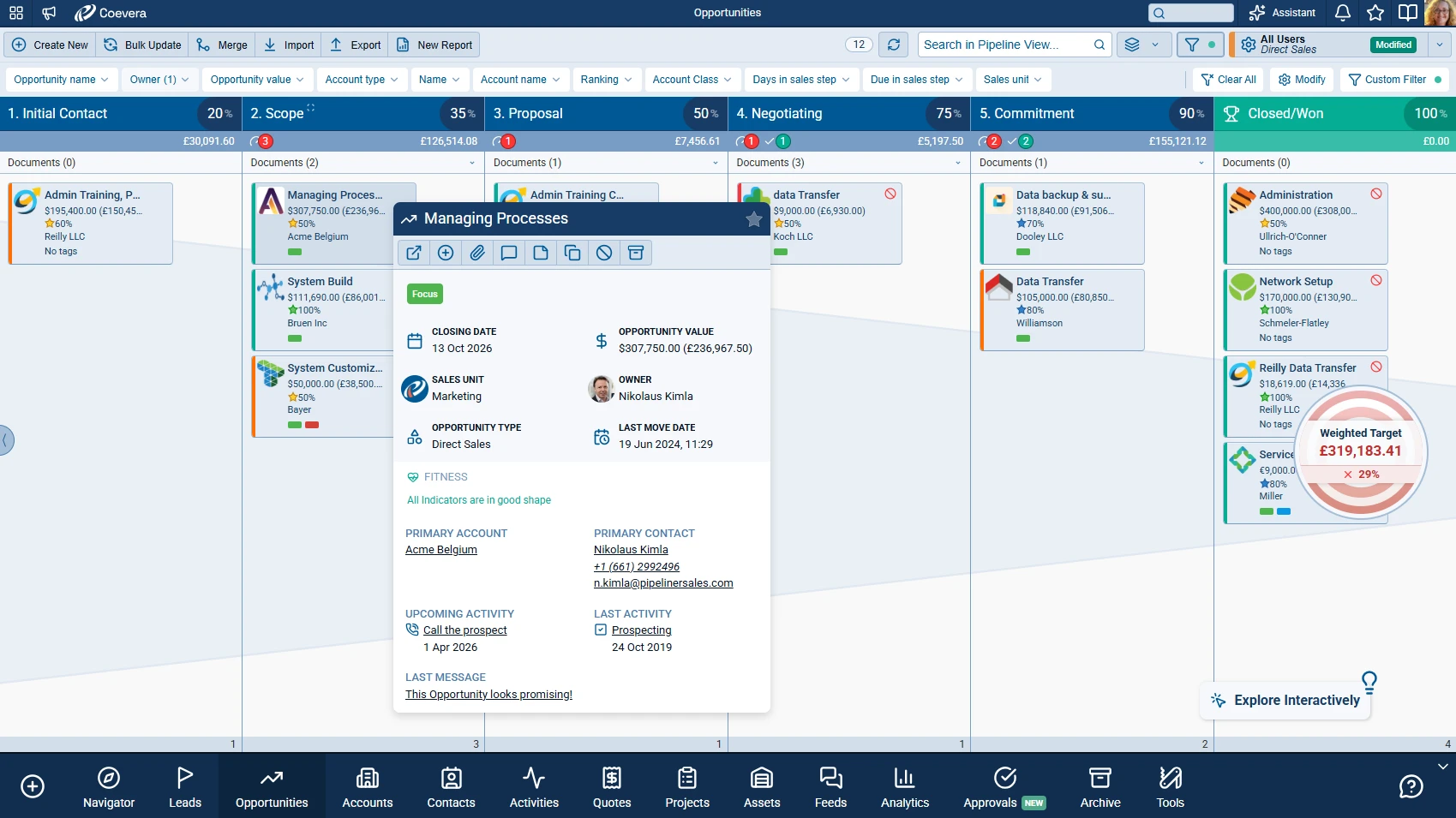
On the interface itself, Coevera offers multiple pipeline views, including Kanban, list, compact, bubble, and map, all showing live data. A rep who can read the whole pipeline at a glance is more likely to keep it current than one scrolling a long list of rows.
Adoption is not about forcing reps to log more. It is about building a system that gives back more than it asks. Cut the busywork, fit the workflow, keep a human in the loop, and the CRM stops being a chore and becomes the place the work actually lives.
Test it against your own pipeline
Load a live pipeline into Coevera and see whether your reps keep it current. No credit card required.
Start free trial