Nobody schedules a meeting about duplicate account records. That is exactly why they get expensive. Bad CRM data almost never announces itself as a crisis. It just makes every forecast a little less true, and every rep a little less willing to trust the system they are asked to update.
What bad CRM data actually looks like
Bad CRM data is not one problem. It is a pile of small ones that add up.
You know the signs. The same account appears three times under slightly different spellings. A contact left the company a year ago, but the record still lists them as the buyer. Half your open deals have no next step and no close date. Key fields sit empty because nobody was ever required to fill them.
For a revenue operations or sales operations leader, this is the daily texture of the job. Reps trust the system a little less each week. Managers stop believing the pipeline report. And the data keeps drifting, because every unlogged call makes the next record harder to trust.
The unsettling part is how little of this anyone notices. Validity's 2025 report, based on 602 CRM users and administrators across the US, UK, and Australia, found 90% of organizations recognize CRM data as the cornerstone of their operations, while 76% said less than half of their CRM data is accurate and complete. In the same study, 68% of executives believed their teams had adequate data. Their teams disagreed.
What poor CRM data quality costs you
The cost shows up in three places: revenue, deals, and time.
Start with revenue, because that is the number leadership responds to. Validity found 37% of organizations lose revenue as a direct result of data quality, and that one in four companies experience a drop of 20% or more in annual revenue. That is not a rounding error hiding in a spreadsheet. It is a material drag on growth, sitting inside your system of record.
Then deals. The same study put the loss at an average of 16 sales deals per quarter as a result of poor-quality data. Put a number on your own average deal size and that figure stops being abstract very quickly.
Then time. Validity found staff spend an average of 13 hours a week hunting for basic information in the CRM. That is not time spent updating records. It is time spent looking for things that should already have been findable.
There is a fourth cost that is harder to price. Validity found 37% of staff regularly fabricate data to tell leaders what they want to hear. Once a team stops believing the system reflects reality, the system starts collecting fiction, and the forecast built on top of it inherits every bit of that.
Why AI raises the stakes
Here is the part that changes the arithmetic.
For years, bad data mostly slowed people down. A rep noticed a wrong phone number and fixed it. A manager sanity-checked a strange forecast. Humans caught a lot of errors before they did any damage, simply because a human had to touch every record on its way out the door.
AI removes that pause. An agent acts on your data at machine speed, and if the data is wrong the agent is wrong too, faster and at larger scale. Point one at a list full of duplicates and departed contacts and it will email all of them, update the wrong records, and log activity against accounts that no longer exist. Nothing waits for someone to notice.
The timing is the problem. Validity found 54% of organizations already deploying generative AI tools, while 45% said their CRM data is not prepared for AI. Validity's own read of that pairing is blunt: organizations are building sophisticated systems on shaky foundations.
There's a growing gap between confidence and reality when it comes to data quality.
Cynthia Price, SVP of Marketing, Validity
Forrester's 2026 B2B predictions put a governance frame around the same risk. It forecasts that untested generative AI functionality, combined with lagging AI user skills, will lead to incidents that cost companies enterprise value through falling share prices, legal settlements, and fines. Worth noting what Forrester actually names as the causes: the tools and the skills, not the records. Add unreliable data to those two and you have every ingredient in one place.
How to protect your CRM data
You cannot make data perfect. You can make it trustworthy, and a few unglamorous habits do most of the work.
- Require the fields that matter. Make deal stage, next step, and close date mandatory so records cannot go half-empty.
- Validate at entry. Catch malformed emails, empty fields, and impossible dates when they are typed, not six months later.
- Dedupe on a schedule. Merge duplicate accounts and contacts regularly rather than once a year in a panic.
- Give every record an owner. Clear ownership means somebody is accountable for keeping it current.
- Close the confidence gap. Ask your reps what percentage of records they would stake a deal on, then compare that with what your leadership team assumes.
These matter more the moment AI enters the picture. If an agent is going to act on your records, someone needs to see what it plans to do and be able to stop it.
One field, 579 of 3,432 records empty, and the import still reported success: Blueprint 005 shows the check that catches it.
How Coevera handles data quality
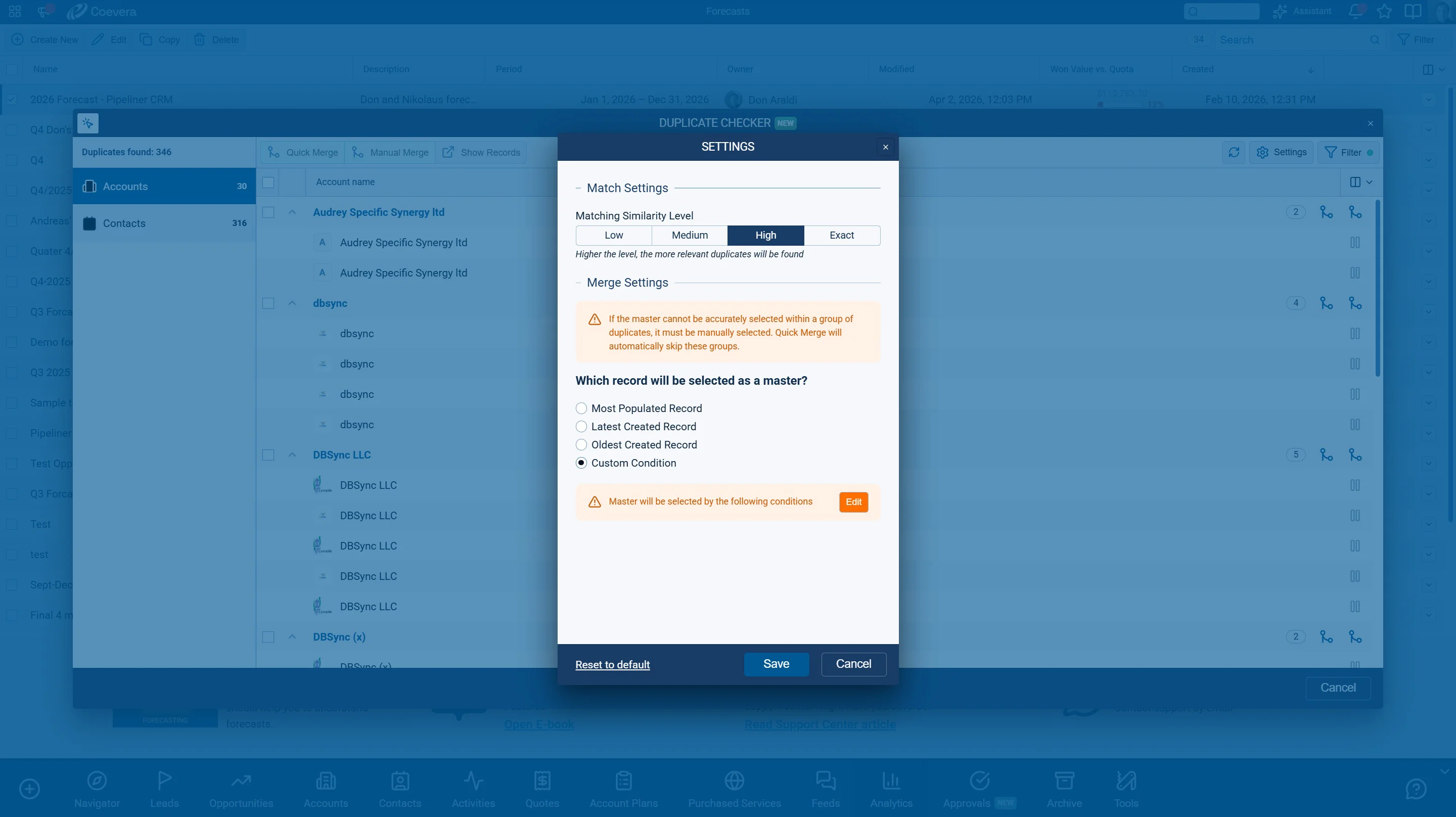
Coevera puts the basics on every plan. Validation rules on custom fields and merging for duplicate contacts and accounts are included across all four plans, so the two habits that prevent the most damage do not sit behind an upgrade. Duplicate checking is included on the top plan and available as an add-on below it, and an audit log is included on the two upper plans.
The AI side is built so it cannot quietly act on a bad record. Voyager 1 comes with every plan and handles assistive work. Voyager 2, the agentic tier, is a paid add-on on every plan, running on a credit system with a free monthly allowance. Both run on what Coevera calls approval-based autonomy, which the company states plainly: nothing happens to a deal or record without a human in the loop.
Voyager shows its reasoning, asks before it acts, and learns when you correct it. That matters most precisely when the underlying record is wrong. An agent that explains what it is about to do, and why, gives your team the chance to catch a bad record before it becomes a bad email or a broken forecast. Because the reasoning is visible rather than just the output, a manager can audit the thinking instead of taking it on faith. You can see how the pieces fit in the products center.
Clean data and supervised AI solve the same problem from two directions. One reduces the number of errors. The other stops the errors that remain from acting on their own.
Put it against your own records
Load a live pipeline into Coevera and see what your data looks like with validation on. No credit card required.
Start free trial