Here is a number that should stop every sales leader in their tracks: 74% of organizations say poor data quality is their biggest barrier to AI adoption. That means nearly three out of four companies investing in AI-powered CRM tools are building on a foundation of sand. The algorithms are not the bottleneck. Your data is.
If you have been eyeing AI features in your CRM—predictive lead scoring, automated deal insights, intelligent pipeline forecasting—but haven’t addressed what’s sitting inside your database, this playbook is your starting point. We will walk you through exactly how to audit, clean, structure, and govern your CRM data so that AI tools like Coevera’s Voyager AI can deliver results you actually trust.
Why Clean Data Is the Real AI Advantage
Every AI model is only as good as the data it learns from. When your CRM is filled with duplicate contacts, incomplete deal records, and outdated company information, even the most sophisticated algorithms will produce unreliable results. Gartner estimates that poor data quality costs organizations an average of $12.9 million per year—and that figure climbs significantly when you add failed AI initiatives on top.
The companies seeing real returns from AI in their sales processes share one trait: they invested in data readiness before they turned on AI features. Think of it like preparing soil before planting. No amount of advanced irrigation technology will help if the ground is full of rocks.
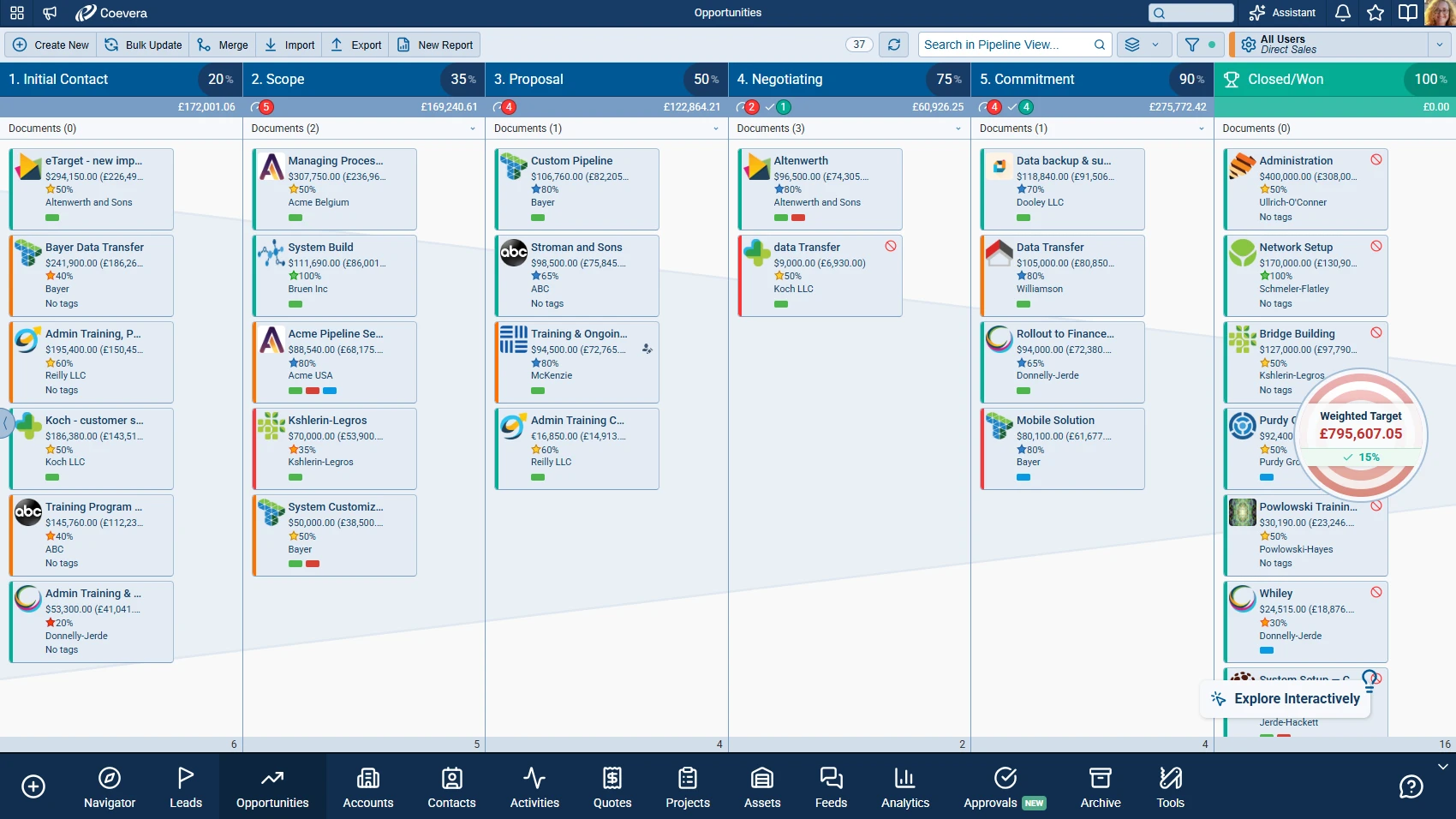
For sales teams running Coevera, this means ensuring your pipeline stages, contact records, activity logs, and deal attributes are consistently structured and reliably populated. Voyager AI uses this data to surface winning patterns, flag at-risk deals, and automate follow-up sequences—but only when it has clean inputs.
Step 1: Run a CRM Data Audit
Before you clean anything, you need to know what you are working with. A data audit is a systematic review of your CRM’s health across four dimensions: completeness, accuracy, consistency, and timeliness.
Completeness
Pull a report on field fill rates for your most critical data points. How many of your contact records have a phone number? An email? A job title? For deals, check whether the pipeline stage, expected close date, and deal value are populated. Any field with a fill rate below 80% needs attention. AI models struggle to find patterns when half the data points are missing.
Accuracy
Spot-check a random sample of 50 to 100 records. Are email addresses valid? Do company names match the actual business entity? Are deal values realistic? Cross-reference against external sources like LinkedIn or company websites. Even a 10% error rate can meaningfully degrade AI prediction accuracy.
Consistency
Look for variations in how data is entered. Is one rep entering “United States” while another types “US” and a third uses “USA”? Are industry categories standardized, or do everyone use their own labels? Inconsistent formatting makes it nearly impossible for AI to cluster and compare data reliably.
Timeliness
Identify records that haven’t been updated in 6 or 12 months. Stale data is misleading data. A contact who changed roles eight months ago will throw off your AI’s predictions about who to target and when. Set up regular review cycles to keep records current.
Step 2: Eliminate Duplicates and Dead Records
Duplicate records are the silent killer of AI accuracy. When the same company appears three times under slightly different names, your predictive models treat them as three separate entities, leading to fragmented data. The result is weaker signals and worse predictions.
Start by running a deduplication scan. Coevera offers a built-in AI-powered duplicate detection and merge tool. Merge records carefully, preserving the most complete and most recent information from each version. Then remove records that are genuinely dead—companies that have closed, contacts who have bounced, deals that were closed-lost more than two years ago with no subsequent activity.
A learner database is a smarter database. Removing noise allows AI to focus on meaningful patterns. Teams that deduplicate before activating AI features typically see a 15-25% improvement in prediction accuracy within the first quarter.
By the numbers: Gartner estimates poor data quality costs organizations an average of $12.9 million per year — and that figure climbs once failed AI initiatives pile on top, making a focused 90-day cleanup of one pipeline or team a high-return place to start.
Step 3: Standardize Fields and Create a Data Dictionary
AI thrives on structure. If your pipeline stages are labeled differently across teams, or if your industry categories are free-text fields where anything goes, your AI will struggle to draw meaningful comparisons.
Create a data dictionary—a shared document that defines every critical field in your CRM, the acceptable values for each, and who is responsible for maintaining them. For example, define your pipeline stages explicitly: Prospect, Qualified, Proposal Sent, Negotiation, Closed Won, Closed Lost. No variations. No custom stages that one rep invented on a Tuesday afternoon.
In Coevera, use picklists and dropdown fields wherever possible to enforce standardization at the point of entry. This is far more effective than trying to clean up free-text fields after the fact.
For the field types AI can fill and the ones it cannot, see Blueprint 002.
Step 4: Enrich Your Data for Deeper AI Insights
Clean data is good. Rich data is better. Data enrichment adds context that AI can use to find patterns you would never spot manually, such as company revenue ranges, technology stacks, recent funding rounds, organizational headcount, and social media engagement.
Tools like ZoomInfo, Clearbit, and Apollo can automatically append firmographic and technographic data to your CRM records. When your AI has access to both your internal sales activity data and external market intelligence, its predictions become dramatically more useful.
For Coevera users, integrating an enrichment tool with your CRM ensures that every new lead enters the system with a full profile, rather than just a name and email address. This gives Voyager AI a head start on scoring and routing decisions from day one.
Step 5: Build an Ongoing Data Governance Framework
A one-time data cleanup is a temporary fix. Without ongoing governance, your CRM will degrade back to its previous state within months. Data governance is the set of policies, roles, and processes that ensure your data stays AI-ready over time.
An effective governance framework includes the following components:
- Data Ownership: Assign a data steward for each major object (contacts, companies, deals). This person is accountable for quality standards and periodic reviews.
- Entry Standards: Document required fields for every record type. Make critical fields mandatory in your CRM configuration so that incomplete records cannot be saved.
- Review Cadence: Schedule monthly data quality reviews. Run automated reports on fill rates, duplicate counts, and stale records. Address issues before they accumulate.
- Automation Rules: Use Coevera’s workflow automation to flag records that violate quality standards—for example, deals that have been in the same pipeline stage for more than 60 days without a logged activity.
How Coevera’s Voyager AI Rewards Clean Data
When your data foundation is solid, Coevera’s Voyager AI shifts from a nice-to-have feature to a genuine competitive advantage. Here is what becomes possible with AI-ready data:
- Predictive Deal Scoring: Voyager AI analyzes historical win/loss patterns against current deal attributes to tell you which opportunities are most likely to close—and which ones need intervention.
- Intelligent Activity Recommendations: Based on what worked in similar past deals, AI recommends the next best action for each opportunity—whether that is a follow-up call, a product demo, or bringing in a technical resource.
- Pipeline Health Forecasting: With consistent, complete data across your pipeline, Voyager AI produces forecasts that leadership can actually rely on—not the finger-in-the-wind estimates that come from messy pipelines.
- Automated Workflow Triggers: The AI Automatizer can kick off sequences, assign tasks, and route leads based on real-time data signals—but only when those signals are trustworthy.
Your AI Journey Starts with Your Data
The most common mistake sales organizations make with AI is treating it as a plug-and-play solution. They turn on the feature and expect magic. But AI is not magic—it is math, and math needs clean inputs to produce reliable outputs.
By following this playbook—auditing your current data, eliminating duplicates, standardizing your fields, enriching your records, and establishing ongoing governance—you are not just preparing for AI. You are building a data asset that will compound in value over time, making every future AI investment more effective.
Start small. Pick one pipeline or one team, run the audit, and clean it up. Then expand. Within 90 days, you will have a CRM that is genuinely ready for AI—and you will wonder why you did not do this sooner.
Ready to see what Voyager AI can do with clean data? Explore Voyager AI and start your free Coevera trial to experience AI-powered selling firsthand.