The hardest part of an industrial deal is rarely the selling. It is keeping track of who has to say yes, which distributor is sitting on the quote, and whether the order that finally lands can actually be built on schedule. Most CRMs were never designed for that, which is why so many manufacturers end up running the real pipeline out of a spreadsheet.
Why generic CRMs fail manufacturers
Manufacturing sales do not look like software or retail sales, and the difference starts with who is on the other side of the table. Gartner surveyed 632 B2B buyers across industries and found buying groups ranging from five to 16 people across as many as four functions. Gartner does not name those functions. In an industrial deal they are usually engineering, procurement, operations, and finance, each with a different reason to slow things down.
They also disagree with each other. The same research found 74% of B2B buyer teams demonstrate unhealthy conflict during the buying decision process. That is worth sitting with, because it reframes a stalled deal. The silence after a technical review is often not disinterest. It is an argument happening in a room you are not in.
On top of that, you often sell through distributors and dealers rather than direct to the end buyer, and a quote is rarely the finish line. It hands off to your ERP for production scheduling and invoicing.
A generic CRM assumes the opposite of all three. It expects a short, direct deal with one buyer you email a few times and close. That model fits fast, simple sales. It does not fit a deal that stalls in a technical review, moves through a distributor, and ends in an order your plant has to build. When the tool fights the way you sell, reps stop trusting it and fall back to spreadsheets and memory.
What to look for in a CRM for manufacturing
A manufacturing CRM earns its place by matching how you actually sell. These are the criteria that separate a real fit from a generic tool:
- Bidirectional ERP integration, so your CRM and ERP share the same product, pricing, and order data.
- Account-based pipelines that hold many contacts and deals under one company, because you are tracking a group and not a person.
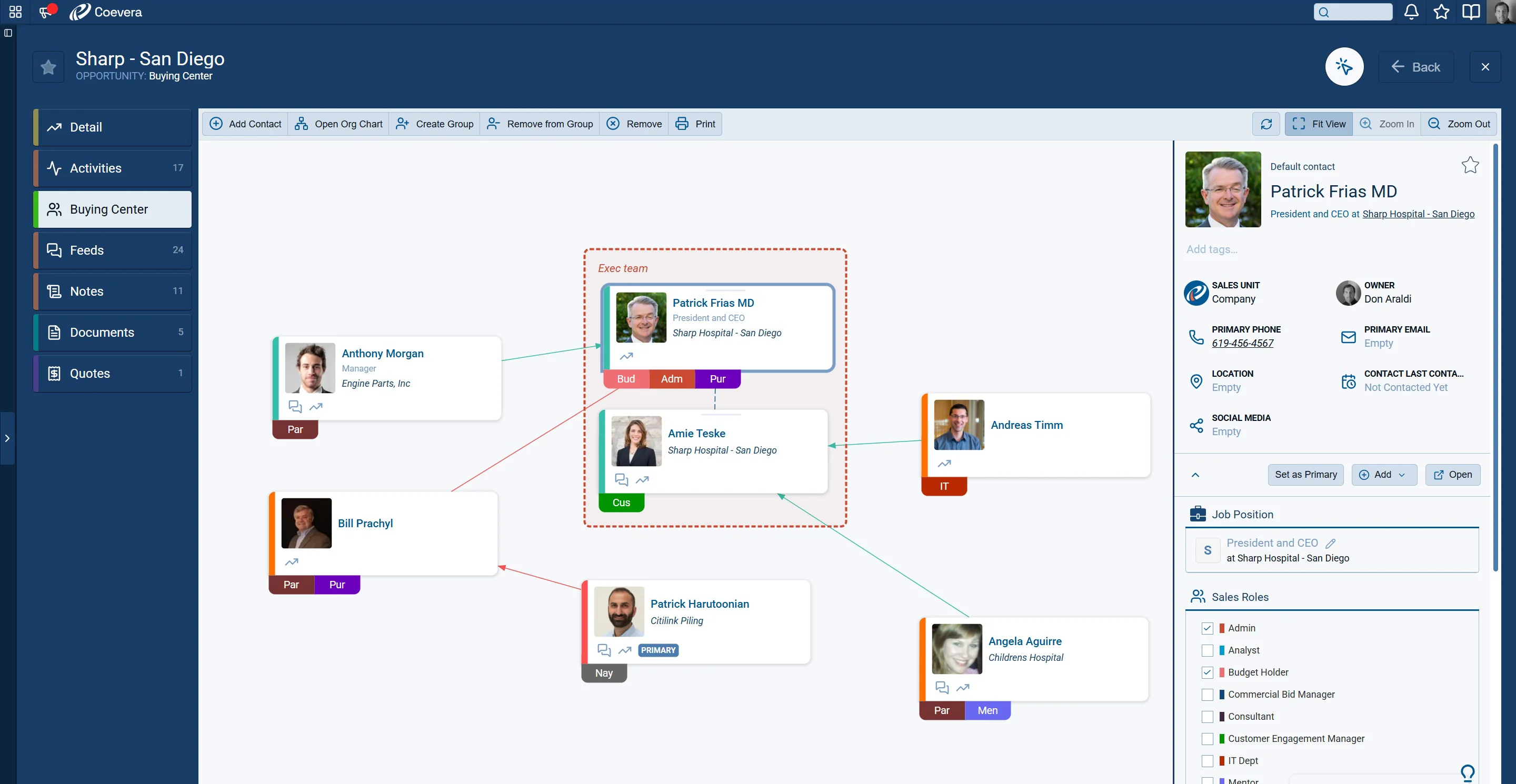
- Stakeholder mapping that shows who influences whom inside the account, so a five-to-16-person buying group is visible rather than guessed at.
- Long-cycle deal tracking with deal-aging indicators that flag deals sitting too long in one stage.
- Distributor and dealer management, so you can see partner pipelines and not only direct deals.
- Quote-to-order workflows that turn an approved quote into an order without rekeying.
- Analytics and forecasting by stage, territory, and product line, not one flat number.
Miss a few of these and the CRM becomes a place to store contacts rather than a tool that runs your pipeline. Cover them, and the software starts to match the shape of your business.
ERP integration is the make-or-break criterion
Your ERP holds the live data your business runs on: products, pricing, inventory, and orders. When your CRM cannot read and write that data, someone has to bridge the gap by hand.
Here is how that plays out. A rep closes a deal in the CRM, then retypes the order into the ERP. A price changes in the ERP, but the CRM still shows the old one. Every manual step is a chance for a typo, a stale number, or a missed update. Double entry wastes time, and it quietly erodes trust in your numbers.
Two-way sync removes the rekeying. A change in one system shows up in the other. Reps quote from current product and pricing data, and your forecast lines up with what the plant will actually build. One-way sync looks fine in a demo and breaks down the moment real orders start moving.
The test is simple. Ask whether a rep ever has to type the same order twice. If the answer is yes, the integration is not deep enough, and the gap will show up in your forecast. Ask the second question too: on which plan does that integration become available? Integration depth is one of the most common things vendors tier, so confirm it against the plan you intend to buy rather than the feature page.
How Coevera fits industrial and manufacturing teams
Coevera is built around multi-stakeholder selling, which is the part industrial teams usually struggle to see. Its key account management covers org charts, relationship maps, account health scoring, white space, and multi-stakeholder tracking for complex deals, and its buying center view shows the decision-making structure inside an account. When a deal has a dozen people behind it, that is the difference between knowing where you stand and guessing.
The pipeline comes in several views, including Kanban, list, compact, bubble, and map, all showing live data. You can scan where every deal sits and spot the ones aging past their stage before they stall.
On the ERP question, Coevera connects to 200 or more apps covering ERP, email, and marketing, and describes the approach as zero middleware. That is connectivity, which is not the same as the two-way test above, so put that question to any vendor against your specific ERP. Two things are also worth checking against your own plan. API access is included on every plan, with monthly call limits that rise by tier, and bespoke custom integration is available on every plan too. Automatizer is the no-code workflow engine. Its availability and monthly process allowance differ by plan, so check the pricing page against the tier you intend to buy rather than assuming the capability comes with it.
Voyager AI adds a lighter layer of help. Voyager 1 comes with every plan and covers assistive work such as creating email, searching documents, and summarizing opportunities and calls. Voyager 2 is the agentic tier and is a paid add-on on every plan, running on a credit system with a free monthly allowance. Coevera's control model is approval-based autonomy: nothing happens to a deal or record without a human in the loop. Voyager shows its reasoning, asks before it acts, and learns when you correct it, so a manager can audit the thinking rather than take an output on faith.
Coevera serves industrial teams. EMCS Industries, a Canadian marine technology company and the pioneer of the Marine Growth Prevention System, is a Coevera customer, as is Mactech On-Site, which provides on-site machining services to power plants, refineries, mining, shipbuilding, and manufacturing. You can see how the pieces fit in the products center, and the plans and pricing are public, so you can check which capabilities land on the tier you are considering.
Test it against your own deals
Load a live pipeline into Coevera and see whether it holds a real industrial deal. No credit card required.
Start free trial