Two years ago, "AI in CRM" meant a button that drafted an email. In 2026, it means software that researches your accounts overnight, preps your calls before you ask, and proposes pipeline changes you approve with a click. The market reflects the shift: the AI in CRM market is projected to grow from $11.04 billion in 2025 to $15.06 billion in 2026, on its way to $51.67 billion by 2030. This guide explains what AI in CRM actually does today, how to separate real agentic capability from rebranded chatbots, and how your B2B sales team should evaluate, implement, and measure it.
The three layers of AI in CRM
Not all "AI in CRM" is the same product. The market in 2026 splits into three distinct capability layers, and knowing which layer a vendor is selling you is the single most useful filter in an evaluation.
Layer 1 — Assistive AI. Tools that respond when a rep asks: email drafting, document search, opportunity summaries, call summaries. Assistive AI saves minutes per task but never acts on its own. In Coevera, this layer is Voyager 1 — a collection of free AI tools for email creation, document searches, opportunity summaries, and call summaries.
Layer 2 — Agentic AI. Software that completes multi-step work toward a goal: preparing a call brief by pulling account history, surfacing contextual guidance mid-deal, building a report from a plain-language request, constructing automations and forms. This is the layer Gartner expects to define 2026 — the firm predicts 40% of enterprise applications will integrate task-specific AI agents by the end of 2026, up from less than 5% in 2025. In Coevera, this is Voyager 2: a collection of agents for call preparation, contextual guidance, report creation, automations, and forms.
Layer 3 — The super-agent. A coordinating intelligence that directs the task-specific agents and works across every entity in the CRM — accounts, contacts, leads, opportunities, products. Voyager 2 includes a full-function interactive AI Super Agent of this kind, plus a real-time sales assistant built on The Collaborator (Coevera's embedded coaching layer, drawing on the 1,600+ episode Sales POP! catalog) — indexed so Voyager surfaces the right selling insight at the right moment of the deal. Other CRMs have training portals that teach you the software; The Collaborator teaches the craft of selling. For the practitioner's view of this shift — what agents do well, where they still fail, and how to hold them accountable — see What B2B Sales Leaders Need to Know About AI Agents in Sales on Sales POP!.
Most teams evaluating "AI CRM" in 2026 are comparing layer-1 products against layer-2 products without realizing it. Ask the vendor which layer each advertised feature actually belongs to.
Why approval-based autonomy matters
The hardest question in agentic AI isn't "what can the agent do" — it's "what happens when the agent is wrong." Gartner predicts over 40% of agentic AI projects will be canceled by the end of 2027, citing escalating costs, unclear business value, and insufficient risk controls. The projects that survive will be the ones where humans can see, approve, and correct what the AI does.
That's the standard Coevera builds Voyager around: it shows its reasoning, asks before it acts, and learns when you correct it. The opposite of black-box AI.
A concrete example from the May 2026 Coevera 6.2.0 release: Voyager AI Relationship Charts analyze an account and propose the corporate structure — missing parent companies, subsidiaries, the leadership org chart — in a guided preview-and-confirm flow. The agent does the multi-step research; you review the proposal and apply it. Nothing changes in your data until you say so.
Why this matters for your team specifically: reps don't trust forecasts, scores, or recommendations they can't interrogate, and an AI feature reps don't trust is an AI feature reps don't use. Approval-based autonomy isn't a safety compromise on capability — it's the adoption mechanism. Voyager AI's business model and strategy whitepaper covers the architecture in depth.
Predictive sales analytics: what's real and what's hype
Predictive analytics is the oldest AI layer in CRM and still the most misrepresented. The real capability: models trained on your historical deal data that score open opportunities, flag at-risk deals, and project revenue ranges. The hype: claims of precision that no model can deliver on thin or dirty data.
The practical test is whether the predictions come with their inputs visible. A deal-risk score that says "risk: high" is a label; one that says "risk: high — no contact activity in 21 days, single-threaded, stage velocity below segment average" is something a rep can act on. Our guide to predictive sales analytics in CRM breaks down how the models work and what to look for in 2026.
AI sales forecasting in CRMs
Forecasting is where AI in CRM earns or loses credibility with the C-suite, because the output lands in board meetings. AI-driven forecasting replaces gut-feel roll-ups with evidence-based projections built from pipeline history, rep activity, and deal velocity — and recalculates continuously as the quarter moves.
The discipline that separates teams that get value from teams that don't: track the AI forecast against the human commit and against actuals, every period, and feed the misses back. A forecast model improves only if someone is watching where it was wrong. For methods and what to test in a trial, see AI sales forecasting in CRMs.
Preparing your CRM data for AI
This is the section most teams skip and most projects die on. Gartner predicts that through 2026, organizations will abandon 60% of AI projects that aren't supported by AI-ready data — and 63% of organizations either don't have or aren't sure they have the right data management practices for AI.
For a B2B sales team, "AI-ready" is less abstract than it sounds. It means: required fields actually filled, stages used consistently across reps, duplicate accounts merged, activity logged in the CRM rather than in inboxes and spreadsheets, and historical outcomes (won/lost, reasons) recorded well enough to train on. An agent reasoning over incomplete pipeline data produces confident nonsense — the worst possible output.
We now have a single source of truth for all our information.
— Tenaska
Work through the AI-ready CRM data preparation playbook before turning on any agentic capability. Two weeks of data hygiene buys more AI accuracy than any vendor feature.
The vendor landscape in 2026
The AI CRM market in 2026 sorts into three broad camps, regardless of logo.
Enterprise suites with AI add-ons. Full-platform CRMs where AI capability is licensed separately, per feature or per tier, and typically requires admin configuration before it reaches reps. Capable, but the cost compounds and the AI is often assistive dressed as agentic.
Lightweight CRMs with assistive AI. Simple pipeline tools that added drafting and summarization. Good for very small teams; the ceiling appears when you need agents that act, not just assist.
Sales-native platforms with built-in agentic AI. Sales-native platforms where the agent layer is built into the same product reps already work in. Coevera sits here: Voyager 1's assistive tools are free on every plan, and Voyager 2 is available as an add-on on any tier — no requirement to climb to an enterprise plan to get agents. See pricing for current packaging, and the 200+ native integrations connecting the rest of your stack.
Implementation roadmap: the first 90 days
This roadmap works whether you're activating AI in your current CRM or implementing a new one — the sequence is the same; only the tooling changes.
Days 1–30: Foundation. Run the data-readiness audit (fields, stages, duplicates, activity capture). Define the 2–3 workflows where AI should act first — call preparation and deal-risk flagging are the highest-confidence starting points. Set the baseline metrics you'll measure against.
Days 31–60: Assistive layer live. Turn on assistive tools for the full team — email drafting, summaries, document search. These require no trust-building and produce immediate time savings, which earns the political capital for the agentic phase. Train inside real deals, not a sandbox.
Days 61–90: Agentic layer with approval loops. Activate agents on the workflows you defined, with every action routed through approval. Review agent proposals weekly as a team: what did it get right, what did it get wrong, what did reps correct. Corrections are training, not failure.
The pattern to avoid: switching everything on at once for everyone. AI adoption fails the same way CRM adoption fails — by asking for trust before demonstrating value.
See approval-based AI inside your pipeline
Try Voyager AI in Coevera free — no credit card required.
Start free trial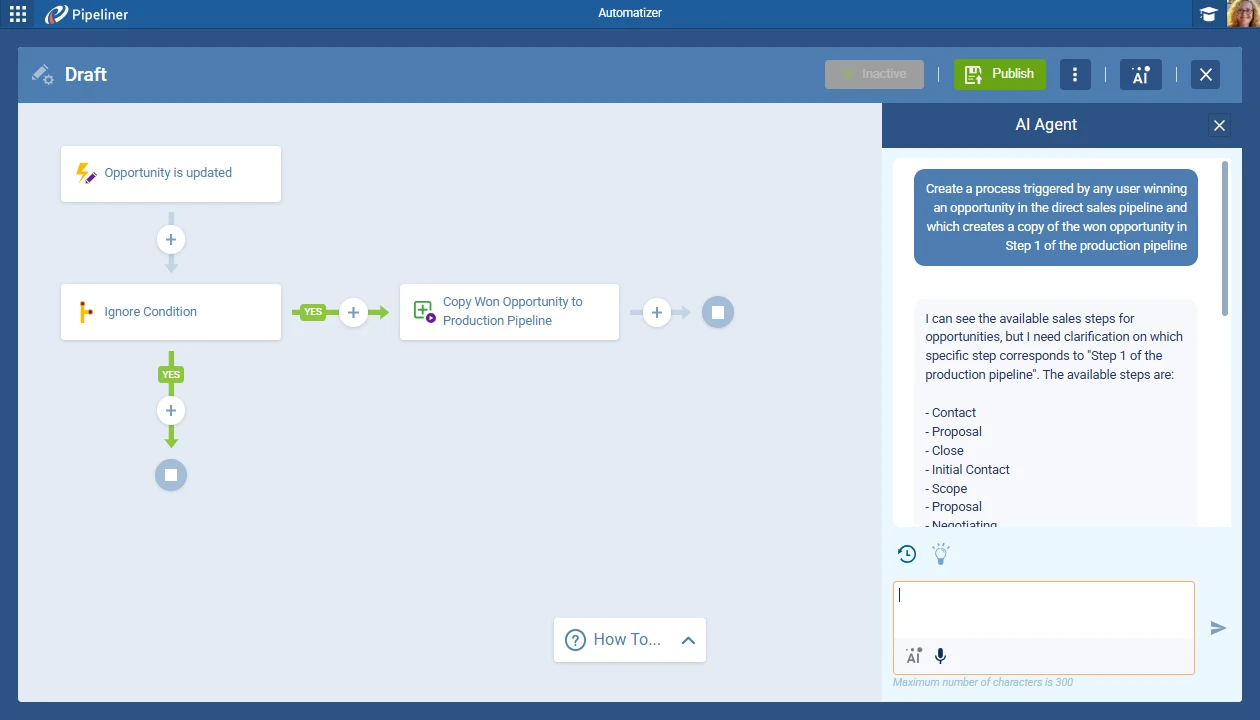
KPIs that prove (or disprove) AI ROI
Measure these from day one or you'll be arguing from anecdotes in the renewal meeting:
- Time-to-prepared-call — minutes from "meeting booked" to "rep has a usable brief." The clearest before/after for agentic call prep.
- Forecast variance — AI forecast vs. actuals, tracked by period, against your pre-AI baseline.
- Agent approval rate — what share of agent proposals reps approve unmodified. Rising approval rate = the AI is learning; flat low approval = it isn't, and you should know that by day 60, not at renewal.
- CRM adoption rate — logins, records updated within 24 hours of activity. AI that works inside the deal should pull reps into the CRM.
- Admin hours per week — agentic report creation and automation building should reduce, not add, system upkeep.
The risks: hallucinations, autonomous errors, and data leakage
Be honest about the failure modes — your security and legal teams will ask.
Hallucination. Generative models can state false things confidently. In a CRM context that means an invented detail in a call brief or a misattributed quote in an account summary. Mitigation: AI that shows its sources — Voyager's call briefs cite the records they pull from, so a rep verifies before walking in.
Autonomous errors. An agent acting without review can propagate one mistake across hundreds of records. This risk is rising fast enough that Gartner predicts "death by AI" legal claims will exceed 2,000 by the end of 2026, driven by insufficient AI risk guardrails — and regulators are responding with scrutiny across industries. Mitigation: approval-based autonomy as the default, not an optional setting.
Data leakage. Every AI feature is a question about where your customer data goes. Ask vendors directly: does our data train your models, and does it leave our environment? Coevera's AI processing runs inside its secure AWS environment, Voyager has no background access to your records and sends only the minimum context a request needs to the AI model it calls, and your data is never used to train AI. Coevera is ISO 27001:2022 certified and GDPR compliant — details at security.
None of these risks argues against AI in CRM. They argue for choosing AI whose architecture assumes the human is in charge.