Sales forecasting has always been a blend of art and intuition. Reps estimate the close probability. Managers apply experience-based gut checks. Finance adjusts downward based on prior sandbagging patterns. The result is often a forecast that disappoints by 10 to 30 percent.
AI-powered forecasting uses historical data, pipeline health signals, and probabilistic modeling to improve accuracy. Instead of relying on reps’ confidence or managers’ hunches, AI forecasting detects patterns across thousands of deals and identifies which are likely to close.
This guide explains how AI sales forecasting actually works, the levers that control accuracy, and how to pilot and evaluate AI forecasting capabilities in your CRM.
How AI Sales Forecasting Actually Works
Data Inputs to Forecasting Models
AI forecasting models need raw material: historical deal data. Specifically, they ingest deal stage, win probability, deal size, days in stage, activity patterns (calls, emails, meetings), buyer engagement signals (email opens, meeting attendance), and rep tenure. Some models also use external intent signals, such as website visits from company IP addresses or published job openings at target accounts.
Model Types and Output Formats
Most CRM-embedded AI forecasting uses one of two approaches. The first is logistic regression or gradient boosting on historical win rates by stage and deal age. This approach asks: given that this deal is in Stage B after 30 days, what is the probability that it closes, based on similar deals in the past? The second uses ensemble models that layer in additional signals: rep skill, account health, buyer engagement, and activity velocity. Coevera uses ensemble models powered by Voyager AI that combine deal characteristics with account and rep patterns.
Output formats vary. Some systems output a single probability percentage per deal. Others output deal scoring on a 1-100 scale, along with confidence bounds. The best forecasting systems surface both the score and the reason: which signals pushed probability up or down. That narrative helps sales leaders coach reps and adjust strategy. Learn more about AI Reports in Coevera.
The Four Levers That Control Forecasting Accuracy
Data Quality and Pipeline Health
Garbage in, garbage out. If your CRM contains deals stuck in “Prospecting” for two years, deals with missing close dates, or deals assigned to inactive reps, the AI model trains on noise. The first accuracy lever enforces pipeline discipline: consistent stage definitions, mandatory close-date fields, and regular pipeline reviews to remove dead deals. Read more about Coevera’s AI Data Intelligence Platform.
Rep Discipline and Activity Logging
Models work better when activity is logged. Calls, emails, and meetings that occur but never make it into the CRM create blind spots. If a rep talks to a buyer twice weekly but only logs once a month, the model underestimates engagement. Encouraging reps to log activity (or automating it via Outlook/Gmail integrations) directly improves the forecast signal.
Historical Data Depth and Recency
Models improve with more history. Two years of deal data trains better than six months. Recency also matters: if your sales process has changed in the last year, older data becomes less relevant. Seasonal products require multiple seasons of historical data. High-deal-velocity teams benefit from 18 to 24 months of clean historical deals.
Deal Stage Definitions and Consistency
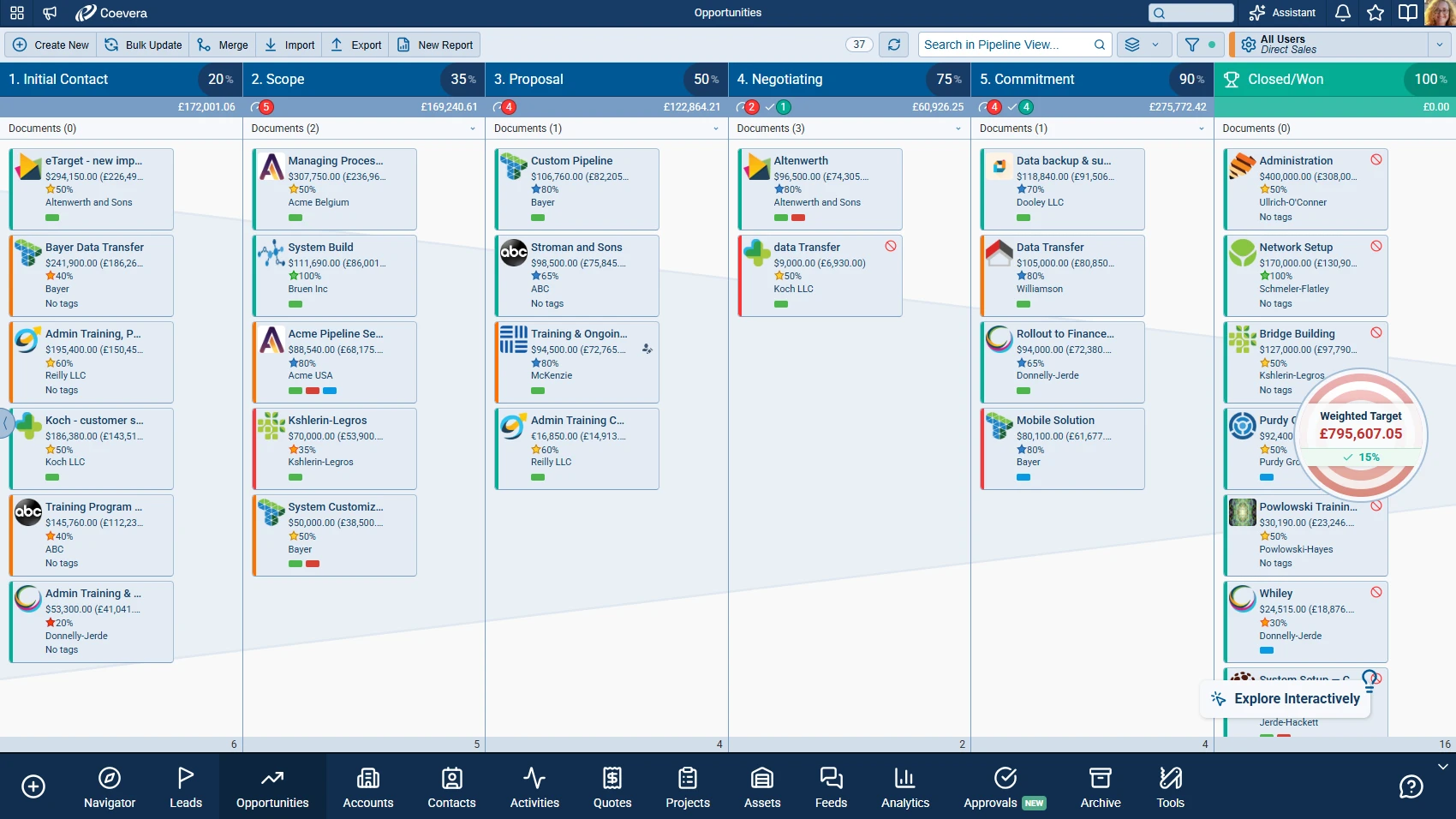
When stage definitions are loose or inconsistent, forecasting breaks. If “Proposal” means “sent quote” for some reps and “negotiating contract” for others, historical win rates by stage become meaningless. AI forecasting requires that stage definitions align with buying-cycle milestones and be applied consistently across the team. See how Coevera’s Visual Pipeline View enforces stage consistency.
By the numbers: manual forecasts typically disappoint by 10 to 30 percent, while AI models trained on clean data and calibrated to your process can beat them by 10 to 20 percentage points — the gap that makes a structured pilot worth running.
Practical Pilot Plan: 30/60/90 Day Framework
Days 1 to 30: Setup and Baseline
Import 12 to 24 months of closed deal history into your CRM. Validate that deal records include stage, close date, deal size, and rep assignment. Clean obvious data quality issues: remove test deals, merge duplicate accounts, and fill in missing close dates. Set up activity logging via email and calendar sync. Take a baseline forecast by running your manual forecast process (manager review, rep input, bottom-up rollup). Activate AI forecasting in your CRM.
Days 31 to 60: Comparison and Refinement
Run AI forecasts weekly alongside your manual forecast and compare the outputs. Where do they diverge? Are there deals the AI flags as low probability that reps believe in? Do those deals close or stall? Adjust stage definitions if the team finds them ambiguous. Add more deals to the historical training set if available. Measure forecast error: how far off was AI from actual closed deals at the end of the period? Use Coevera’s Sales Reports to track and compare results.
Days 61 to 90: Adoption and Governance
If AI forecast accuracy beats manual by 15 percent or more, move to production. Establish ownership: who reviews and adjusts the AI forecast? When can reps or managers override, and when must they defer to the model? Build a monthly rhythm: forecast review with leadership, one deep dive on miss drivers, one win on AI-identified deals. Measure consistency: what is the monthly variance between forecast and result? See Coevera’s improved forecast creation wizard for a guided forecasting experience.
Minimum Data Requirements for AI Forecasting
Before activating AI forecasting, ensure your CRM meets these baseline requirements:
- At least 100 to 200 closed deals in your historical data
- A minimum of 18 months of deal history (24 months is better)
- Consistent stage definitions across the sales team and over time
- Deal amounts recorded for at least 90 percent of closed deals
- Close dates on all closed deals
- Rep assignment for all active and historical deals
- At least 60 percent of open deals have activity logged in the past 30 days
- Email and calendar integrations active to capture buyer engagement
Governance: Who Owns the Number
AI forecasting changes the forecast process. Previously, the VP of Sales owned the forecast, informed by manager input. With AI, the question becomes: what is the AI saying, and when do we override? Learn more about AI forecasting and pipeline management best practices.
Set a clear override protocol. Allow individual reps to flag deals as exceptions if they have late-stage buyer-commitment signals that the CRM does not yet capture (e.g., a verbal commitment not yet documented). Allow managers to override up to 10 percent of deals. Require documentation for all overrides. Audit overrides monthly: if rep overrides are closing less often than AI-scored deals, tighten discipline.
Presenting AI Forecasts to Leadership
Boards and CFOs want certainty. Confidence bounds and probability percentages feel academic. Frame AI forecasts in business language. Instead of “The model gives deal XYZ a 45 percent probability,” say “This deal is at a similar stage of maturity to deals that close 45 percent of the time based on three years of history.” Include comparison to prior forecast versions. Show the miss rate: if your manual forecast missed by plus or minus 15 percent last quarter, and the AI forecast accuracy is plus or minus 8 percent, quantify the improvement. Use Coevera’s Sales Reports and dashboards to present results visually.
CRM AI Forecasting Evaluation Checklist
- Does the platform offer deal-level probability scoring, not just stage-based percentages?
- Can you view the reason behind each score (which factors increased or decreased the probability)?
- Does the model use activity and engagement signals, or only deal and stage data?
- Can you upload external intent signals (firmographic, technographic, intent data)?
- How does the platform handle deals in early stages with sparse activity (does it default to low probability)?
- What is the minimum amount of historical data required to activate forecasting?
- Can forecast outputs be exported to Excel or embedded in dashboards?
- Does the vendor provide published accuracy benchmarks or accuracy tracking over time?
- Can you set override rules (e.g., requiring approval for manual overrides), or is it completely manual?
- Is there a trial period to compare AI forecast accuracy to your current manual forecast?
Conclusion
AI forecasting in CRMs is no longer theoretical. Mature platforms like Coevera now embed forecasting models that, trained on clean historical data and calibrated on your sales process, can exceed manual forecast accuracy by 10 to 20 percentage points. The 90-day pilot framework lets you validate before committing. The governance structure ensures leadership maintains confidence in the number while allowing the model to improve over time. Starting with a focused pilot reduces risk and builds organizational confidence in AI-assisted selling.