In 1945, the economist Friedrich Hayek asked a question that has nothing on its surface to do with software and everything to do with your CRM. How does a system coordinate itself when the knowledge it needs is dispersed, local, and tacit, scattered across many people who each know a small, specific slice of reality? His answer: no central authority can gather all of it, because the knowledge that matters most lives in the particular, in "the man on the spot." That insight is the missing piece in the debate over AI deal scoring versus human judgment.
Every sales leader is running Hayek's problem
The knowledge that decides whether a deal is real is exactly the kind Hayek described: what this buyer is afraid of, what was actually promised, what a competitor whispered last week, what "good enough" means to this committee this quarter. That knowledge sits with the rep, and it resists being reduced to a field. This is why the most valuable pipeline information so often stays trapped in a rep's head, and why forcing it into a single score destroys it in transit.
the ultimate decisions must be left to the people who are familiar with these circumstances, who know directly of the relevant changes and of the resources immediately available to meet them.
— F. A. von Hayek, "The Use of Knowledge in Society," 1945
Why the composite health score keeps failing
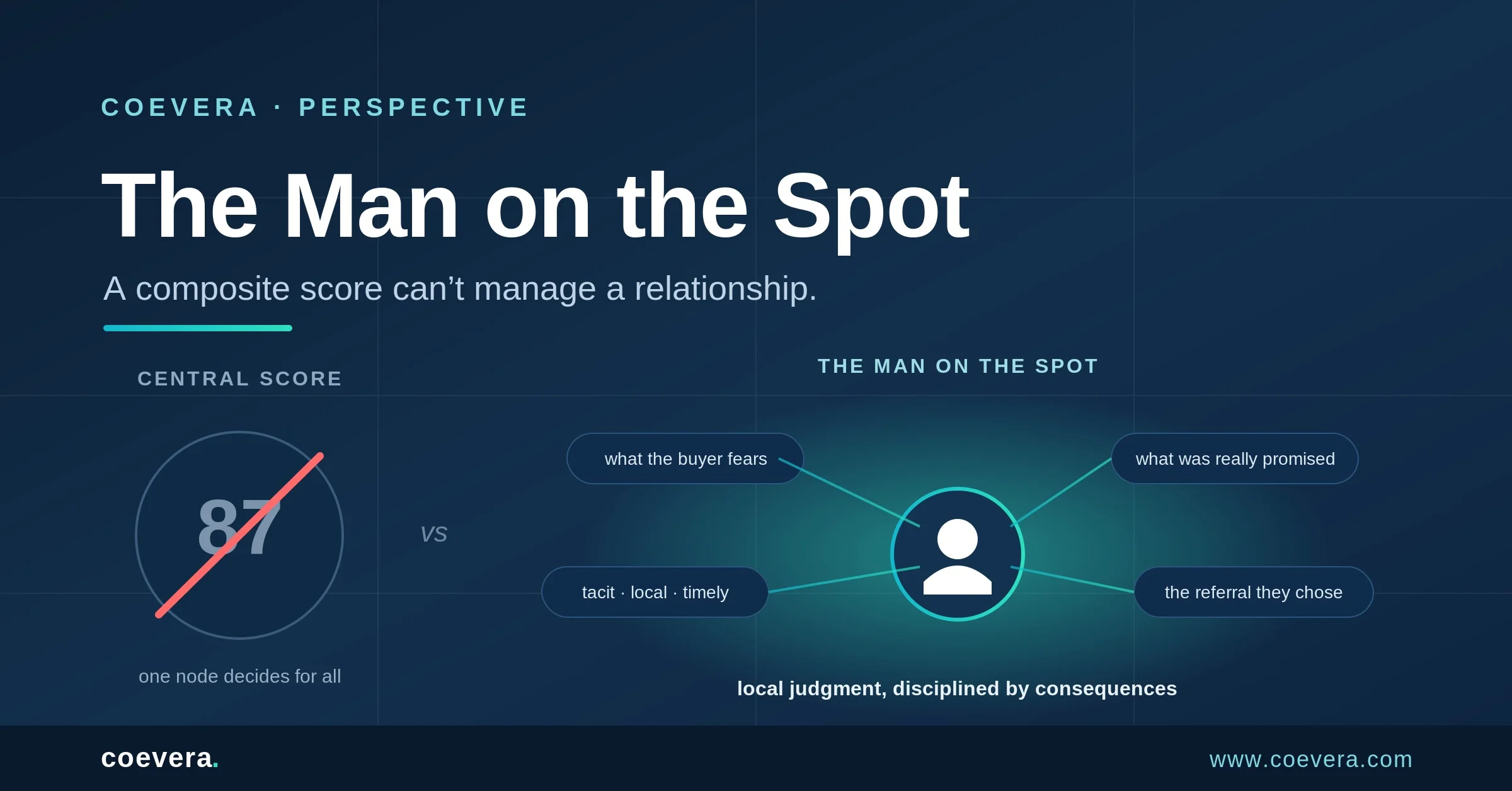
A composite health score, the single number claiming to tell you whether an account is healthy or a deal will close, is central planning applied to relationship knowledge. It takes the dispersed, tacit understanding of the person closest to the customer, strips it of context, aggregates it into one node, and hands back a verdict. It fails for the same reason planned economies failed: the information it needs cannot be centralized without being destroyed.
Every composite score is central planning applied to relationship knowledge. It fails for the same reason the planned economy failed.
There is a Goodhart problem on top of it: when a measure becomes a target, it stops being a good measure. Tie compensation or pipeline reviews to a health score and reps will optimize the score, not the relationship. This is also why predictive lead scoring has limits: a great model fed stale CRM records still misses badly, and a number designed to be maximized will, eventually, be gamed.
Value is subjective, so "fair value" can't be computed
There is a deeper reason, from the same Austrian tradition. Value is subjective. It does not live in the product, the price, or the data; it lives in the customer's mind and reveals itself only through their actions. If value is subjective, then "fair value" is not something a system can calculate, because there is nothing objective sitting there to measure. The machine can count what happened. It cannot feel what it was worth.
Local judgment, but disciplined, not naïve
Here is the honest objection: if we hand the decision back to the man on the spot, aren't we just swapping the myth of the all-knowing planner for the myth of the unbiased local one? The rep isn't neutral. Compensation, account ownership, and plain sentiment all color how they read their own signals. True, and worth saying out loud.
But Hayek never claimed the local actor was neutral. His claim was that no central authority could do better, and that markets discipline local actors without overruling them, through consequences: profit and loss, reputation, competition. Local judgment in a functioning market is accountable judgment. The design question isn't "human or machine?" It is how to build market-like discipline into a sales organization so local judgment stays free and stays answerable.
Read contrasts, not a single number
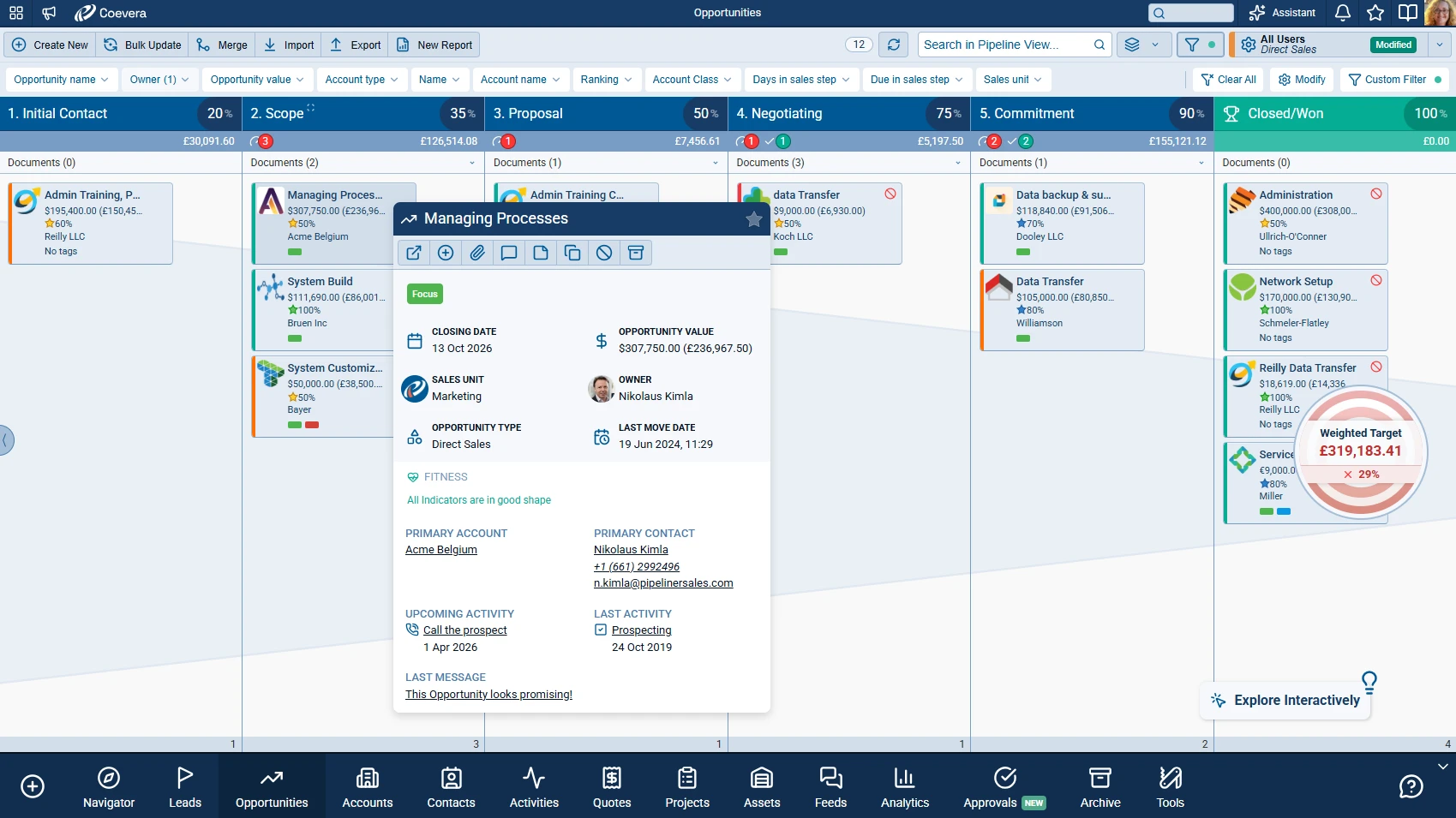
That discipline changes what we ask the software to do. Instead of computing one score to be maximized, the system should surface contrasts for a human to interpret through a visual pipeline that keeps the evidence in view:
- Renewal + declining usage + a shrinking circle of champions + zero referrals = friction retention.
- Renewal + growing engagement + voluntary advocacy = earned loyalty.
Same data, opposite meaning. A single number hides the difference; a contrast pattern, read by the person on the spot, reveals it. This is the practical case for a visual pipeline over a black-box score: the machine lays out the evidence, and the human, who knows what it means in context, makes the call.
Trust is the money customers choose to spend
It also clarifies what actually signals trust: not the money a customer had to spend, but the money they chose to spend. Renewals can be manufactured by switching costs. Referrals cannot: a referral carries reputational risk for the person who makes it, which is precisely why friction can never produce one. If you want to measure trust, make it easy for the customer to leave, and watch what they do anyway.
Hayek called the market order a catallaxy, from a Greek word that also means "to turn an enemy into a friend." A healthy sales organization works the same way: not a central planner scoring its subjects, but a community of accountable judgments, disciplined by transparent consequences. Coevera's job is not to replace the man on the spot. It is to give them the light to see clearly, and the accountability that makes seeing clearly matter.
See the pipeline the man on the spot actually uses
A visual, shared pipeline lays out the evidence instead of hiding it in one score, so the person closest to the customer makes the call.
Start a free trial