By
By 
There is a people in northern Australia, the Guugu Yimithirr, whose language has no words for left and right. To say where a thing is, they must reach for the compass: the cup sits to your north, the child stands to the west. A speaker cannot form the simplest sentence about space without knowing, at every moment, which way is north — and so they always do. Spin one of them around inside an unfamiliar building and they will still point to the cardinal directions without a flicker of hesitation. Their grammar obliges them to attend to something the rest of us are free to ignore. And what the grammar obliges, the mind learns to see.
I begin a series essay with an anthropologist’s footnote for a reason. We are in the habit of treating language as a coat of paint on a world that is already fully there — first the thing, then the word we hang on it. This is almost exactly backwards. Language does not merely label what we perceive; it shapes what we are able to perceive in the first place. And if that is true of cups and directions, it is far more consequential for the work I have spent my life defending: the work of selling.
The word comes before the thing
The evidence is not soft. Russian draws a lexical border between light blue (goluboj) and dark blue (sinij) where English sees a single color in two shades. Russian speakers tell those blues apart measurably faster right at that border — and the advantage disappears the moment you occupy their language centers with a distracting task. The Himba of Namibia group greens and blues under different names than English does, and in controlled experiments they distinguish shades most sharply at their own category borders — borders that sit in different places than ours. Change the words and you change, quite literally, what the eye reports.
It reaches past color into judgment. Tell a patient a procedure has a “ninety percent survival rate” and they consent; tell them it carries a “ten percent mortality rate” and they hesitate — the same fact, two framings, two different worlds of relevance. Kahneman and Tversky built a life’s work on the discovery that how a thing is said governs not only the opinion we form but what we notice as worth weighing at all — work that brought Kahneman the 2002 Nobel Prize, an honor Tversky did not live to share. Wittgenstein put the whole matter in one line: the limits of my language mean the limits of my world.
The modern science is more disciplined than the old strong version of that claim. Language does not imprison thought; translation remains possible, it merely costs effort. But it tilts thought — it makes some distinctions cheap and habitual and others expensive and rare. The category is not a consequence of what we notice. Very often, the category is what lets us notice at all.
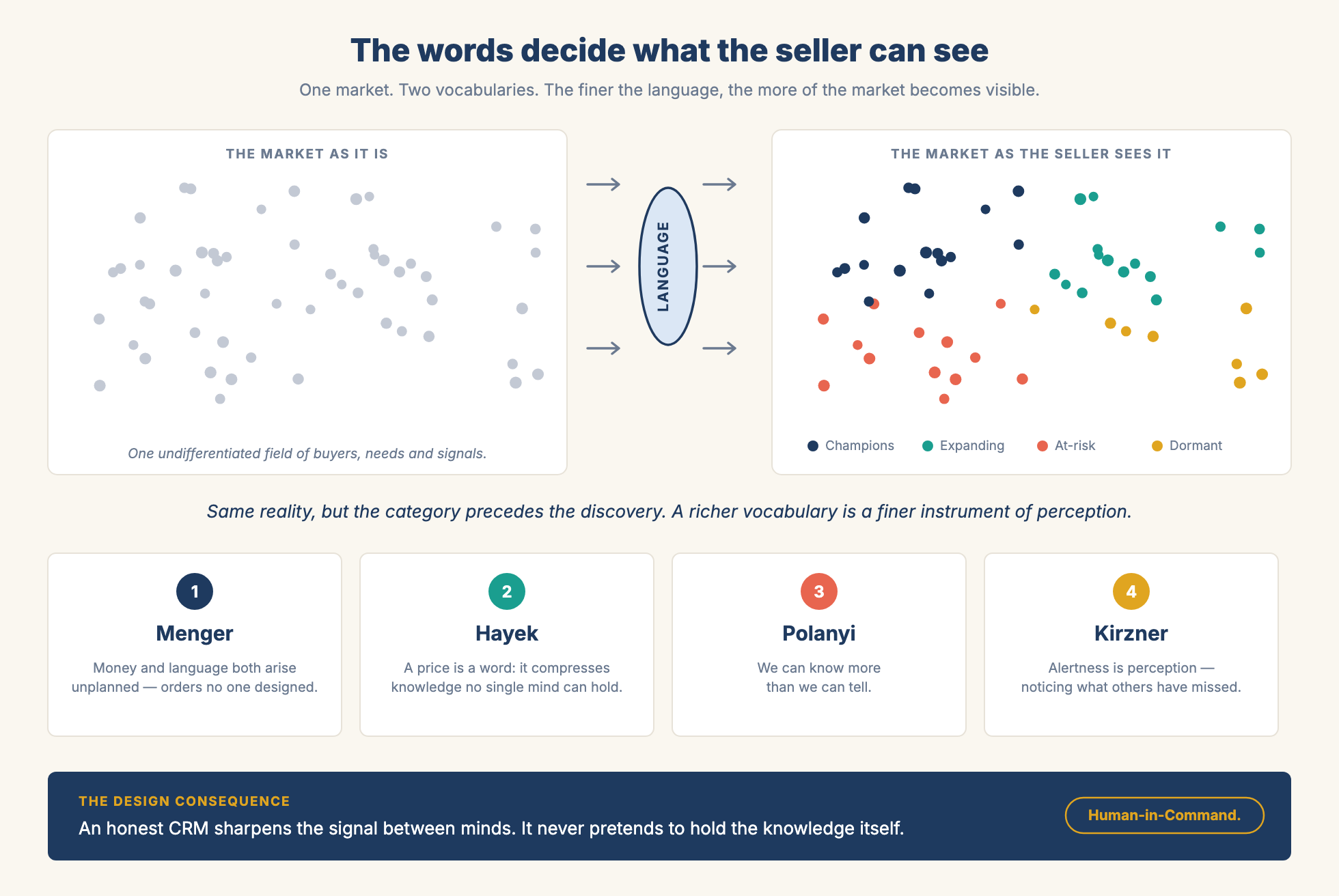
This is our oldest insight, not a new one
Those of us who think in the Austrian tradition should feel a shock of recognition here, because this is Carl Menger’s discovery wearing a different coat. Menger showed that money was never invented by any planner; it emerged, unbidden, out of countless individual acts of exchange, each person reaching for the more saleable good until one good became the medium for all. Money is a grown order, not a made one. And language is the very same kind of thing — no lawgiver, no committee, no central grammarian, only millions of speech acts settling over centuries into a shared structure that carries more knowledge than any single mind ever held. Hayek gave the pair their proper names: the grown order, the kosmos, against the made order, the taxis. Language is the first and greatest of all spontaneous orders. A rich vocabulary is not a personal cleverness. It is inherited capital — the distilled, dispersed experience of everyone who ever needed to make that distinction before you.
Which brings us to the sentence at the center of everything I believe about this work. A price is a word. In his 1945 essay on the use of knowledge in society, Hayek showed that a price does not need to explain why tin has grown scarce; it simply tells everyone who handles tin to use less of it. The price compresses an ocean of dispersed circumstance into a single figure a stranger can act on. That is exactly what a word does — it transmits what is needed without transmitting the whole causal history behind it. Small wonder Hayek reached for the Greek and called the market a catallaxy, from katallattein: not merely “to exchange,” but “to turn an enemy into a friend, to admit into the community.” The exchange of words and the exchange of goods are not cousins. They are the same act.
The market and the mother tongue are the two great things no one designed and no one could do without. Both are systems for sharing knowledge that no single head can hold.
The boundary of what can be said
Now we arrive at the edge. Michael Polanyi named it in eight words that ought to hang over the desk of everyone who builds software for salespeople: we can know more than we can tell. The greater part of what makes a seller effective is tacit — the trained read of a room, the feel that a deal has gone quiet for the wrong reasons, the intuition that this buyer is protecting a decision he has not yet admitted to himself. Israel Kirzner gave the entrepreneurial version of the same faculty a name: alertness, the wakefulness that notices an opportunity invisible to everyone else in the room. And alertness is, at bottom, an act of perception — which means it obeys the law we began with. What a seller can notice is bounded by the distinctions the seller can draw. The category precedes the discovery, in the market exactly as in the color wheel.
The first error: the fantasy of total capture
Here is where most CRM software goes wrong, and it goes wrong on principle, not by accident. The naive ambition is to capture everything: the complete record, the lossless history, every signal pressed into a field. It is the dream of total explicitness. In Hayek’s vocabulary this is precisely the pretense of knowledge — the belief that one can centralize and fully articulate what is, by its nature, dispersed and unsayable. It fails for the same reason central planning fails: not for want of computing power, but in principle. The essential part resists being told. This is why good salespeople quietly despise their CRM. Every mandatory field is a tax on their tacit knowledge, and the tax is routinely higher than the yield.
The new error: false explicitness
Artificial intelligence changes this equation, and one half of the change is a genuine gift. A language model works in ordinary, unstructured speech. It lowers the cost of articulation: the seller talks or writes the way she thinks, and the machine absorbs the lossy translation into structure. Better still, a model can exercise a kind of machine alertness — surfacing patterns across ten thousand relationships that no single mind could ever hold in view. That is real Hayekian compression of dispersed knowledge, and we should welcome it without embarrassment.
But the second half of the change is the subtlest danger our profession has yet faced, and it deserves a name. Call it false explicitness. A model produces fluent, confident summaries that feel like knowledge — and in feeling complete, they quietly iron flat the tacit remainder that never made it into words. The machine can take “we can know more than we can tell” and hand you back “here is everything, told.” The pretense of knowledge returns, only this time it arrives in an eloquent voice, and eloquence is persuasive. A summary that never says here is where what can be said runs out tempts a manager to centralize a judgment that must, on pain of failure, stay dispersed among the people actually in the room.
The old CRM asked the seller to say more than they could, and lost the knowledge in the silence. The careless AI says more than it knows, and loses the knowledge in the fluency. Both mistake the map for the territory.
The discipline of an honest system
So what does a CRM built on Austrian foundations actually do differently? It stops trying to replace tacit knowledge and sets itself the humbler, harder task of improving the signals by which dispersed perception coordinates — the price-as-a-word, rebuilt for the sales relationship. Three disciplines follow directly, and none of them is a feature request.
Respect the cost of telling. Every mandatory field is a demand to make explicit something that may be tacit, or whose articulation costs more than it returns. Fewer, more meaningful signals beat total capture every time. Over-instrumentation does not preserve knowledge; it destroys the very thing it reaches for.
Keep the why, not only the what. The tacit dimension lives in context and reason — exactly what rigid fields amputate. The place where the unformalizable can at least be gestured at is plain language, and the modern gift is that AI finally makes plain language cheap to capture and search. Use it there.
Build the system to keep the human awake. The job of the software is not to decide. It is to preserve the conditions under which a human being notices what matters — to sharpen alertness, not to substitute for it. The AI improves the signal; the discovery, the genuinely entrepreneurial act, stays with the perceiving person.
This is why Human-in-Command was never a marketing slogan for us. It is the exact epistemological consequence of Polanyi and Hayek taken seriously. A model that is honest about the edge of the sayable — that knows where its own knowledge ends — is an instrument that amplifies human judgment. A model that pretends there is no edge is the fatal conceit with a better vocabulary. The difference between a system that manages the seller and one that empowers the seller is, in the end, a difference in what each believes can be said.
Coda: a doing, not a thing
Wilhelm von Humboldt held that language is not ergon — a finished work — but energeia, an activity, a perpetual making. He anticipated, by a century, the Austrian view of the market as process rather than state: not a thing that is, but a thing that is endlessly being done. Selling is the same. It is not a record to be stored; it is an act of perception and exchange, renewed in every conversation. Perception is shaped by language because both are living movements, not objects at rest. The best thing our tools can do is widen the words a seller has to think with — and then have the wisdom to fall silent exactly where the knowing outruns the telling.