Here is a question I like to ask people who think selling is a lower form of work than building the product. What do these two have in common: a shop assistant who tells you where the batteries are and what they cost — and an enterprise seller closing a seven-figure, deeply technical deal with a global industrial buyer?
On the surface, nothing. One earns minimum wage. The other earns more than most executives. But strip away the price tags and the job is identical. Both transfer knowledge. One moves a small piece of it — aisle four, €3.99. The other moves a large and difficult piece — here is how this changes the way your business runs. The size differs. The function does not.
This is the thing most companies never quite see about their own sales force: the function of sales is to impart knowledge. Salespeople are knowledge workers. They don't push products at customers; they hand customers the means to reach a goal the customer cares about. As Peter Drucker put it, a good seller focuses on the benefit to the customer, not the product from the maker's point of view. The value lives in the use — in the satisfaction it brings and the results it delivers. Once you accept that, the modern anxiety — won't AI just replace them? — starts to fall apart. Let me show you why, standing on the shoulders of the Austrian School.
Menger's four conditions — turned into a deal checklist
Carl Menger, in 1871, gave us the foundation. For a thing to be valuable to a person, four conditions must all be met:
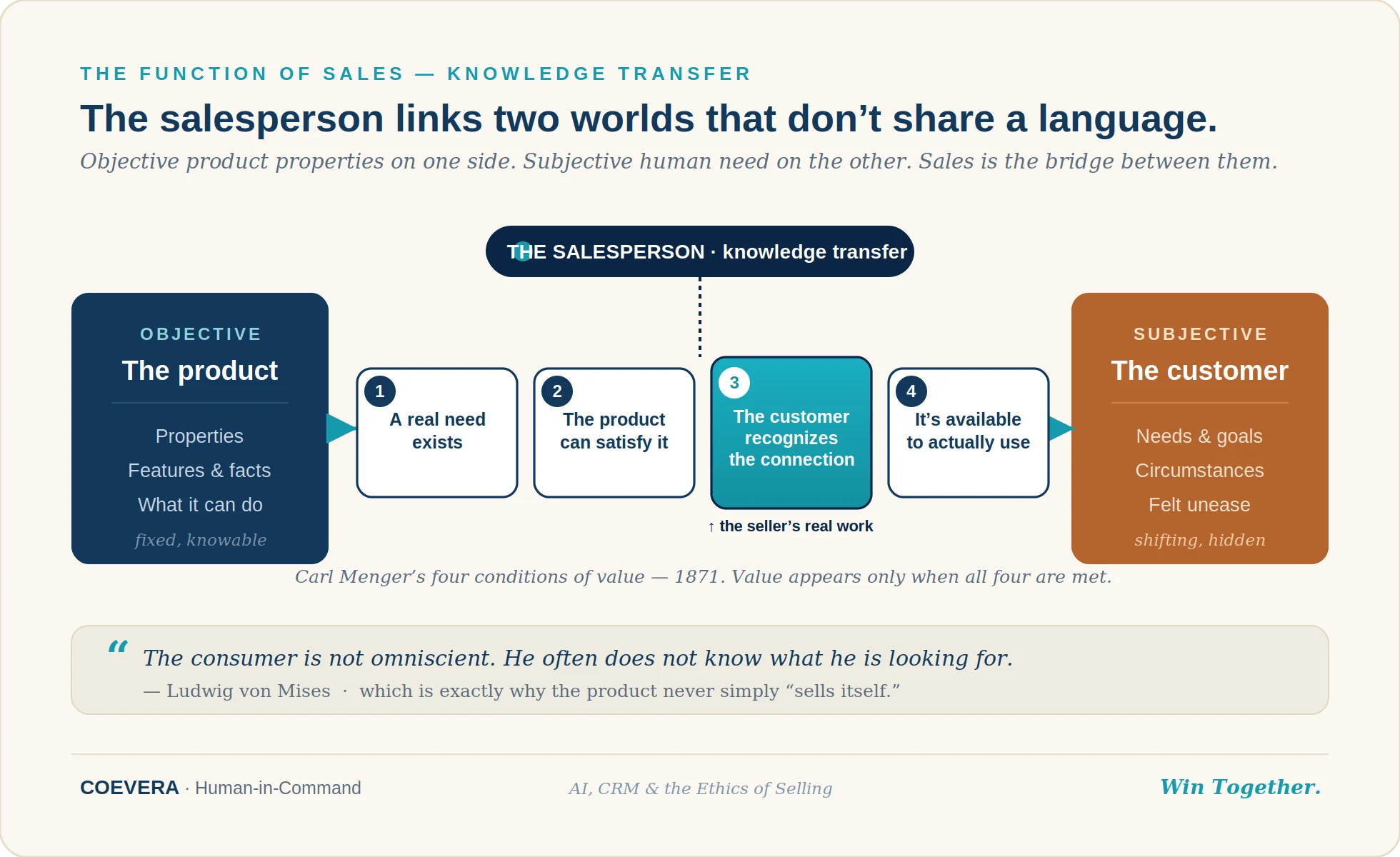
Conditions 1 and 4 are mostly facts of the world. Condition 2 is a fact about the product — engineering decided it, not sales. But condition 3 — recognition of the causal connection — is the salesperson's home turf. A product can perfectly satisfy a need that the buyer is standing right next to and cannot see. No recognition, no value. The properties just sit there, objectively real and subjectively invisible.
I keep Menger's four conditions on a wall, mentally, in every deal review. When a deal stalls, nine times out of ten it's stuck on condition 3. The customer doesn't doubt the product works. They haven't yet recognized that it works for them.
Mises: the customer doesn't know what he's looking for
The consumer is not omniscient. He does not know where he can obtain at the cheapest price what he is looking for. Very often he does not even know what kind of commodity or service is suitable to remove most efficaciously the particular uneasiness he wants to remove.
— Ludwig von Mises, Human Action, ch. XV §13
The customer is limited by their own subjective perception. They know the past market — what was available, what they bought last time — but rarely the future, and rarely the full set of possibilities open to them right now. They come to you asking for a faster horse. This is not a knock on customers; it is the human condition. And it is precisely this gap — between what the customer thinks they want and what would actually relieve their unease — that gives sales its reason to exist.
To do this, the seller needs two kinds of knowledge at once: deep knowledge of the product's properties, and deep knowledge of this particular customer's needs and circumstances. That dual fluency is rare — and it's why great sellers are paid like the knowledge workers they are.
The bridge: where value is actually finished
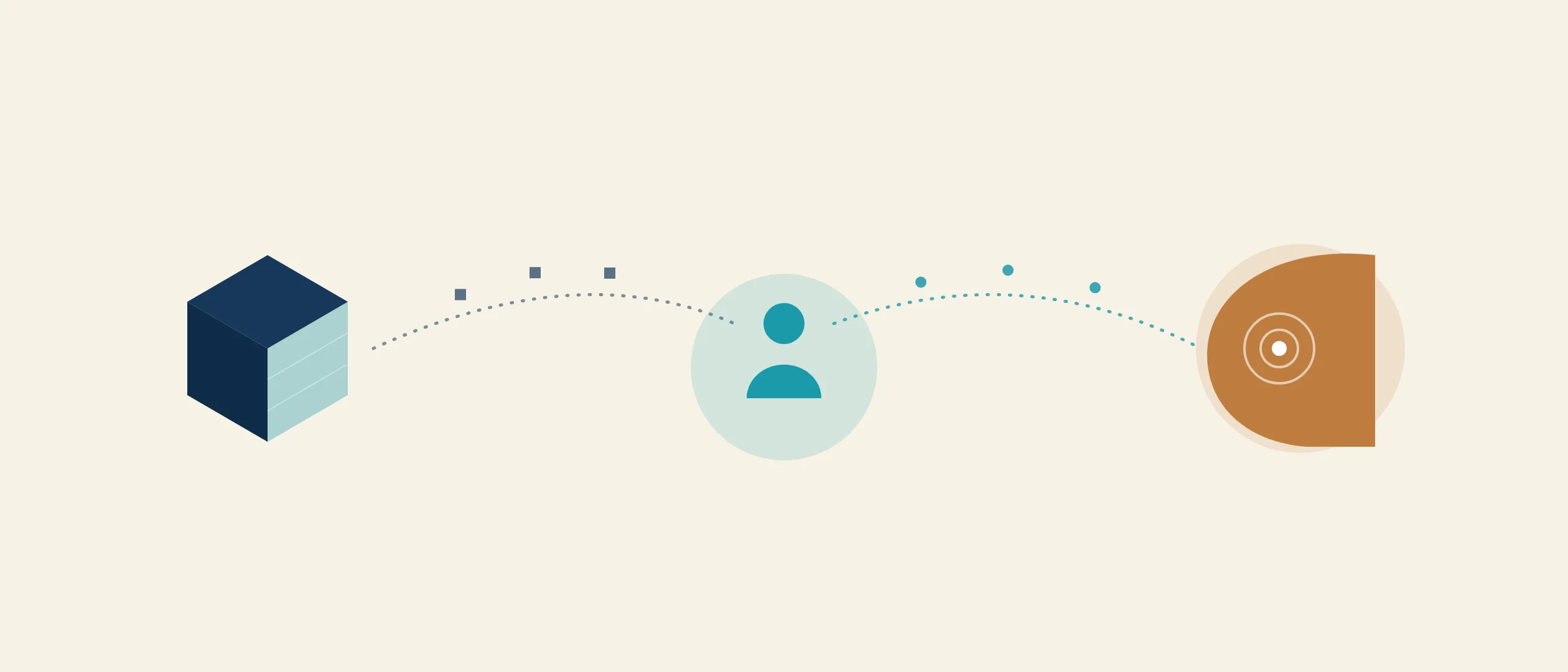
Now we can name the function precisely. Sales links the objective properties of a product with the subjective needs of a customer. That link is the last step in value creation. Engineering builds the properties. Marketing raises awareness. But the value is not finished — not yet value to this person — until someone connects the two. That someone is the seller. Two honest caveats, because this is the ethics series and I won't oversell the seller:
- The seller only adds value; they cannot manufacture it. Even the best seller cannot inflate a weak product into a great one. Knowledge transfer is real value creation — but it is the last step, not the only one.
- This is why "Human-in-Command" is not a slogan for us. The objective side — the product's properties, the customer's signals — is increasingly something AI can surface beautifully. But the linking of the two, the act of recognition in condition 3, is human judgment. AI can hand the seller a sharper map. It cannot walk the bridge for them.
Drucker was half right — and the half he missed matters more every year
Drucker argued that the aim of marketing is to make selling superfluous — to understand the customer so well the product sells itself. It's a brilliant line, and half true. But he stepped right over Mises. He assumed away the customer's ignorance, and so he got the direction of the trend backwards.
Here is the rule that has held my entire career and is holding harder than ever: the more specialized, differentiated, and powerful a product becomes, the more it needs a human to explain, translate, and mediate it. Simple commodities can drift toward selling themselves. Complex, fast-moving, AI-shaped products do the opposite — they widen the recognition gap faster than any customer can close it alone.
The age of AI is not the end of the salesperson. It is the age in which condition 3 gets harder, the gap gets wider, and the knowledge worker who can stand on the bridge becomes more valuable, not less. The product will not sell itself. It never did. Nothing sells itself — someone has to make the customer see.