By
By 
Whenever a crisis arrives — a market crash, a collapsed quarter, a scandal — we reach almost by reflex for a single explanation: greed. It is a striking habit, and not only among people with no training in economics; economists reach for it too. Yet no social science has ever seriously proposed a homo avarus, a greedy man, as its working model of the human being. We would never explain rising divorce rates by lust, or unemployment by a taste for idleness. Only with greed do we permit ourselves the shortcut — invoked like a spirit, and duly condemned.
I start here because this habit of explanation says less about greed than about the pictures of man we carry without ever inspecting them — and thinking it through, I could not stop thinking about my own trade. Because nowhere is the greedy automaton reached for more casually than in the picture the world carries of the salesperson. And nowhere does that picture do more quiet damage than when it is built, unexamined, into the software we hand our sellers every morning.
Every model of the market hides a model of the human
There is a forgotten student of Carl Menger, Julius von Gans-Ludassy, who saw the problem early. In a methodological work of 1893 running past a thousand pages, Die wirtschaftliche Energie, he mounted an early attack on the mechanical image of homo oeconomicus and concluded that economics is "the science of action as such" — five decades before Mises built praxeology on the same ground, without ever expressly crediting him. And the lesson underneath his attack is one the rest of us keep having to relearn. An image of the human being has a steering effect on any science that adopts it: it decides which questions get asked, which goals count as worthy, which methods feel legitimate — and it does this whether the image is true or merely convenient. Give a picture of man normative force through law, teaching, or a product, and it stops being a description. It becomes a mold that reshapes the very thing it claimed only to portray.
Software is no exception. It is, in fact, the purest case. Every CRM ever shipped encodes a conception of what a buyer is and what a seller is — a hidden premise, rarely said out loud. The only question is which conception, and whether its builders ever had the honesty to say it out loud. So let me say it out loud.
Homo economicus: the automaton in the funnel
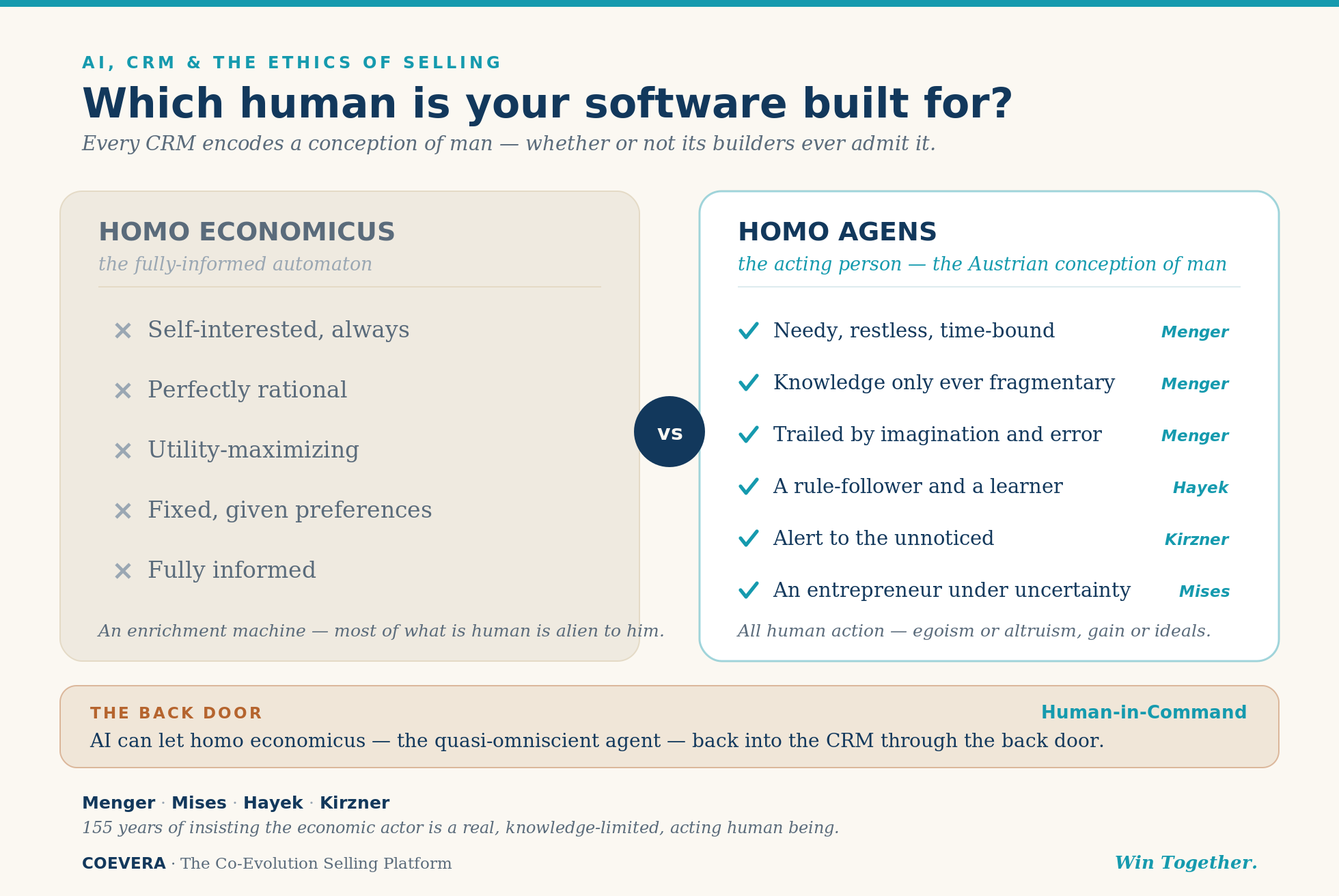
The reigning model, the one that has roamed lecture halls for over a century, is homo economicus. His properties are quickly listed: he is self-interested, perfectly rational, utility-maximizing, fixed in his preferences, and — the tell that gives away the whole fiction — fully informed. An enrichment machine, in short, to whom most of what is human is alien.
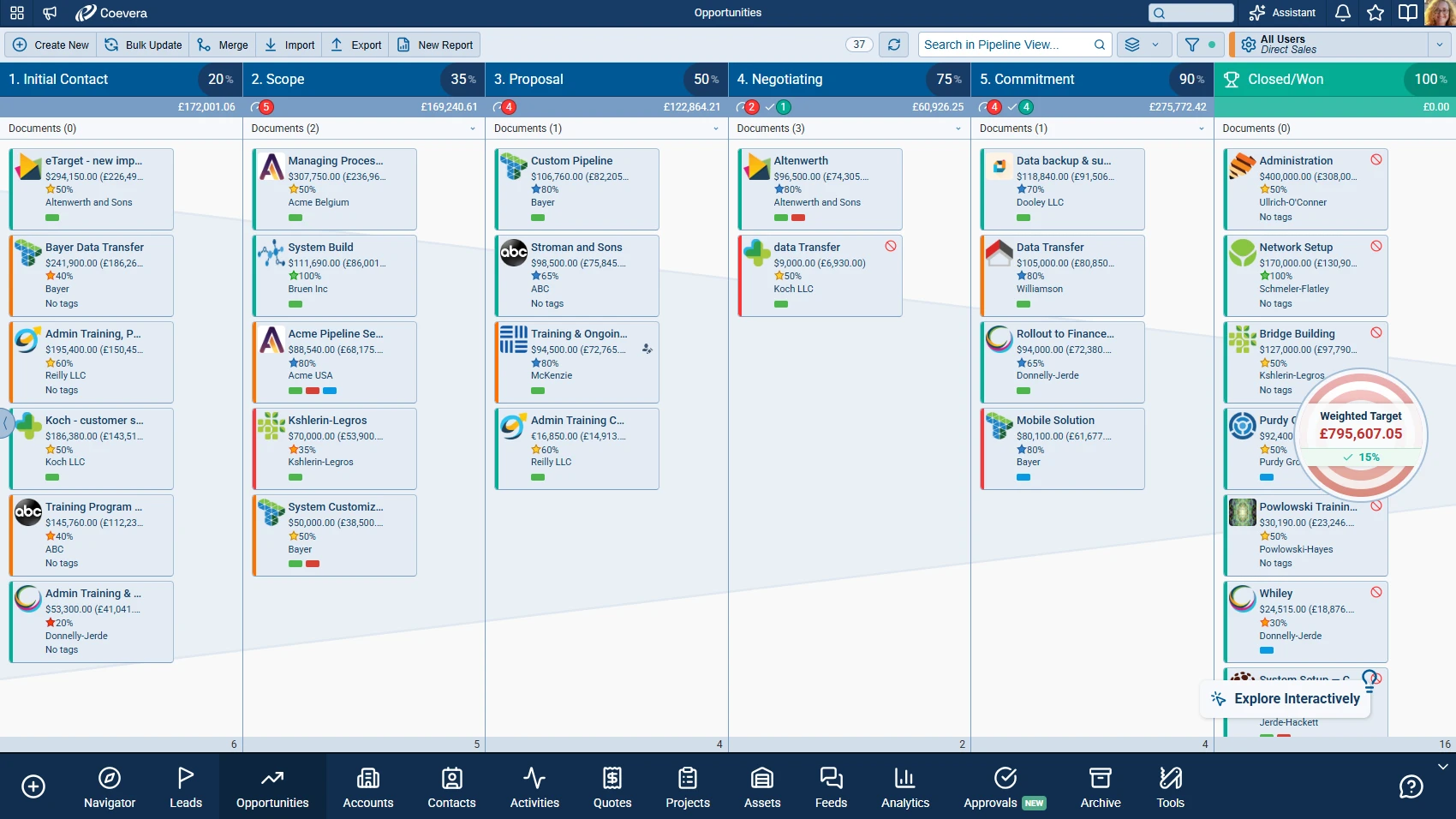
Look at the standard CRM and you will find this creature installed twice over. He is the buyer: a rational unit who will advance through the pipeline if only the correct trigger fires at the correct stage — as though wanting were mechanical and information complete. And he is the seller: an enrichment automaton to be tracked, scored, and optimized, whose worth reduces to activity counts and whose humanity is, precisely, alien to the system measuring him. Ludwig von Mises called it a fundamental mistake to treat this phantom as the subject of economics: economics, he insisted, deals not with homo economicus but with homo agens — man as he really is, often weak, stupid, inconsiderate, and badly instructed. We have spent decades pouring that mistake into code.
Menger's real human being
The Austrians began from somewhere else entirely. Menger's founding work of 1871 opens not with wealth or price but with human needs — the word need and its variants appear more than five hundred times in that first edition — because for him the human being is, first, a needy creature: restless, aware that his time is limited, surrounded by more scarcity than abundance, forced to rank his wants and revise them as conditions shift. What lifts him even halfway above his circumstances is not perfect information but the opposite — a thirst to learn, to acquire knowledge he does not yet have. And even then his knowledge stays fragmentary. Menger insisted that perfect knowledge never exists, that all economizing happens under time, uncertainty, and the possibility of error — he even kept a category, "imaginary goods," for the things we value only by mistake. Imagination and error accompany economic activity at every step.
Read that description again and notice how astonishingly modern it is — and how exactly it fits the people on both ends of a real sale. The buyer who does not fully know what he wants. The seller working with partial knowledge, under time pressure, adjusting on the fly. This is not a defective version of homo economicus to be engineered out. It is the human condition that selling exists to serve.
Mises, Hayek, Kirzner: knowledge, rules, and alertness
Mises replaced the automaton with something far larger. His science of human action — praxeology — is built not on the businessman but on everyone: it takes in the egoist and the altruist, the person chasing profit and the person chasing an ideal, the thrifty and the reckless alike. Action, for Mises, is simply the structure of a human being choosing under uncertainty — and because every choice reaches toward an unknown future, it always carries a speculative moment. Which yields a conclusion that has been the quiet foundation of my own work: every acting person is, in the praxeological sense, an entrepreneur. The salesperson most of all. That is the whole case for the Salespreneur in a single line of Mises.
Hayek supplied the epistemology. Against the assumption of an omniscient actor — the same omniscience he had already demolished in the calculation debate — he showed in The Sensory Order that human reason and even human perception are inherently limited. Man, for Hayek, is not a calculating machine but a rule-following, learning, social creature, leaning on inherited traditions and institutions to reduce a complexity no single mind could master. And Israel Kirzner named the faculty that makes such a creature effective in a market: alertness — the wakefulness that notices what others have missed. Regular readers of this series will hear the echo. Alertness is an act of perception; perception is bounded by the categories we can draw. The conception of man and the edge of the sayable are the same argument seen from two sides.
The ghost comes back through the back door
Here is the warning that made me want to write this piece. When equilibrium models swept economics in the 1930s, Hayek complained that "that skeleton in our cupboard, the 'economic man,' whom we have exorcised with prayer and fasting, has returned through the back door in the form of a quasi-omniscient individual." The exorcised ghost, back in the house — and note the form he returns in: quasi-omniscient. I can think of no better description of what artificial intelligence now threatens to do to CRM.
Because the seductive promise of AI is total information. The system that has read everything, knows every account, forgets nothing, and will therefore tell you what to do. And that is homo economicus resurrected in silicon — the fully-informed agent, the very trait that always gave the fiction away, now rebuilt as a feature and sold as progress. Build your CRM around that promise and you re-import the oldest epistemological mistake in economics, only faster and with a more confident voice. It is the central-planning conceit from the first essay in this series, and the false explicitness of the last one, wearing the mask of a helpful assistant.
The automaton was never real. Our only genuine achievement would be to rebuild him in a machine and finally believe him.
Human-in-Command is an anthropology
This is why, for us, Human-in-Command was never a control setting or a compliance checkbox. It is a conception of man. It insists that the human in the loop is Menger's real person and Mises's entrepreneur — knowledge-limited, alert, moral, acting under uncertainty — and not an automaton to be optimized until nothing human is left to optimize. It is also why we refuse homo avarus as the portrait of the salesperson. The Salespreneur is the deliberate refutation of the greedy automaton: a person who creates value and, in Menger's and Mises's sense, produces a little peace in every voluntary exchange.
There is a quiet vindication in how this argument has aged. A century and a half after Menger, the Nobel Prize goes to behavioral economics for demonstrating what the Austrians said at the start — that the real human being is not fully informed, not purely self-interested, not a machine. The mainstream keeps renovating homo economicus rather than retire him. We do not have that luxury, because we are not writing papers; we are shipping software that will shape how millions of sellers and buyers are seen and treated. The conception of man is no longer an academic question. It is an engineering decision — and we have made ours.
In dialogue with the founders and historians of the Austrian School — Menger, Mises, Hayek, Kirzner, and the school history by Eugen Maria Schulak and Herbert Unterköfler (Mises Institute, 2011). The reading of that tradition for CRM, AI, and the practice of selling is my own.