
A deal that stalls in your pipeline rarely announces it. It just goes quiet, slips its close date, and then shows up in a forecast that misses. Sales opportunity management software exists to stop that. It shows where every deal really stands, what to do next, and which ones deserve your team's time this week. The best tool for the job depends on how your team sells, not on which vendor has the biggest logo.
The best sales opportunity management software in 2026 depends on deal complexity and sales motion. The short version: Coevera for B2B teams that want visual opportunity tracking with AI, Salesforce for large enterprises, Pipedrive for simple visual pipelines, Membrain for complex multi-stakeholder B2B sales, and HubSpot when opportunity management must align with marketing. The full ranking, with who each one fits, is below.
What is sales opportunity management software?
Sales opportunity management software helps a team track and advance individual deals, called opportunities, through defined stages from qualified to closed. It adds structure to a pipeline: stage progression, next steps, deal value and win probability, forecasting, and reporting. Most CRMs include it. Dedicated tools go deeper on sales process and forecasting. The goal is the same in every case, which is to move more of the right deals to closed won and to see problems early enough to act.
How to choose opportunity management software
Start with your deals, not the feature list. How complex is a typical deal, and how long is the cycle? A 14-day transactional sale and a 9-month deal with five stakeholders need different tools. How much does forecasting accuracy matter to your board? And, above all, will reps update the system without being chased? A tool your team ignores produces a pipeline you cannot trust. Answer those, then read the list below against your answers.
Best opportunity management software at a glance
Prices are directional, billed annually, and were checked in July 2026. Confirm on each vendor's live pricing page before you sign.
| Tool | Best for | Starts at (user/mo) | Free plan | Standout |
|---|---|---|---|---|
| Coevera | Best for B2B sales organizations with a defined sales process | ~$85 (min. 15 users) | No (14-day trial) | Award-winning visual opportunity views |
| Salesforce | Large enterprises | ~$25 | Yes (Free Suite, 2 users) | Deep tracking, Einstein and Agentforce |
| HubSpot | Opportunity plus marketing | ~$20 | Yes | Deal tracking aligned with marketing |
| Pipedrive | Simple visual pipelines | ~$14 | No | Fast, clean deal progression |
| Membrain | Complex B2B sales process | ~$69 (Active Pipeline) | No | Enforces your sales methodology |
| Zoho CRM | Value as you scale | ~$14; Zia AI on higher paid tiers | Yes (3 users) | Deep features, Zia AI |
| Freshsales | Ease of use | ~$9; Freddy AI from ~$39 | Yes (3 users) | Freddy AI deal insights |
| Close | High-velocity inside sales | ~$35 | No | Calling and deals in one screen |
| Salesflare | Automated B2B tracking | ~$29 | No | Auto-updated pipeline |
| Monday CRM | Customizable workflows | ~$12 | No | Flexible deal stages and boards |
How we evaluated
We scored each tool on five things that decide results, not just signup: how clearly it shows deal stage and health, forecasting quality, how well it supports a real sales process, total cost of ownership, and whether reps actually adopt it. The order reflects fit for mid-market B2B teams, which is the largest group of buyers, but each entry says exactly who it suits.
One disclosure, so you can weigh the ranking properly: Coevera publishes this guide and ranks its own product first. Every price and capability below is taken from the vendor's own public pricing page, and Coevera's watch-outs — no free plan, a 15-user minimum, and a paid agentic AI add-on — are listed in the same place as everyone else's. Check the figures yourself before you buy anything, including ours.
1. Coevera: best overall for B2B
Coevera tops the list for opportunity management, and it has the outside review to back it. The software-selection platform SelectHub rates it (as Pipeliner CRM, relaunched as Coevera in April 2026) best in class for opportunity management, along with sales performance management and team collaboration. Reps track deals across multiple pipeline views, including compact, bubble chart, and map views, with multiple pipelines for different sales motions. Voyager AI adds deal scoring to prioritize the opportunities most likely to convert and surfaces upsell signals, and its agentic tier works with approval-based autonomy, so it shows its reasoning and asks before it acts. Competitors have AI too, so the difference is transparency, not just capability.
Where it fits: B2B sales organizations of 15 to 2,500 sellers that want serious opportunity tracking without enterprise overhead. Watch-outs: no permanently free plan, the agentic AI tier is a paid add-on, and every plan starts at 15 users, so the floor is about $1,275 per month — smaller teams are handled case by case. Pricing starts around $85 per user per month billed annually, with a 14-day free trial. See the pricing page for tiers.
2. Salesforce: best for large enterprises
Salesforce set the template for the opportunity object, and its Sales Cloud offers deep tracking, forecasting, territory management, and automation, with Einstein and Agentforce for AI. Its depth is the point when complexity is high.
Where it fits: large teams with admins and complex deal structures. Watch-outs: cost and admin overhead rise fast. The Starter Suite is around $25 per user per month, but most growing teams land on Enterprise near $175 per user per month. Mid-market teams often over-buy it. See our Coevera vs Salesforce comparison.
3. HubSpot: best for opportunity plus marketing
HubSpot pairs deal tracking, customizable pipelines, and forecasting with its marketing tools, so opportunity data and campaigns share one system. Its Breeze AI spans an assistant and autonomous agents, and a free CRM tier makes it easy to start.
Where it fits: teams that want opportunity management aligned with marketing. Watch-outs: cost climbs once you need paid features, with the Professional tier around $100 per seat per month. Paid plans start around $20 per seat per month.
4. Pipedrive: best for simple visual pipelines
Pipedrive is built around a visual deal pipeline, which makes moving opportunities from stage to stage fast and obvious. It is easy to learn and inexpensive to start.
Where it fits: small teams that want simple, visual deal progression. Watch-outs: no free plan, and its AI is assistive. Pricing starts around $14 per user per month, with mid tiers near $39 to $59. For teams outgrowing it, see our best Pipedrive alternatives guide.
5. Membrain: best for a complex B2B sales process
Membrain is built for teams whose deals are long and multi-threaded. It ties opportunity management to your defined sales process, prompting the right next step at each stage and enforcing the methodology you have chosen. That structure suits complex B2B selling with several stakeholders.
Where it fits: B2B teams running 90-day-plus cycles with multiple decision-makers and a formal process. Watch-outs: it is more process-heavy than a simple pipeline. Pricing is modular, and the module you want for opportunity management is Active Pipeline at about $69 per user per month, not the $49 Prospecting module. Published rates run from around $49 (Prospecting) through $69 (Active Pipeline) to about $89 (Account Growth), so confirm which products you need.
6. Zoho CRM: best for value as you scale
Zoho CRM offers deep deal management for the money, with Zia AI for scoring and an assistant, and a free plan for up to three users. It is strongest inside the wider Zoho ecosystem.
Where it fits: budget-conscious teams and current Zoho users. Watch-outs: the breadth can feel busy and may need configuration time, and the AI is not in the entry plan. Paid plans start around $14 per user per month billed annually, but Zia's scoring, prediction, and Ask Zia assistant are not included at that entry price, and the tier each one requires varies.
7. Freshsales: best for ease of use
Freshsales keeps deal management simple, with Freddy AI for deal insights and next-step suggestions, built-in phone and email, and a free tier for up to three users.
Where it fits: small teams that want AI deal insights in an easy CRM. Watch-outs: the AI you are buying it for is not in the entry plan. Paid plans start around $9 per user per month billed annually, but Freddy AI's deal insights and contact scoring sit on the Pro tier at around $39.
8. Close: best for high-velocity inside sales
Close puts calling, SMS, and email on the same screen as the deal, so high-volume teams can work opportunities without switching tools. Its Chloe AI can call and qualify leads and update the CRM.
Where it fits: SDR-heavy and inside-sales teams that move deals fast by phone. Watch-outs: no free plan. Team plans (Essentials) start around $35 per seat per month billed annually, with a one-person Solo plan around $9 (about $49 and $19 billed monthly).
9. Salesflare: best for automated B2B tracking
Salesflare auto-updates the pipeline from emails, meetings, and activity, so small B2B teams see where deals stand without manual logging. It nudges reps on opportunities that need attention.
Where it fits: small, automation-minded B2B teams that want a hands-off pipeline. Watch-outs: no free plan, and pricing starts around $29 per user per month. Its AI is assistive rather than agentic.
10. Monday CRM: best for customizable workflows
Monday CRM sits on the monday.com work platform, so you can shape deal stages, fields, and automations to match an unusual process. It suits teams that already run operations in monday.
Where it fits: teams that want highly customizable deal workflows alongside project work. Watch-outs: the free tier is Work Management, not the CRM, and paid CRM plans start around $12 per user per month with a three-seat minimum.
Track every opportunity with less guesswork
Try Coevera free for 14 days. No credit card required.
Start free trial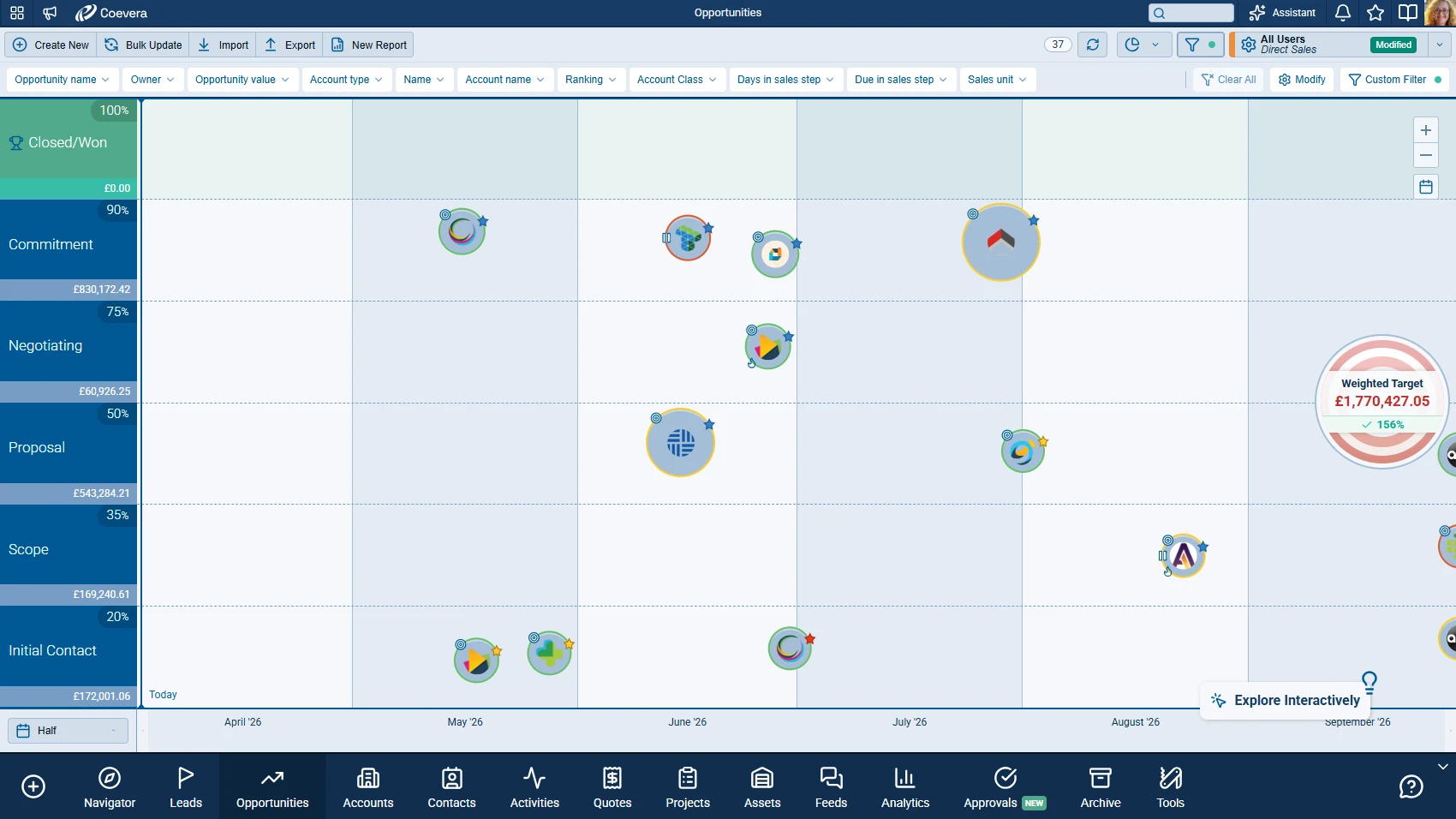
How to pilot with real deals
The surest way to choose is a short pilot, because a tool only helps if reps keep it current. Shortlist two or three that fit your motion, then run each for two weeks with live opportunities.
- Load live opportunities
Use real deals, not sample data, so you feel how the tool handles stage changes, slipped dates, and forecasting.
- Watch unprompted updates
The best signal is whether reps move deals and log next steps without being told. That predicts a trustworthy pipeline.
- Total the real cost
Add admin time, add-ons, and AI tiers to the per-seat price, then compare the three-year cost before deciding.
Software only helps if your team works opportunities the same way every time.