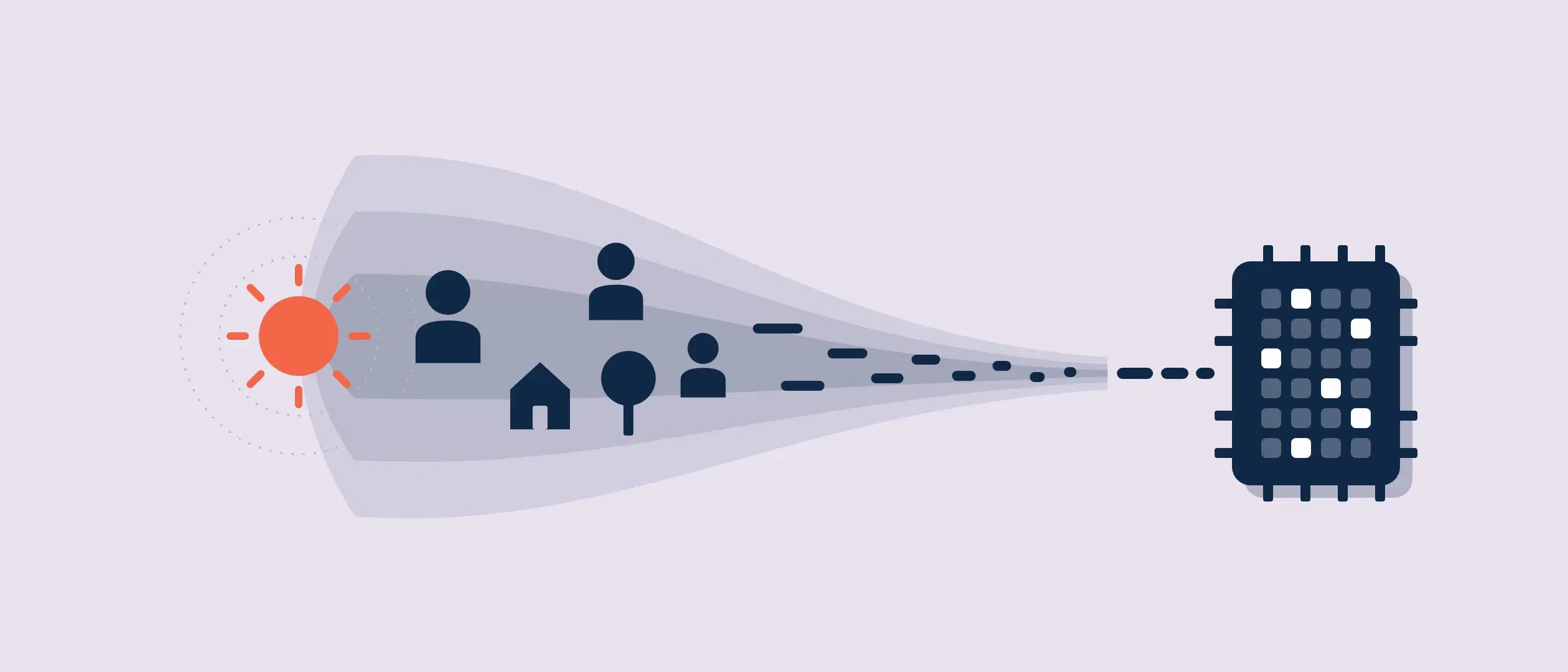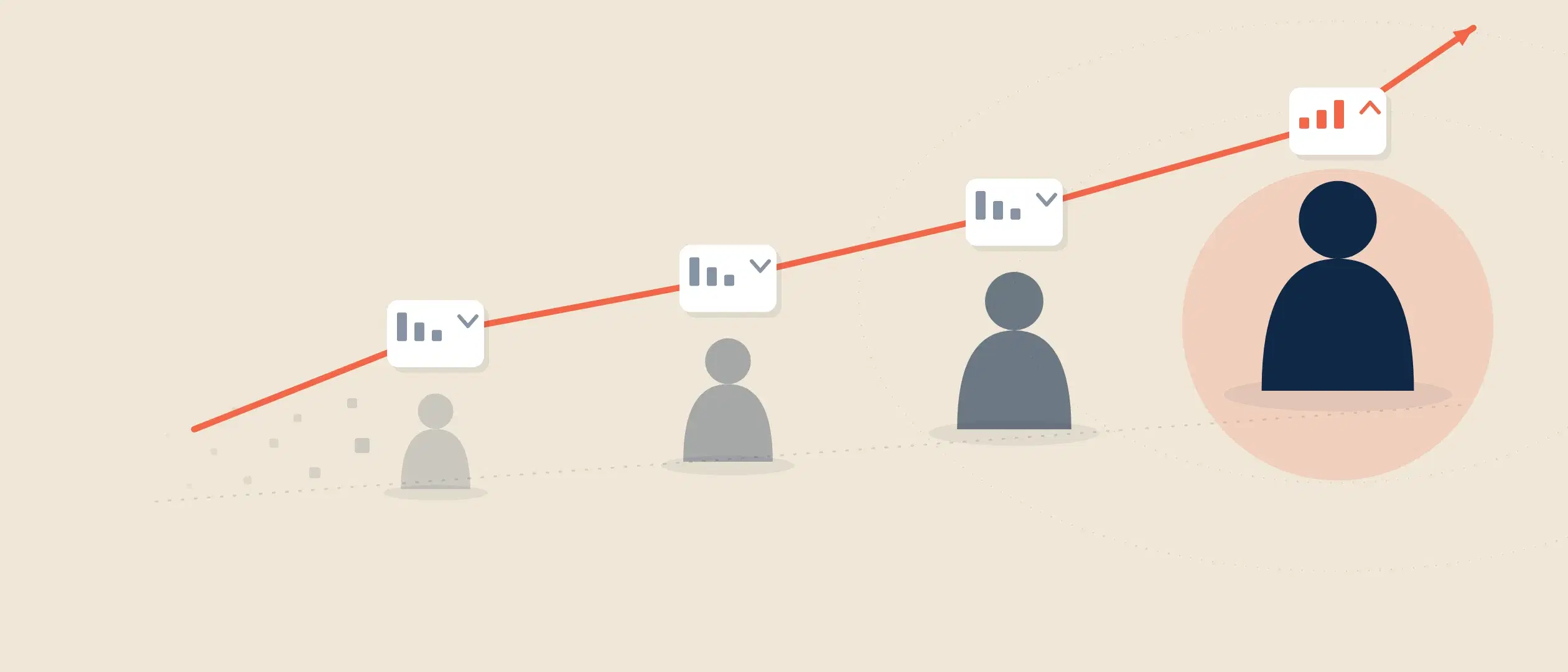
Here's an uncomfortable truth: if your customer knew everything about your product and its real value, you wouldn't be needed. The entire reason a salesperson exists is the gap between what someone knows and what they need to know to decide well.
But there are two knowledge gaps in every conversation — the customer's, and yours. Get either one wrong and you'll give confident, articulate, completely wrong advice. The economist Friedrich Hayek had a blunt name for that: a "pretence of knowledge." Acting on knowledge you do not actually have, he warned, is likely to make us do much harm.
Four kinds of knowledge. One of them is where deals go to die
Borrow the framing made famous by Donald Rumsfeld and sharpened by economist Israel Kirzner. Every fact in a deal sits in one of four boxes — split by whether you know it, and whether you're aware it matters.
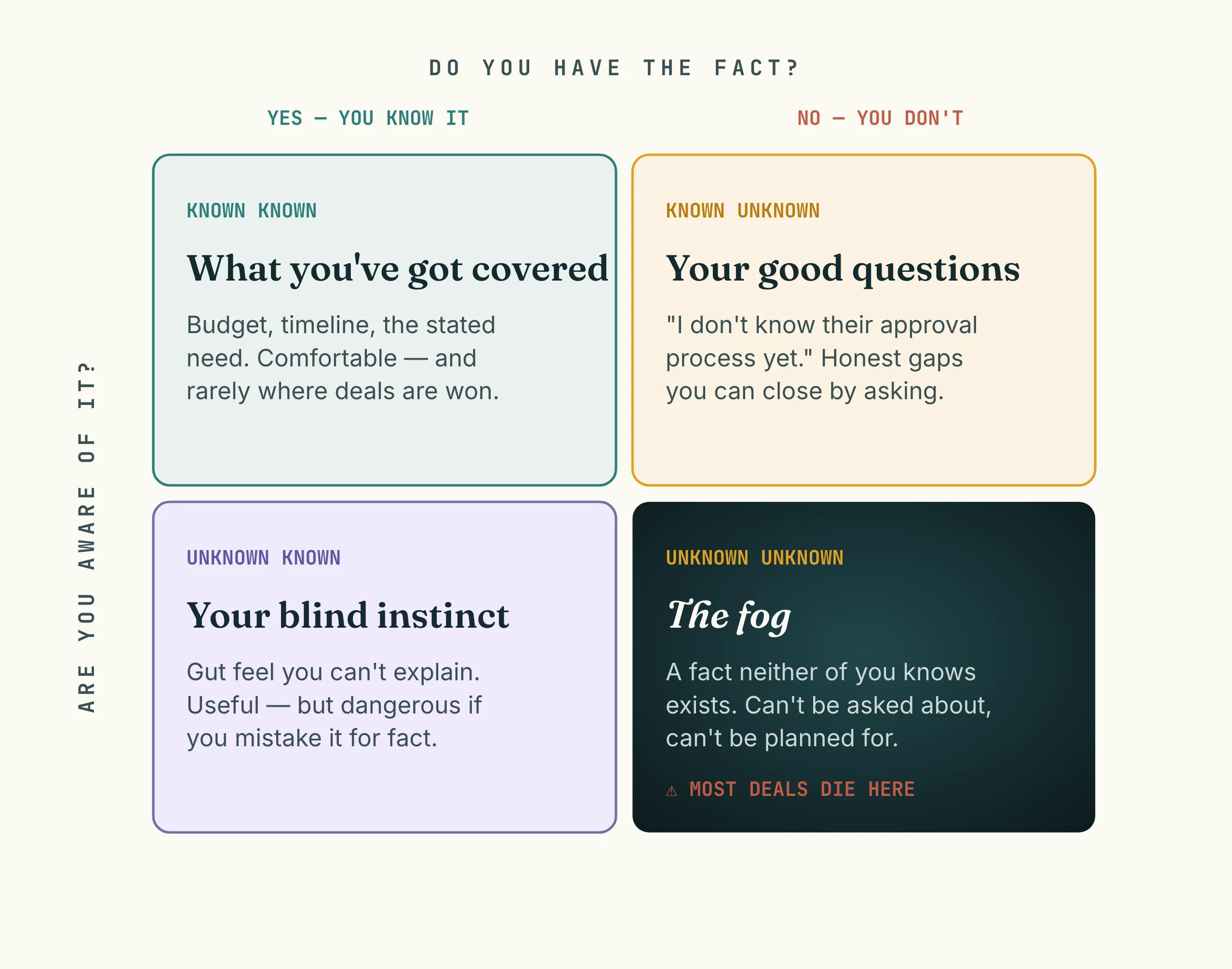
Kirzner called the bottom-right box "sheer ignorance" — not knowing that there's even a fact you know nothing about. A budget freeze nobody mentioned. A rival the customer hasn't told you about. An internal politics landmine. You can't ask a question you don't know to ask.
It is not what we know, but what we don't know that we should always deal with — to avoid the biggest mistakes, catastrophes and panics.
— after Friedrich A. von Hayek
The confident customer is your highest-risk customer
We assume the hard sale is the skeptic. Often it's the opposite. A buyer overwhelmed by options and specs will — just to escape the discomfort — lock onto one solution that feels coherent, whether or not it fits. They ignore better alternatives without realising they're doing it.
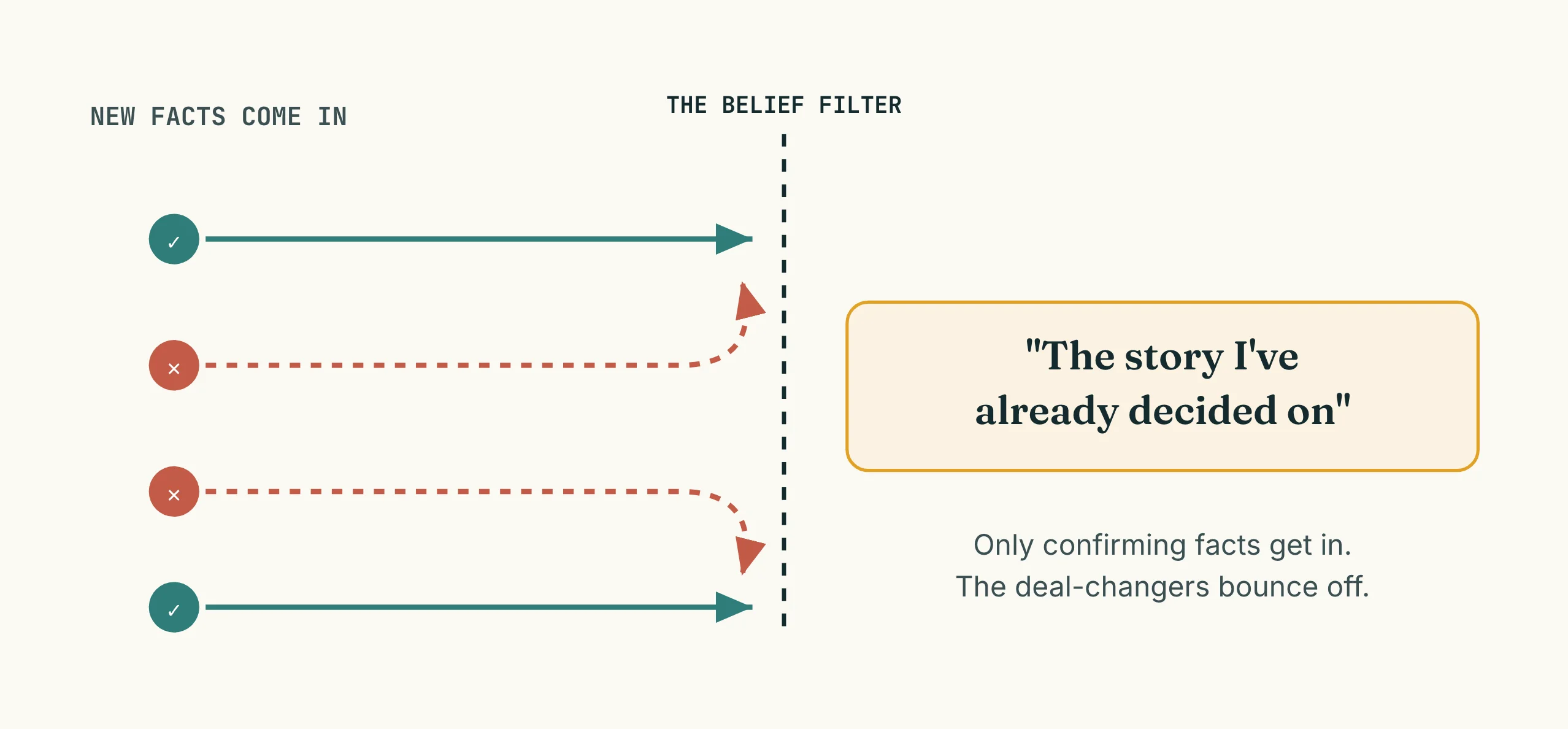
Daniel Kahneman explained why: we build very good explanations from very few clues. A buyer assembles a tidy story out of fragments and then trusts it completely. Worse, confirmation bias means new information that matches the story gets waved through, and anything that challenges it quietly bounces off.
Warning signs
- They name a specific solution before describing the problem.
- They dismiss alternatives fast, without curiosity.
- Their reasoning sounds too clean and complete.
- They quote a spec but can't say why it matters to them.
What to do
- Slow the fixation: "What made you land on that one?"
- Reopen the field gently — show one option they ruled out early.
- Ask what would have to be true for them to be wrong.
- Surface the problem behind the chosen answer.
The bigger danger isn't their overconfidence. It's yours
Reps love a fast read on a customer. But Kahneman's warning cuts both ways: building a confident picture from a handful of clues feels like insight — and is usually just a good story. The salesperson who's sure he understands the customer's needs is one bad assumption away from steering them wrong.
Hayek's antidote is uncomfortable for high performers: "I prefer true but imperfect knowledge, even if it leaves much indetermined and unpredictable, to a pretence of exact knowledge that is likely to be false." In plain terms — a confident wrong read costs you the deal and the relationship. An honest "I'm not sure yet" keeps both alive.
Signs you're presuming
- You've already written their pitch in your head.
- You're explaining their needs back faster than they raised them.
- You skip discovery because "this is a classic case of X."
- You feel mild irritation when they don't fit the pattern.
Stay honest
- Treat your first read as a hypothesis, not a verdict.
- Say "I don't know yet" out loud — to them, and to yourself.
- Hunt for the fact that would break your assumption.
- Hold the picture loosely until they confirm it.
Five questions that drag the unknown into the light
You can't ask about a fact you don't know exists — but you can ask questions designed to flush it out. These invite the customer to reveal what neither of you had on the table.
- "What would make this a bad decision a year from now?"
- "Who else gets a say in this that we haven't talked about?"
- "What have you already tried — and why didn't it stick?"
- "If budget vanished tomorrow, what would actually change?"
- "What haven't I asked that I should have?"
None of these sells anything. They lower the customer's guard and let the hidden facts surface on their own. That's the point — you're not extracting, you're cultivating.
Sell like a gardener, not a craftsman
Hayek's most useful image for sales was never written for sales at all. The craftsman forces raw material into the exact shape he pictured. The gardener can't do that — he doesn't control the plant. He can only create the conditions in which the right outcome grows.
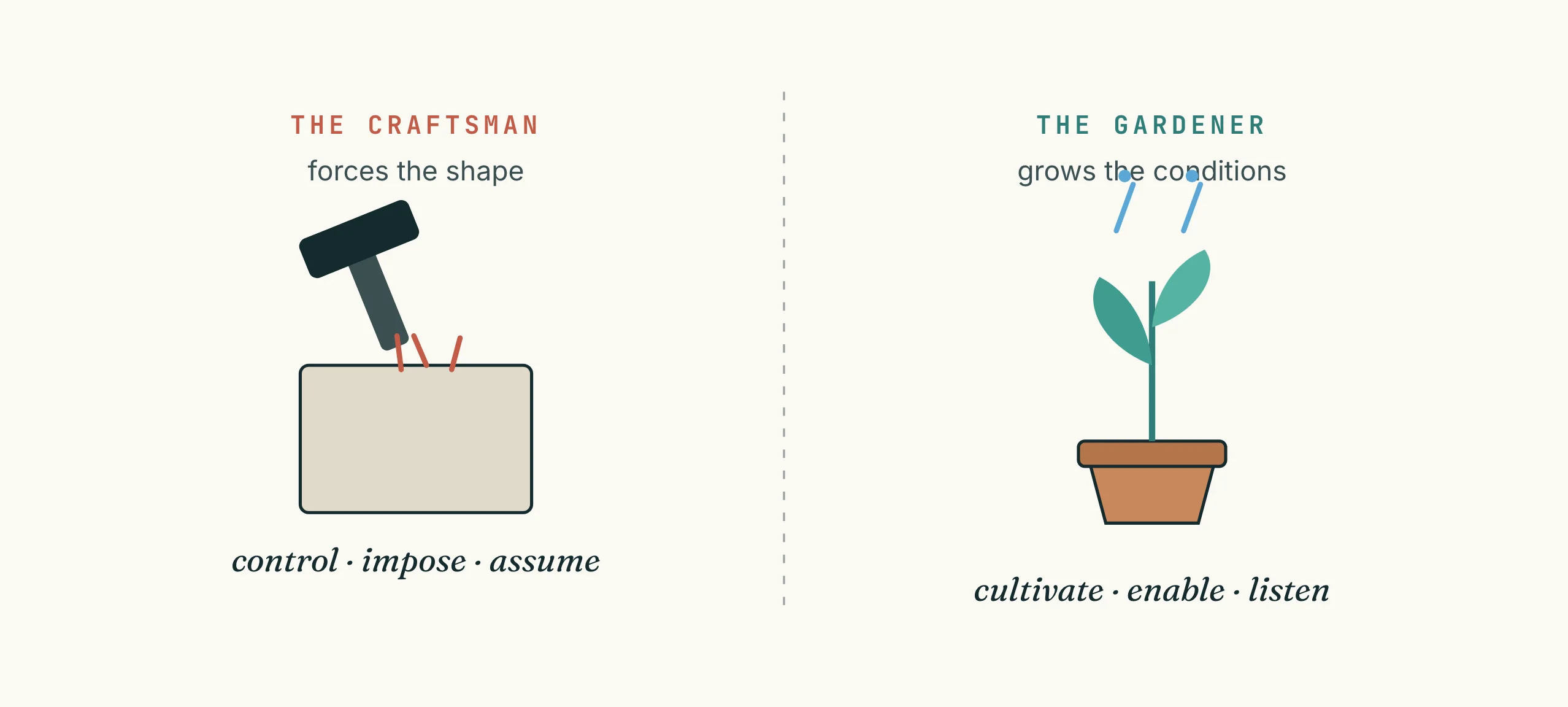
…not to shape the results as the craftsman shapes his handiwork, but rather to cultivate a growth by providing the appropriate environment, in the manner in which the gardener does this for his plants.
— F. A. von Hayek, "The Pretence of Knowledge," 1974
The craftsman-seller arrives with the answer and hammers the customer into it. The gardener-seller knows he doesn't have the full picture — so he builds the conditions for the right decision to emerge, then gets out of its way. One feels powerful. The other actually works.
It's the art of the good salesperson to hold that balance: see what the customer knows, without overestimating what you do.