Let’s now take up another foundational aspect of account management and sales itself: quotas and forecasting. In my experience, I’ve only witnessed a few companies that did well in managing quotas and forecasting. This is because there are two groups with seemingly conflicting interests: the sales team and company and sales management. Salespeople say that quotas are too high and are not achievable, whereas management insists that quotas are not high enough. And it’s fascinating that after so many years, and so many books, seminars, and training on sales, we still have the majority of salespeople underperforming.
In a majority of cases, wishful thinking is all that’s behind quotas, targets, forecasts, and goals. Someone will simply say, “We need to grow by 10 percent per year” and this is shoved in as a quota and forecast. This has never worked, as it’s based primarily on guesswork.
At the outset, pushing quotas and targets onto salespeople without obtaining their agreement just doesn’t work. Salespeople, instead of just carrying on and going for the targets, push back against management. Management comes to accept a “status quo” of salespeople never actually achieving their quotas.
To really get a grasp on these subjects, we need to remove so much emotion and add some rationality. We need a scenario in which everyone can agree, through logic. That doesn’t mean that there will never be tension between sales management and salespeople, even with such a scenario in place. Such tension is actually healthy and is like the two terminals of a power station that, between them, produce power. But there will be trust in place, and both sides will be moving confidently forward.
How might that rational, logical scenario be obtained?
Setting the Target
We utilizing 5 different target types In Coevera:
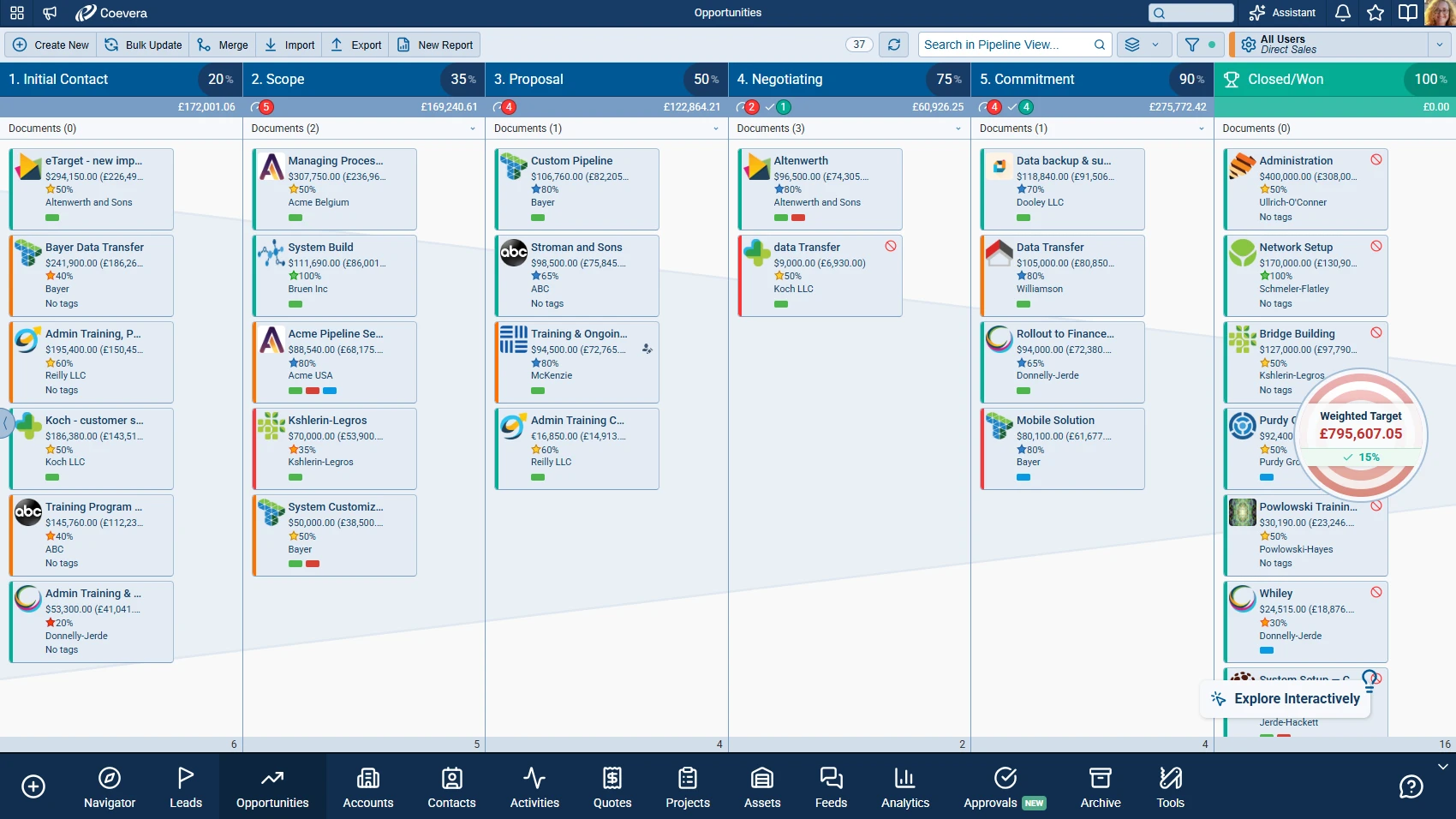
Weighted Target — equal to the sum of the total opportunity values in each sales stage, multiplied by the probability of closure for that sales process stage.
Ranked Target — based on the probability used by the ranking – number of stars up to 5- selected by the sales rep for each opportunity. Each star is worth 20 percent. Ranked Target multiplies the percentage by the value of that opportunity. Probabilities for all opportunities are added together to achieve the overall Ranked Target.
Balanced Target — an average of both the Weighted Target and the Ranked Target.
Unweighted Target — the total value of all open opportunities in the pipeline.
Won Target — the amount that has already been won.
The Won Target shows the amount we’ve already achieved. The win rate is available in the Coevera Archive—another significant feature not available in any other CRM—along with the loss rate. These can be compared. The Won Target is very useful because it shows us the amount of Unweighted Target we need to reach the target we have set for the month, quarter, or year.
The effectiveness of our sales process is indicated by the Weighted Target and shows us how far we have to go in optimizing that process. It takes into account the duration of each opportunity in each step.
The Ranked Target is established by the salesperson’s understanding of their opportunities.
The Balanced Target is the most conservative of all of these and is calculated by combining the Ranked and Weighted Targets together. It is the most realistic overview in the Sales War Room, and is best utilized with the Power Panel filters.
Pay Attention to Sales History
Getting to a target will require a certain amount of unweighted value, and understanding this amount requires looking back at your history. What percentage of your target, overall, have you achieved in the past? This is a typical lagging indicator—meaning an indicator that shows what we have previously achieved. As you improve, you’ll need less unweighted opportunity value to reach your target, because you’ll be incrementally optimizing your conversion rate.
In practice: Public companies tolerate almost no forecasting error — investors won't accept even a 5 percent variance — while private firms rarely match that. Coevera's forecasting tool aims to bring that enterprise-level precision down to small and medium businesses.
Getting the Quota Set
While some combine them, the truth is that the quota and forecast are very different. First, let’s have a look at the quota.
In setting a quota, you must take into account the salesperson and their achievement rate. For example, you wouldn’t set the same quota for a brand new salesperson as you would for one who has been on the job for ten years. The sales manager, or whoever is responsible for setting the quota, must look at the past record of the salesperson. They must consider the sales yield—the time it takes a salesperson to start achieving quotas. If a salesperson is issued too difficult a quota for them to attain, they won’t reach it. The more this occurs, the more negative attitudes are created within that salesperson because they’re failing.
Quota Tool in Coevera
Fortunately, there is now a quota tool within Coevera that makes the setting of quotas far easier and more accurate.
Within this tool, a quota can be set up to be monthly, quarterly, and yearly. You can then add in the various salespeople that will contribute to making this quota, and set and adjust quotas for each person. The overall quota, as well as the individual quotas, can be increased or decreased individually, or by percentage affecting everyone.
The Performance functionality provides, for each salesperson, the weighted average of what they’ve already achieved. This can be compared to the quota.
Using this tool is a more realistic approach than “guestimate” methods of the past. It is far easier to get the salespeople in agreement with management as to what the quota should actually be. This agreement means that everyone can simply get on with making the quota instead of arguing about it.
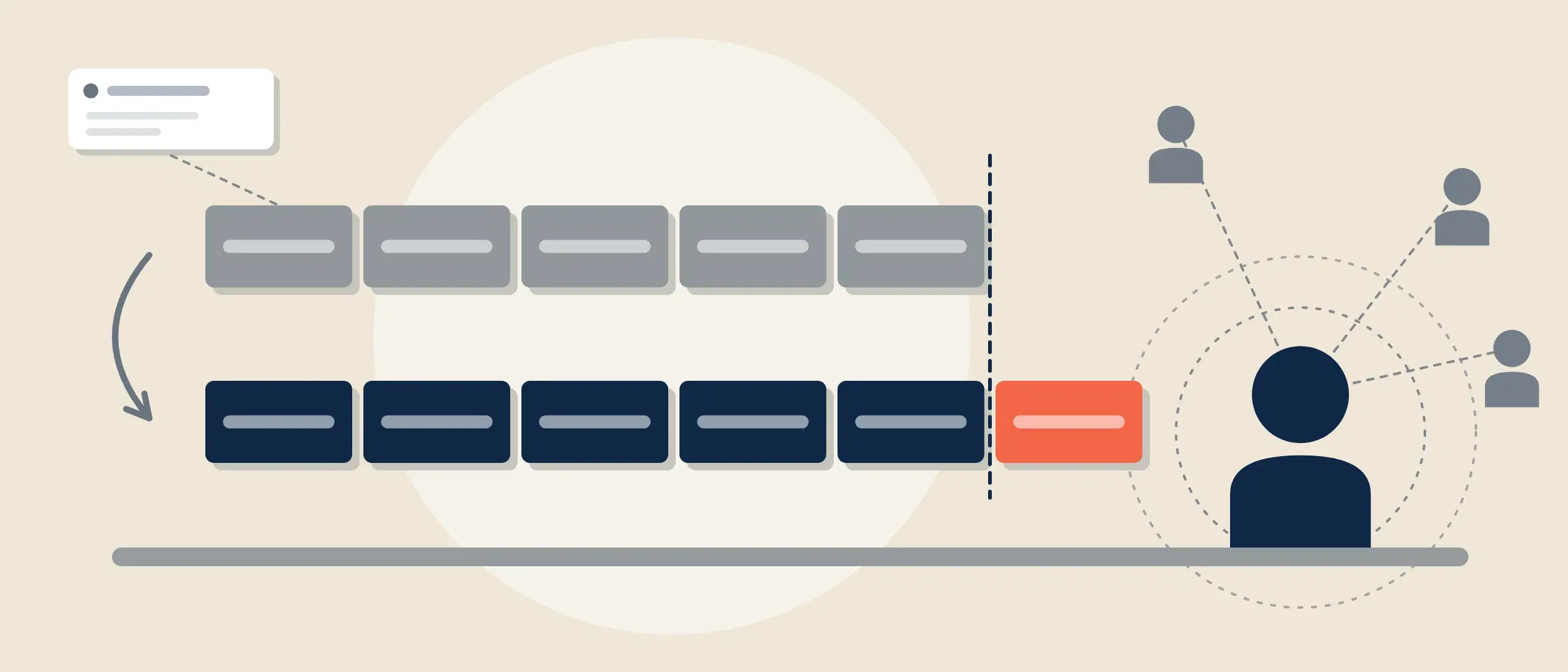
It’s obvious that a business cannot be operated without correctly calculated numbers. Coevera’s quota tool utilizes the underlying sales figures of what has been won in the past. You then know what can be forecast with some reality. For example, if you know that your closing ratio has been 25 percent in the past, you need 4 times more opportunity value in the system to reach the quota.
If your business is just starting up, there won’t be any historical figures, and salesperson growth will be 100 percent per sales period. But simply make sure that sales are being made to the company’s actual buyers (not colleagues, friends, and relatives), and the figures will even out and you’ll be able to calculate precise closing ratios. Quotas will probably be too high in the beginning but can be made more accurate over time.
Being a formal agreement made between a salesperson and the company, a quota should be memorialized in a document and signed by both parties.
Proper Forecasting
After quotas are issued to salespeople, salespeople will then set their own forecasts. With Coevera’s different target types, forecasts can be matched immediately against what opportunities are actually in the pipeline. You’ll be able to see who is forecasting accurately, and where you have issues with salespeople overconfident about their opportunities. You’ll have to work with such people to be more realistic in their forecasting. This will also lead to the person being more realistic with the selling activities, as forecasting should always lead to action.
Similarly, a salesperson could be regularly under-forecasting and appear to be constantly over-achieving. They might be trying to cheat the system a little bit in order to be seen as more of a sales champion, or not to have attention from management.
A salesperson might have a monthly quota and forecast of $300,000. Over the month, the person ends upbringing in $150,000. That means there’s a short of $150 in wrong forecasting, and the company is utilizing misleading numbers in prediction.
Reliable data means everything to you as a manager. Whenever numbers are updated in the system, it leads to realistic forecasting. The target comes from past experience, along with visualizing the number the company wants to reach. The forecast should be constantly adjusted to the opportunities currently in the pipeline. If you find that you don’t have the opportunities in the pipeline needed to reach a quota, you need to take immediate action. That’s a challenge everyone in a sales scenario faces.
Forecasting Tool in Coevera
There is a line graph right at the top of Coevera’s new forecasting tool which reflects current sales forecasts, in real-time. We did that so that sales and company management could always view what was expected. The better the daily process, pipeline forecasting, and analytics, and the more these factors work together, the more accurate the forecasts will be.
As you probably know, public companies have an almost zero tolerance for inaccurate forecasts. Investors won’t brook an even 5 percent variation from a forecast. Private companies, however, rarely operate with that kind of accuracy. With our forecasting tool, we are aiming to bring this enterprise-level professionalism to small and medium businesses. If smaller companies could operate with such precise forecasts, they wouldn’t encounter so many problems. Well, now they can.