Ask three sales managers for their number this quarter and you will get three numbers. Ask them how they got there and you will hear some version of gut feel. That gap between confidence and evidence is what AI sales forecasting closes. Not by replacing judgment, but by giving it a data spine: every deal, every stage change, every stall, read by a model that does not get optimistic in the last week of the quarter.
AI sales forecasting is the use of machine learning inside your CRM to predict future revenue from deal history, pipeline activity, and rep behavior. Instead of multiplying each stage by a fixed probability, the model scores every open deal on how it actually behaves: how fast it moves, who is engaged, and how similar deals ended. In 2026 the practical difference is not the algorithm, it is the inputs. Teams with clean, complete CRM data get forecasts they can run the quarter on. Teams with stale pipelines get fast, confident, wrong answers.
What AI sales forecasting is (and what it is not)
Traditional forecasting starts with a spreadsheet and a stage-weighted pipeline: every deal in "Proposal" counts at 60%, every deal in "Negotiation" at 80%. It treats deals as interchangeable. AI forecasting treats each deal as its own case. The model looks at signals such as deal age against your typical cycle, activity level, stakeholder engagement, and stage skips or reversals, then scores the deal against the outcomes of past deals that looked like it.
What it is not: a crystal ball, or a replacement for the forecast call. The model proposes a number and the evidence behind it. Managers still adjust for what the data cannot see, like a champion who just changed jobs. The best forecasting operations in 2026 are AI-generated and human-adjusted, in that order.
AI vs traditional forecasting methods
The classic methods still matter, and your team should know them. (Our guide to sales forecasting methods, templates and software walks through each one.) Here is how the approaches compare in practice.
| Dimension | Traditional (stage-weighted, historical) | AI-assisted |
|---|---|---|
| Deal probability | Fixed percentage per stage | Scored per deal from behavior and history |
| Inputs | Stage, amount, close date | Stage, amount, close date, plus activity, velocity, and engagement signals |
| Bias handling | Inherits rep optimism | Flags deals where behavior contradicts the rep's call |
| Update cadence | Weekly forecast call | Continuous, recalculated as the pipeline changes |
| Failure mode | Slow drift from reality | Confidently wrong when CRM data is dirty |
Note the last row. Neither approach survives bad data, but AI fails faster and more convincingly. That is why the next section is the heart of this guide.
Forecast accuracy starts with CRM data quality
Every AI forecasting model is a pattern reader, and it can only read the patterns you recorded. Among data and analytics leaders, 84% agree that AI's outputs are only as good as its data inputs, and 74% of sales teams using AI are now prioritizing data hygiene to support it, according to Salesforce's State of Data and Analytics research. In forecasting terms: missing close dates, stale stages, and duplicate opportunities do not just add noise, they teach the model the wrong lessons.
Before you evaluate any AI forecasting tool, audit four things in your CRM: every open deal has a real close date, stages reflect where deals actually are, won and lost deals are marked with a reason, and duplicates are merged. That work is unglamorous and it is the highest-leverage forecasting investment you can make. We cover the full playbook in the CRM data preparation playbook for AI-ready data.
The time savings are real. The reinvestment mostly is not
Gartner's May 2026 survey puts the efficiency gain in plain numbers: AI tools save sellers an average of 4.8 hours per week. The same research found that 72% of sales organizations fail to reinvest those savings into high-value sales activities. The teams that do reinvest are 2.2x more likely to exceed customer growth goals and 3.1x more likely to exceed lead-to-opportunity conversion goals.
For forecasting specifically, the reinvestment plan writes itself. Reps currently spend 60% of their time on non-selling tasks, the same State of Sales research reports. When AI takes over forecast data assembly and rollups, move the recovered manager hours into deal inspection and coaching, the two activities a model cannot do for you.
Four capabilities to look for in an AI forecasting tool
- Per-deal scoring with visible reasoning
The tool should show why a deal scored the way it did, in plain language you can challenge. A score without reasons turns the forecast call into an argument with a black box.
- Continuous pipeline rollups
The forecast should recalculate as deals move, not once a week when someone exports to a spreadsheet.
- Scenario views
You should be able to ask what happens to the number if the three biggest deals slip a quarter, without rebuilding a model.
- Human override that teaches the model
When a manager corrects the forecast, the system should record why and learn from it. Judgment is data too.
How Coevera approaches forecasting
Coevera treats forecasting as a byproduct of a pipeline reps actually keep current. The visual pipeline makes deal state something reps see and move, not a form they fill in later, which protects the data the forecast depends on. The built-in Predictive Forecasting layer covers AI-powered revenue forecasting, deal risk scoring, and pipeline coverage analysis, and Voyager 2 adds agentic help with approval-based autonomy: agents for report creation and contextual guidance that show their reasoning, ask before they act, and learn when you correct them. You see which deals the AI is worried about and why, then decide. Competitors have AI forecasting too. The difference Coevera aims for is that you can interrogate the answer, not just receive it.
The coaching side matters as much as the math. The Collaborator, built on the 1,600+ episode Sales POP! catalog, surfaces relevant guidance inside the deal, so when the forecast flags a stalled opportunity, the rep gets craft, not just a red flag. Explore the product tour or see pricing.
See your pipeline the way the forecast sees it
Try Coevera free for 14 days. No credit card required.
Start free trial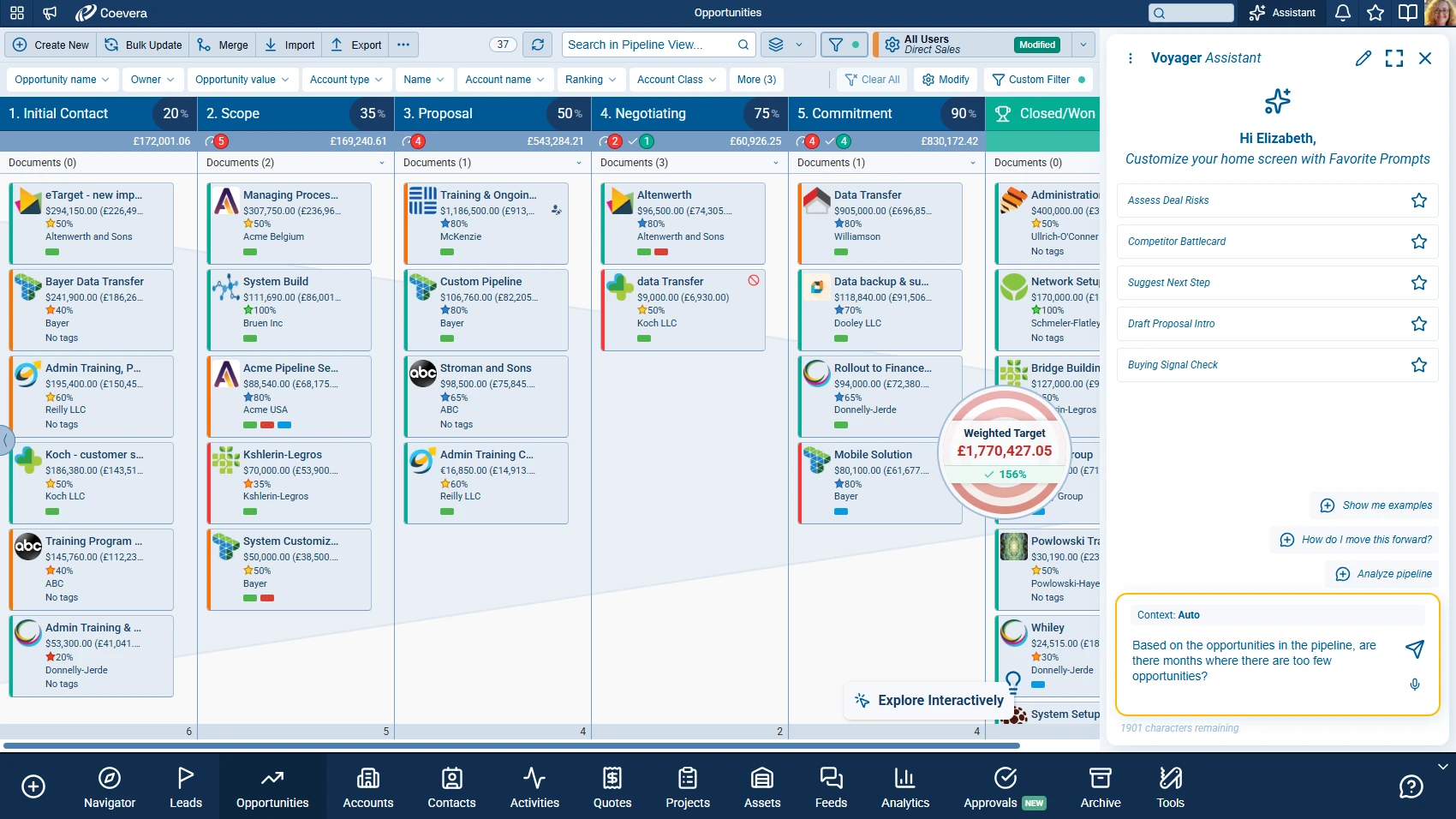
A 90-day rollout plan
Days 1 to 30: clean the pipeline. Real close dates, honest stages, merged duplicates, loss reasons on every dead deal. Baseline your current forecast accuracy so you can prove improvement. Days 31 to 60: run AI and manager forecasts side by side. Do not act on the model yet. Compare misses weekly and fix the data gaps each miss exposes. Days 61 to 90: let the AI number anchor the forecast call, with managers adjusting on the record. Track two metrics: forecast error against actuals, and how many manager overrides beat the model. If overrides usually win, your data is still lying to the model. If the model usually wins, your forecast call just got shorter.
For the deeper mechanics of forecasting inside a CRM, see AI sales forecasting in CRMs.