Every technology cycle produces a prophecy about the end of the salesperson. Every cycle, the prophecy is wrong in the same specific way, and being precise about how it is wrong is the most useful thing a sales leader can do right now, because the current cycle is louder and better funded than any before it.
We have an unusual advantage this time. The last major prophecy came with a deadline, and the deadline has passed.
The forecast
In April 2015, Forrester Research published Death of a (B2B) Salesman. The central projection: one million of the roughly 4.5 million U.S. B2B sales jobs would be eliminated by 2020, displaced by self-service eCommerce. The framing was memorable: B2B buyers were living in a digital-first 2015 while B2B sellers were still operating in a salesman-first 1965.
I wrote a rebuttal at the time. The purpose of this article is not to relitigate it, but to audit it.
The outcome
The collapse did not occur.
The U.S. Bureau of Labor Statistics currently counts approximately 1.3 million sales representatives in wholesale and manufacturing outside technical and scientific products, and a further 303,200 selling technical and scientific products. Employment across these occupations is projected to grow roughly one percent between 2024 and 2034, with about 142,100 openings annually, most arising from retirement and career transition rather than expansion.
Slow growth is not collapse. It is the profile of a mature profession.
More telling is what happened at the top of the value chain. Sales engineers, professionals who sell products that must be comprehended before they can be purchased, now command a median wage above $120,000. The most consultative work in selling has never been better compensated.
The prediction underneath the prediction
Here is what makes this case genuinely instructive rather than merely a scorecard.
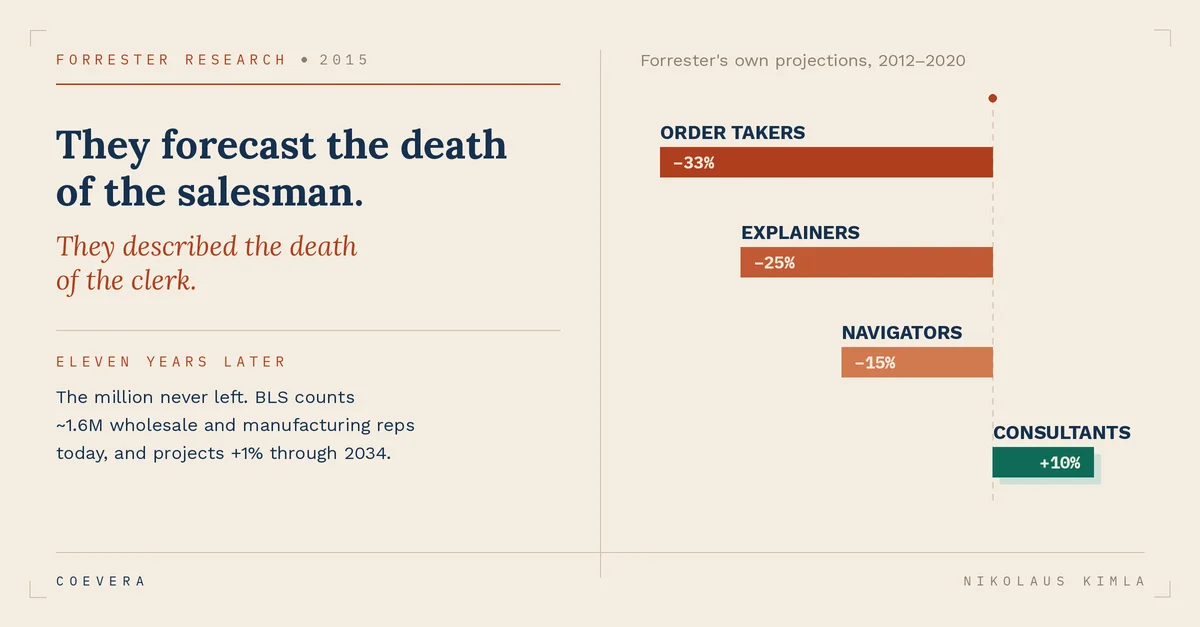
The Forrester analysis was better than the Forrester headline. Beneath the one-million figure sat a four-part segmentation of the profession, with a separate projection for each:
| Role type | What they actually do | Projected change |
|---|---|---|
| Order takers | Process orders a buyer could place themselves online | −33% (~550,000 of 1.6M) |
| Explainers | Supply product information for complex items | −25% (~400,000 of 1.5M) |
| Navigators | Help buyers understand what their own organization needs | −15% (~150,000 of 900,000) |
| Consultants | Deep knowledge of the buyer's business; shape the decision | +10% growth |
The category expected to grow was the one that requires understanding the customer's business better than the customer does.
This is not a forecast about the death of a salesman. It is a forecast about the death of a clerk, and simultaneously a forecast about the rising value of genuine sales work. Both halves were in the report. Only one half became the headline.
That is not an accident of editing. "One Million Jobs Vanish" is a more distributable asset than "A Clerical Function Migrates to a Web Interface." The second is accurate; the first is marketable.
Why the order taker was never a salesperson
We should be candid about the role that disappeared.
The order taker was a human purchase-order form with a car allowance and an expense account. He transported information that wanted to be transported by wire. When a website replaced him, nothing of value was destroyed. A website is simply better at being a form than a person is.
The loss was never that the position vanished. The loss is that our profession ever classified it as selling, allowed it to shape our compensation models, and permitted it to define what "sales" meant to the rest of the business. We spent decades defending the dignity of a job that had no dignity to defend, and in doing so we made the whole profession easier to caricature.
The 2026 remake
The prophecy has returned with better production values.
The current projections, largely from Gartner, run approximately as follows: AI agents will outnumber human sellers by roughly ten to one by 2028. Ninety percent of B2B buying will be AI-agent intermediated by that year, channelling more than $15 trillion of spend through agent-to-agent exchanges. Sixty percent of seller work will be executed through generative AI. And Gartner projected that by 2025, three-quarters of B2B sales organizations would augment their traditional sales playbooks with AI-guided selling.
These numbers are now the standard opening slide at every industry event. They are also, almost without exception, presented immediately before a product demonstration.
That structural detail deserves scrutiny. In 2015, the most alarming claim originated with a research firm that maintained an eCommerce advisory practice. In 2026, the loudest claims come from vendors selling autonomous SDR agents, circulating cost-per-lead comparisons, roughly $39 for an agent against $262 for a human, with the confidence of someone quoting from their own price list.
This does not make the figures false. It does mean that a forecast about the elimination of a job, published by the vendor of the replacement, is a commercial document. Read it accordingly, particularly during budget season.
What AI genuinely does automate
Dismissing the entire thesis would repeat the error I criticised in 2015, so let us be precise about what is real.
The volume layer of prospecting is being automated, and it should be. Account research, list construction, data enrichment, first-draft personalization, intent-signal monitoring, CRM maintenance: this is substantial, time-consuming work that machines perform faster and more cheaply than people. Organizations deploying agents thoughtfully expect reductions of roughly a third in research and drafting time. That is genuine capacity, and any leader refusing it is simply choosing to be more expensive than a competitor.
But observe which role is being consumed first: the SDR, the role our industry created after 2015 to replace the field representative.
We took the order taker, relocated him indoors, issued a sequencing platform and a quota of four hundred touches per week, and called the result modernization. We rebuilt the clerical layer with better software and a younger workforce. Now we express surprise that automation eats it.
This is the actual lesson of the past eleven years, and it generalizes:
Automation does not come for salespeople. It comes for whatever we most recently reduced to a script.
Any activity we can fully specify, we will eventually delegate to a machine. This is not a threat; it is a definition. The strategic question for a sales organization is therefore not "will AI replace my team?" but "how much of my team's week currently consists of specified procedure?", because that portion has a shelf life measured in quarters.
What AI does not automate, and why
The evidence absent from the promotional slides tells a more interesting story.
Approximately one fifth of teams have fully replaced human SDRs with autonomous agents. More than twice that number operate hybrid configurations, where the agent surfaces opportunity and a person takes the meeting. And Gartner's own longer-range work projects that by 2030, three-quarters of B2B buyers will prefer human interaction for complex or high-stakes transactions. Forrester has separately warned that buyer confidence degrades when AI-generated information proves inaccurate.
The same institutions forecasting agent-mediated commerce are documenting that when a decision is expensive and a career is attached to it, buyers want a person.
This is not sentimentality, and it will not be cured by better models. It is structural.
A consequential B2B purchase is not primarily an information problem. It is a risk-transfer problem.
When a CFO signs, she is not acquiring features. The features were knowable long before the meeting. She is acquiring a counterparty: a named individual whose reputation is now attached to the outcome, who can be called when the implementation stalls, who has an ongoing interest in her success because his own standing depends on it. She is buying somewhere for the risk to go.
An agent cannot receive that transfer. It cannot be embarrassed. It has no reputation to damage, no relationship to protect, no exposure of any kind. It has nothing to lose, which is precisely the property that disqualifies it from anything that matters. It will never advocate for the buyer against its own principal, which is the single most valuable thing an exceptional salesperson occasionally does.
Machines are becoming extraordinarily capable of producing answers. They are becoming no better at being answerable.
The salespreneur thesis, strengthened
We have argued for two decades that a salesperson is properly understood as an entrepreneur, a person operating a business within a business, allocating scarce resources under genuine uncertainty and judged on outcomes rather than activity. Every technology cycle since has strengthened this case rather than weakening it. This one strengthens it most.
The reason is straightforward. AI collapses the cost of nearly everything a representative historically spent the day doing: finding, researching, writing, summarizing, updating, reporting. That work was never the value. It was the tax on the value.
What AI does not collapse is the cost of judgment: recognizing which of forty accounts is genuinely in motion, knowing when to slow a deal rather than accelerate it, identifying which executive is telling the truth, and possessing the discipline to decline revenue when the fit is wrong.
These were always the scarce inputs. They are now the only scarce inputs. When the abundant complements to a scarce resource become free, the return to that resource rises. Which means the market price of judgment is going up, not down, and the professionals who possess it are about to become considerably more valuable, not less.
What to do about it
Automate your own procedure before someone automates you. Take the parts of your team's week that can be written as a sequence of steps and delegate them this quarter. If you can specify it, you no longer need to staff it.
Reinvest the recovered hours deliberately. The purpose of automation is not headcount reduction; it is reallocating human hours to the two activities no model performs: being present with a customer, and being accountable for what was promised.
Audit your roles against the four archetypes. Any role in your organization that is predominantly order-taking or explaining is on a clock, regardless of how modern its tooling looks. Move those people toward navigating and consulting deliberately, or the market will move them involuntarily.
Interrogate the forecasts you are being sold. Ask who profits from the prediction. Ask what the same firm projects about buyer preference. Both numbers are usually published; typically only one appears on the slide.
The scorecard for 2037
A prediction of my own, and readers are invited to audit it in eleven years.
There will be fewer people in B2B sales, and they will earn considerably more. The clerical layer rebuilt after 2015 will be gone again. Agents will handle vast volumes of routine, repeat, low-consequence transactions, and no one will mourn the paperwork.
And the consequential purchases, those that reshape an organization, cost real money, and place someone's judgment on the record, will still be made by human beings who trust other human beings.
The salesperson is not dying. The salesperson is being liberated, painfully and expensively, from a century of accumulated clerical work.
The professionals who understand the difference between selling and processing will have the best decade of their careers. Those who do not will be replaced, not by artificial intelligence, but by the part of their job they never troubled to outgrow.
Nikolaus Kimla is the founder and CEO of Coevera.