Continuing our series on the topic of “Win Together” let’s now take a look at how, if we’re to succeed into the future, humans and technology must win together, too.
Technology’s Racing Progress
As I see it, our first real challenge is our ability to keep up with the speed of technology development. Just look over the last 50 years and the fact that computer chips continue to decrease significantly in size but greatly increase in capacity. But we must keep technology advancing because technology is one of the vital components to solving today’s global issues.
One salient fact stands out, and that is the contribution of open source to technological progress. Open source has made continuous cooperation and collaboration possible on a broad scale. Millions of programmers worldwide are working on solving similar or the same issues, making technological advancement that much more rapid.
Knowledge sharing such as that we see today has not always been possible. Can you imagine what it would have been like if Leonardo Da Vinci’s amazing innovations could have been shared with the entire world during his lifetime? Today we have similar geniuses, and this kind of sharing is enabled.
Advancement With Collaboration
A great aspect in today’s network society is that geniuses are able to surround themselves with other geniuses. It’s not simply adding on people—it creates an exponential level of innovation. That collaborative innovation can occur all over the globe, independent of time, locality, race, gender, and even language.
Unprecedented technology advancement results from this sort of collaboration. As an example, just driving a car amazes me in the last few years. I remember my first car when I was a teenager, and in comparison, I feel like I’m piloting a spaceship. It’s just a matter of time until we have self-driving cars.
Because we’re humans, our tendency is to mentally compare technology growth with human development. Humans pass through phases in growth—infancy, childhood, puberty, young adulthood, adulthood, middle age, and elderly. We cannot judge technology the same way. Whereas a human child cannot go to sleep one night and wake up an adult, technology could indeed make such a jump. Because of the sheer amount of programming talent being directed at it, technology that’s immature one month could be spectacularly mature the next month.
Technology in Use
Despite its availability, time was that humans could use technology optionally. “Why should I use that? I can do it better myself!”
Fortunately or unfortunately, those days are gone. Especially in business, there is little to nothing we can do without technology. Data entry, data aggregation, data analysis, data enrichment, product tracking from manufacturing to delivery to customer—all of these and many other functions are impossible without technology.
Without technology, covid would have been far more disastrous than it was. It wasn’t just the fact we were able to use videoconferencing tools such as Webex, GoToMeeting, and Zoom, but the existence of smartphones and other innovations also got us through.
We’ll continue to see the development of solutions based on the issues we had to overcome during the pandemic. For example, the son of a good friend of mine has developed an automated solution for remote tutoring (you can see it at gostudent.org). There will be many more to come.
Through time, the proliferation of technology will only increase. I predict that by the year 2030, innovations and advancements will be growing so fast we won’t be able to comprehend them. It will be like a constant roller-coaster ride.
Worth knowing: The author flags that humans and technology are already merging — a legless man competing as an Olympic runner, heart pacemakers, limb and organ replacements — and warns this could extend to brain implants like Elon Musk's project, a direction he fears may cross ethical boundaries.
The Merging of Technology With Humans
As technology advances, our approach to ourselves as humans is undoubtedly changing. It became possible for a legless man to compete as a runner in the Olympics. There has existed for some years now a pacemaker for the heart. Replacement of many other limbs and organs is undoubtedly in our future.
I honestly don’t think there is a limit as to how far this can go—and I fear this could be a problem and could cross ethical boundaries. For example, should we have chips implanted into our brains? Several projects are moving forward in this area right now, one being led by Elon Musk.
The Balance Maintained
It is vital that the balance be maintained between technology and humans, in such a way that we are not overtaken by technology. Machines outpace humans in the fact of not being lazy, inefficient, lacking endurance, requiring sleep, and not possessing many other shortcomings. A person might think that, when all is said and done, a robot might be able to do something better.
But bear in mind that humans are capable of innovating and creating, whereas machines are not. It’s the one factor that makes humans utterly unique in comparison to computers. This includes the creation of machines themselves.
Down to Coevera
Let’s narrow this down to what it all means for Coevera.
We covered earlier that the entire Coevera stack is built on open-source technology. That means we don’t just have single programmers developing and upgrading Coevera components—we have millions. Because of this, we have constant access to innovations as they are made. Our technology will never be outdated.
For example, Amazon Web Services (AWS) hosts Coevera in the cloud. AWS is just the host, though, and a developer such as Coevera is free to choose the operating system on which they will run. We could utilize a proprietary OS such as Windows, Red Hat Linux, or another Unix variant, but we decided to use an open-source OS called ubuntu. Additionally, we make use of AngularJS JaveScript, Python programming language, and many others.
Participation in the open-source community constantly orients us to the future. In partnership with technology, we’re genuinely winning together.
We are constantly placing a better system in the hands of our human users. It’s a true benefit to having a solution that is incrementally improved daily. Doing so leads to efficiency. Efficiency leads to productivity, and productivity leads to profitability. Profitability leads to security for a company, its employees, and its communities.
What is soon to be coming down the line? I think that in the not-too-distant future, we’ll be able to issue voice commands to applications and have them perform for us. I believe we’ll see tremendous advancements in computer intelligence. Innovations in algorithms will mean that a system will provide advice to humans to help them think and plan more effectively. This doesn’t mean computers replace humans, but that systems offer options, such as a best-case scenario, a worst-case, and perhaps the best approach that should be taken.
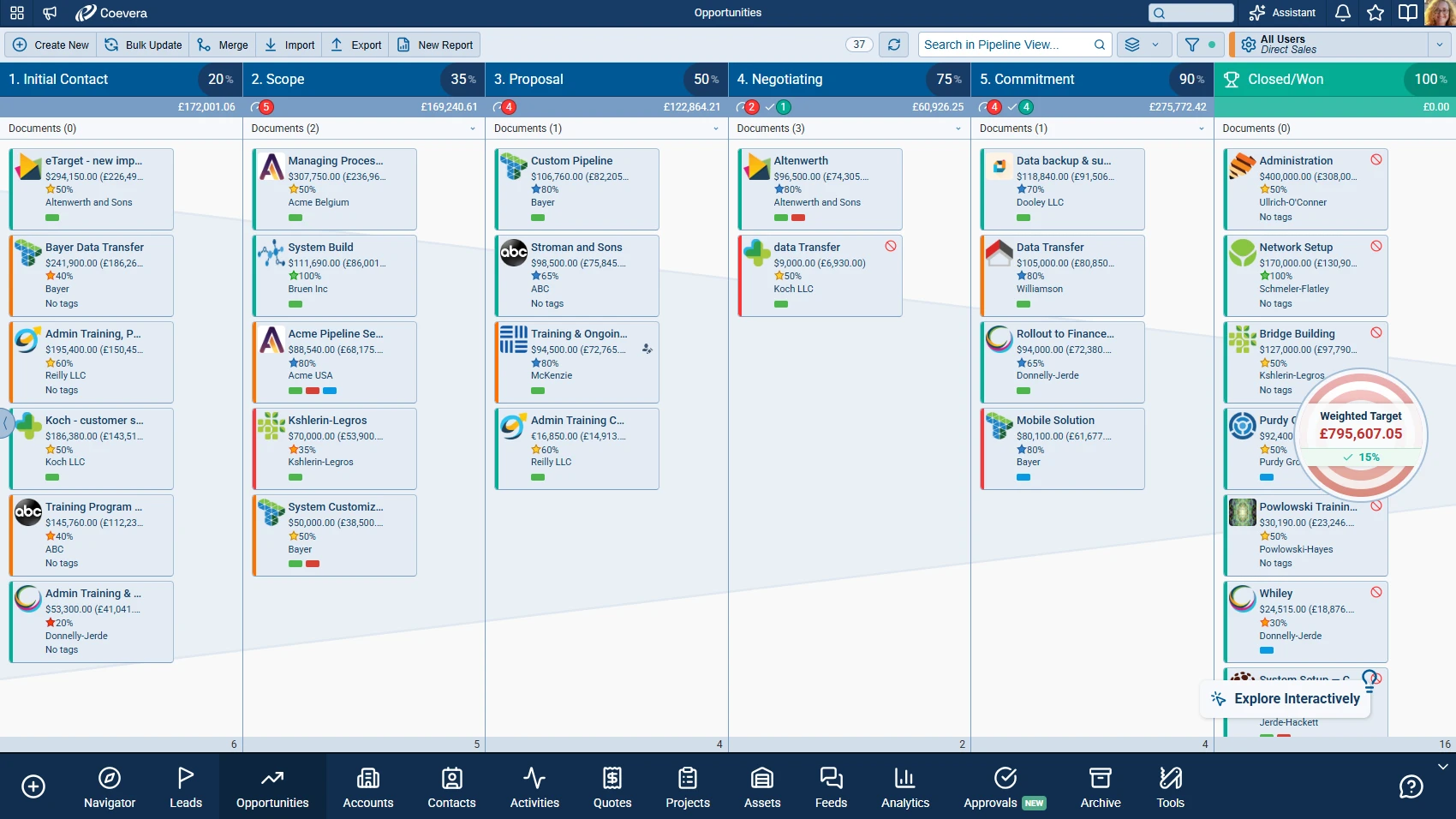
For any business enterprise or organization, CRM must be a core application. Therefore a CRM such as ours being constantly improved makes for a total “win together” for humans and technology.