By

No combat unit enters battle without a shared tactical plan: first covering fire, then the flanks, then take the hill. Without it, every soldier improvises their own tactics, and the unit makes no progress.
The same is true in sales. For reps, a sales process brings order to every sales cycle. For the sales manager, it provides a clear structure through which to lead the team. Without a real sales process, sales management becomes a nightmare. The only way to know where deals stand is to chase each rep individually and decode their personal method — one of the biggest drains on a manager's time.
All troops require a battle plan. For a sales force, that battle plan is your sales process.
— Nikolaus Kimla, Leading from the War Room, 2014
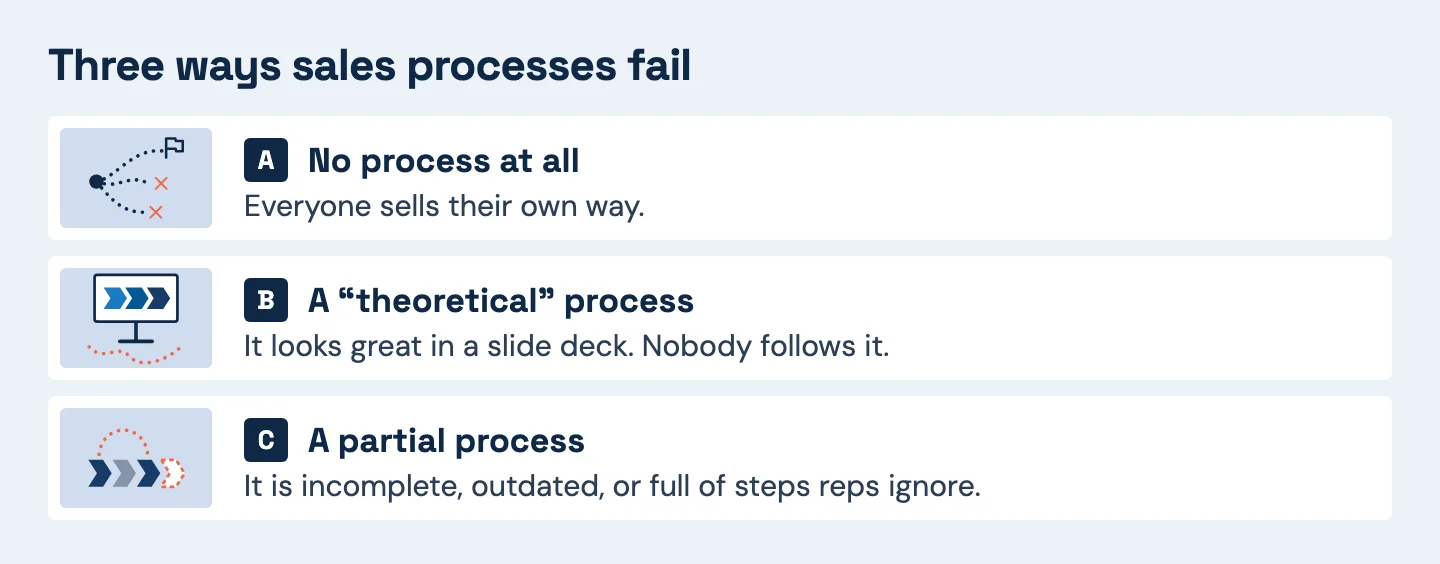
Three ways sales processes fail
Sales process reviews tend to find the same three faults:
- A — No process at all. Everyone sells their own way. Some succeed; others fail simply because they skip the stages that lead to a close.
- B — A "theoretical" process. It looks great in a slide deck. Nobody follows it.
- C — A partial process. It is incomplete, outdated, or full of steps reps ignore.
If yours falls into any of these categories, building a real, adopted process should be your top priority.
How to build an efficient sales process
Consult your proven producers
Your best reps have already developed their own processes — including the vital steps that actually win deals. Involve them. They will show you what's missing and which steps only add time without adding value.
Make the buyer the key to every stage
Traditional processes were built around the seller: the seller calls, pitches, books and closes. But today's buyers are far better informed, and the "lucky pitch" rarely lands. Your process must mirror the buyer's needs, issues and patterns.
Take qualification. Traditionally it usually meant two questions: Can they use our solution? Can they pay for it? What was often missing was the pain — the reasons the buyer is looking at all. That understanding carries a deal through every later stage — or reveals that it won't close.
Example: a company car fleet. A rep learns that XYZ Company wants to buy or lease a fleet and has budget. Why now? Their current vendor's cars have safety issues and service is slow — a serious risk, because XYZ's sales and support teams are constantly on the road. Now the rep can point the buyer to your safety data, share testimonials about your service quality, and offer test drives with the key decision-makers present.
Add value — and measure progress — at every stage
A process only works when each stage adds value for the buyer and measures real progress. In the fleet example, a deal may only move forward when:
- the pain points are fully understood,
- the prospect has agreed to a test drive and demo with a date and time set, and
- the prospect has agreed to invite the other key influencers.
On top of these conditions, you can score the sub-steps — for example:
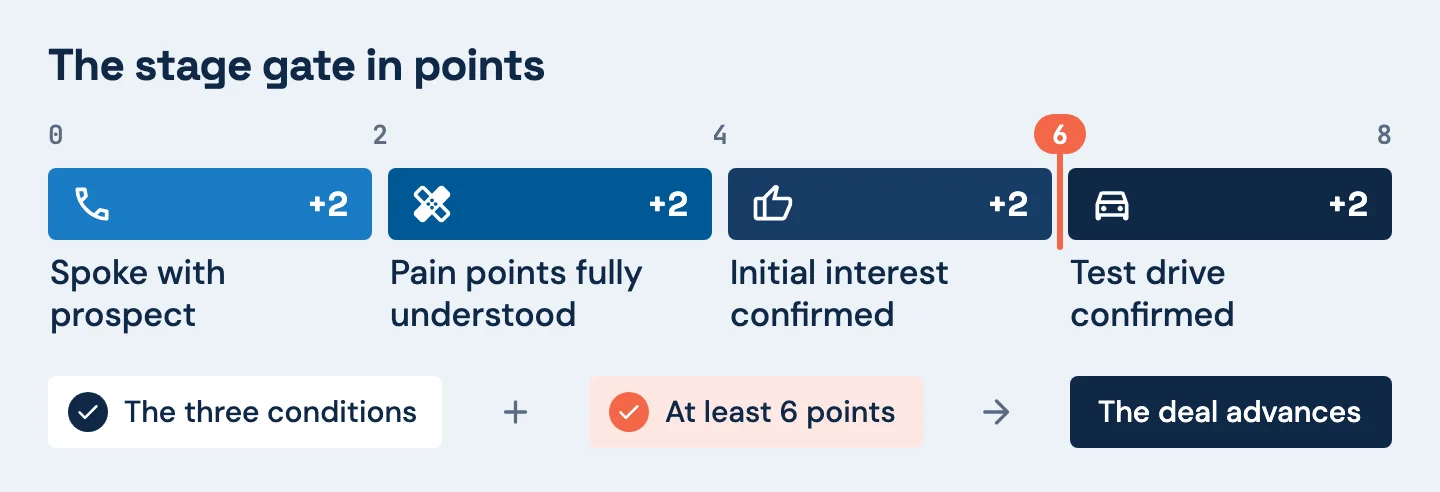
Rule: a deal advances only once it has earned at least 6 points. That turns a gut feeling into an objective stage gate.
Four rules for every stage
- Keep each stage simple and clearly defined.
- Keep the customer focused on your core value as it applies to them.
- Add value with defined advances.
- Provide targeted insight at each stage.
Keep it dynamic
Markets, economies and products change — and reps keep finding better ways to work. A process frozen at launch slowly becomes an obstacle. High-performing sales organizations treat the process as a living system: outdated steps are removed, others are streamlined, and the process stays at maximum efficiency and velocity.
Include Marketing
Marketing and Sales are two units of the same team. Marketing should support every pipeline stage with the right collateral — and the marketing steps that happen before a lead exists are part of your sales process too. (More on this in Part 4.)
Make it your first priority
If you're investing huge effort for modest results, the missing ingredient may be an efficient sales process. It is the first step in turning scattered troops into a tight, coordinated sales force.
Next in the series: Sales and Marketing — run up the white flag.
Adapted from the Coevera e-book Leading from the War Room: Building a Battle-Ready Sales Force by Nikolaus Kimla. Download the full e-book at coevera.com.