Several times in the past, we have covered the topic of navigation. But this was only one type of navigation—toward those factors or destinations that had already been discovered. What about factors or destinations that have not yet been discovered?
Utilizing today’s navigational technology, finding things that are already known is easy. Or, in the case of navigating a ship or an aircraft, the trained navigator knows the hazards and routes to take when heading toward a particular destination.
The Unknown
There is a more complex and critical navigation—the skill of exploring unknown territory. Imagine yourself, as with our early explorers, landing on the shore of an island that no one has ever seen.
At the same time, exploration or innovation is more involved when the explorer isn’t sure if the destination or objective actually exists. Navigation also becomes more complex if the route to reach the objective is not known or not clear—it’s common today to have a destination with many ways to achieve it, none of them necessarily ideal.
In the case of multiple destinations or objectives, the explorer or innovator may not know which to aim for or travel to.
An unknown situation really presents confusion, in which targeting factors is complex because the factors themselves are unknown. A prime example is COVID—no one was at all prepared for it. Responses to it have been all over the map, quite literally. Just look at the different reactions by various governments worldwide.
I have stated many times my non-belief in artificial intelligence when it is applied to navigation, because it is programmed simply and only to find factors, solutions or destinations that are already known.
Heuristic Methods of Navigation
The opposite of navigating toward known destinations is heuristic navigation.
The word “heuristic” is defined thusly: “obtained by exploration of possibilities rather than by following set rules” (Collins English Dictionary). The word comes from Greek heuriskein, which means “to discover.” When utilizing heuristic methods, the explorer or innovator discovers one objective and evaluates it. In doing so, they determine a possible route to the next objective. Neither of these destinations was known beforehand. Heuristic navigation is employed when one knows what a possible target is, but doesn’t know where it is or how to get there.
We can take an example in the game of chess. A set of algorithms could be used to delineate the rules of the game and the restrictions on how each piece—pawn, bishop, knight, queen, etc.—can move. But playing the game and employing strategy takes a heuristic approach. A player makes a move, and then waits for their opponent to make a move in response. When the opponent makes their move, the first player then calculates what their next move should be. This is heuristic methodology, as every step, taken in response to the other player’s move, is designed to strengthen the first player’s position.
Worth knowing: the word heuristic, central to Coevera's approach, comes from the Greek heuriskein, meaning to discover — fitting, since heuristic navigation is used when you know a target may exist but not where it is or how to reach it, exploring possibilities rather than following fixed rules.
Navigation Methodology Applied to Sales
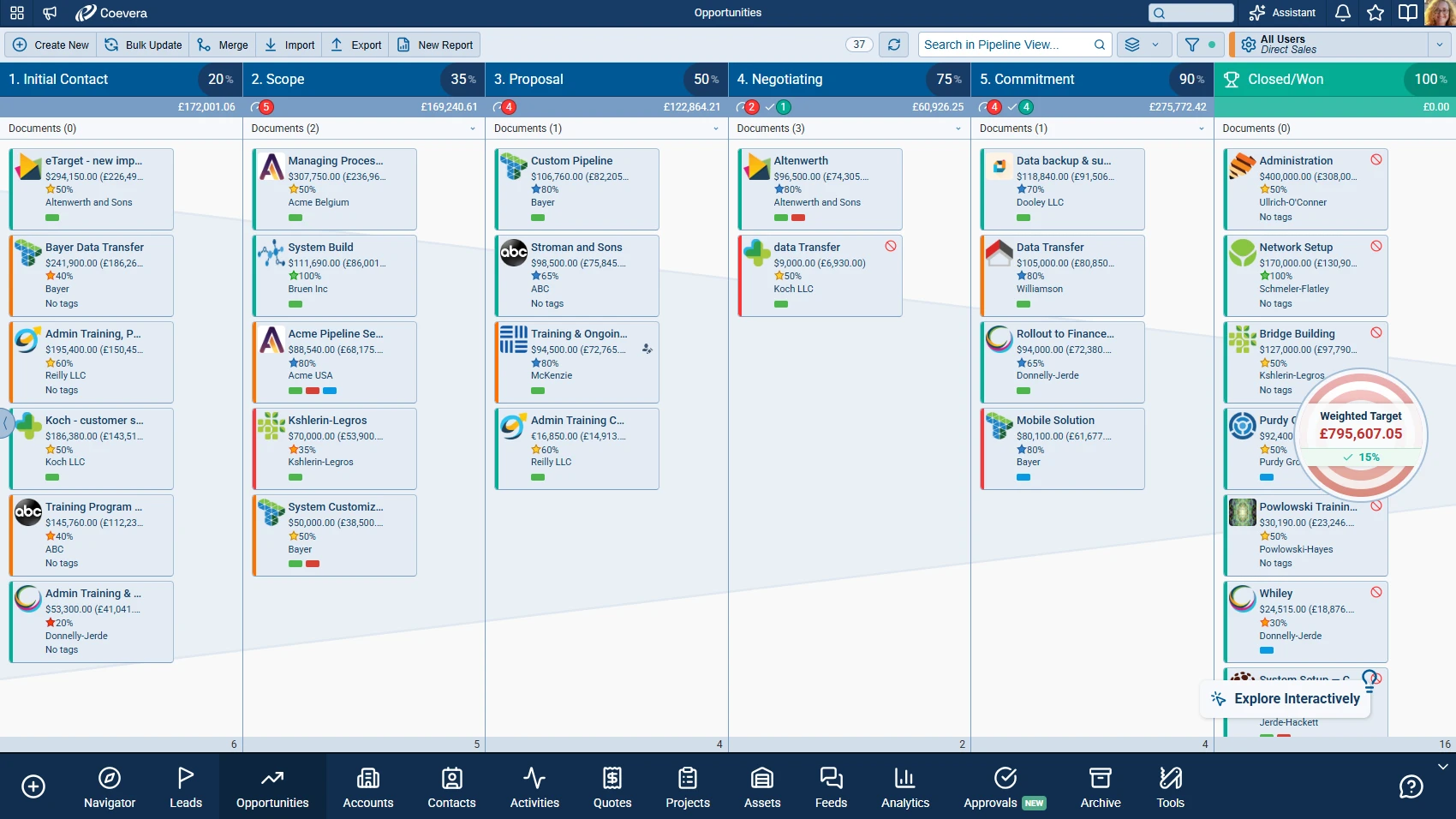
This radical difference between navigating toward a known target and heuristic navigation differentiates Coevera from other CRM applications. Traditional CRM systems have “decided” they know what direction a salesperson should go, and what strategies they should take. These are then programmed into the CRM as known objectives.
Coevera is not equipped with navigation algorithms, but instead utilizes the heuristic approach, as it is far more effective.
A sales heuristic approach would be applied, for example, to the development of a relationship. If a prospect responds to a salesperson’s email, the salesperson would take the next activity within the process, or the next step in the sales process. If there is no response from the prospect, then the salesperson takes a different action. Each step is based on the previous step, and ultimately results in a strengthening of the relationship.
Flexibility is another example. A salesperson has different ways they can offer their product or service, based on the prospect’s requirements or needs. This leads to flexibility in the salesperson’s relationship, and also leads to the bridge of discussion of different options and solutions to the prospect’s various issues.
Introduction of Responsibility
Inherent in the heuristic approach to sales is the principle of responsibility. Whatever the salesperson offers to the prospect must be backed up. The salesperson, backed by their organization, must always deliver what they say they wlll. When a company, or a sales rep for that company, makes a promise, they need to stick to it. Otherwise promises become meaningless.
Additionally, information presented by a sales rep about their company, services and products must be complete and transparent.
Such responsibility would include refraining from making assumptions. A salesperson must never assume that their prospect is not as educated as the salesperson, or that the salesperson is somehow superior to the prospect. Such assumptions can and often do backfire on the salesperson, and will also reflect poorly on the company and its products and services.
Making the Unknown Understood
These methods of working toward sales goals, acquisition of information and establishment of relationships all add up to one overall objective: understand the unknown. It all leads to a better valuation of an opportunity.
The only effective approach to B2B sales, in my opinion, is the heuristic approach. Every Coevera feature has been tried with this approach, and has found to be efficient. This includes our recently added labeling feature for opportunities, which provides companies yet another aspect of opportunity evaluation. Every such feature reduces risk and elevates the factor of opportunity.
We can never, in the end, create a forecast or evaluate an opportunity with 100 percent certainty. You can be more confident a deal will come through if there is a signed contract—but even then, you can only be sure the deal has been finalized when the final invoice has been paid.
It is the heuristic approach that brings one as close as possible to success. And this is what we provide with Coevera.
Start Your Free, No-Obligation 14-Day Coevera Cloud Unlimited Trial.