The next major release of Coevera, coming on September 28, brings a fantastic new feature: Custom Entities (functionality referred to in some other CRM systems as “Custom Objects”). Coevera once again takes a giant leap ahead of any other CRM in the industry by creating a very special and easy way to set up and organize this outstanding functionality. Compared to our competitors, we have reduced a user’s creation and implementation of this type of feature dramatically by over 65 percent.
 play_arrow
Definition and Function of Standard Entities
What does the word “entities” mean in Coevera, and why are these called Entities? “Entities” is the term used in Coevera to refer to different CRM functions.
The functions known as Standard Entities are defaults in Coevera. These are:
- Project
- Account
- Product
- Product Line Item
- Contact
- Appointment
- Lead
- Task
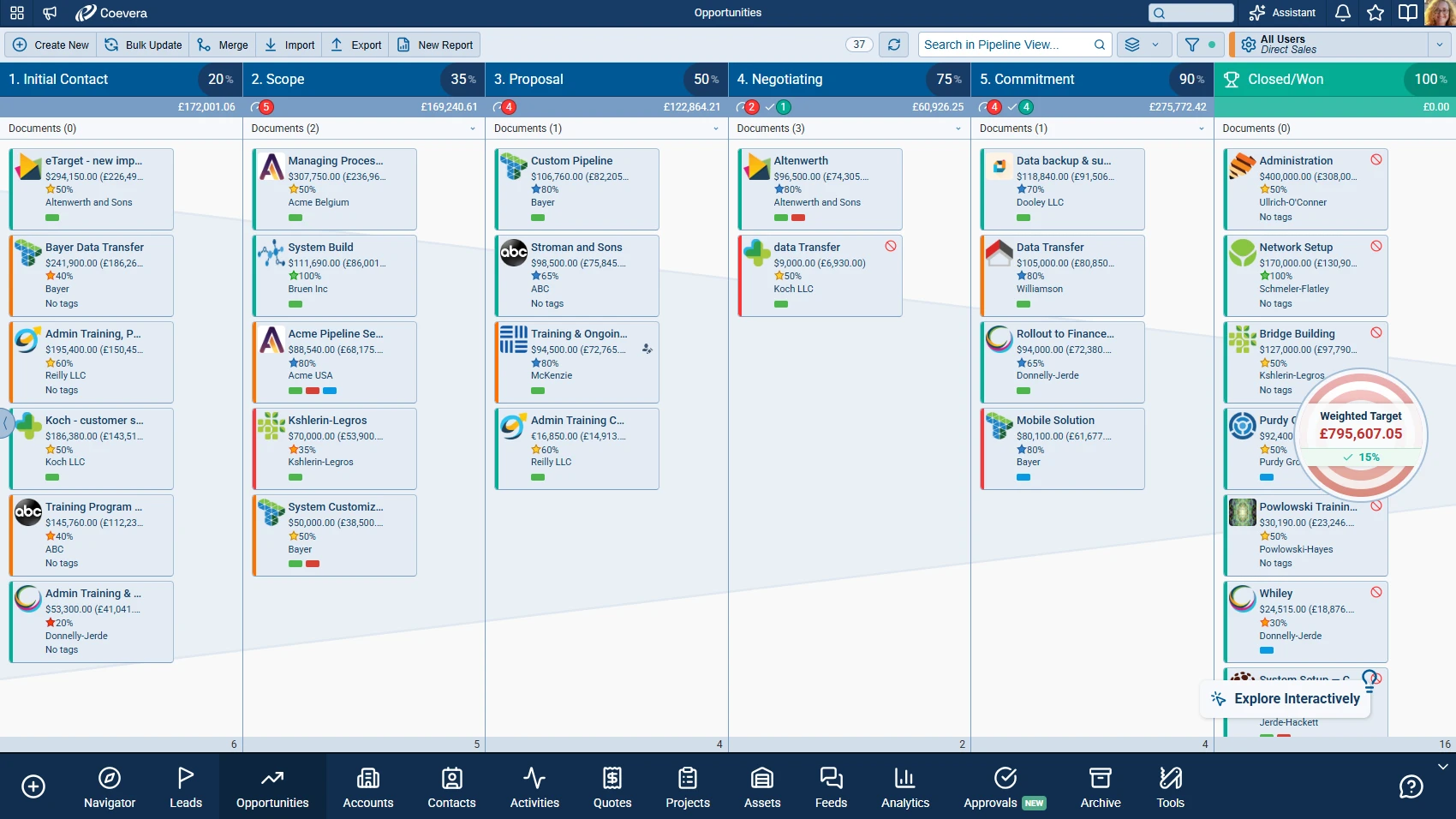
- Opportunity
To understand an Entity, consider it a method through which an enterprise organizes and views its data.
For each Entity, data is organized in customizable fields. In addition, Coevera offers multiple forms for each Entity, making for endless possibilities within the same Entity.
Worth knowing: Custom Entities remain genuinely rare — fewer than 10 solutions worldwide offer this capability at all, and Coevera positions itself as the only one to make it simple rather than considerably more complex, building it with the same point-and-click flow used for Contacts.
And Now…Custom Entities
A company can create a Custom Entity to fit their particular needs.
Let’s take a business context example. Let us say that a manufacturing company, in addition to the Standard Entities provided as defaults, also has a regular requirement to order special raw materials for particular clients in the manufacture of their goods. The company needs to keep track of these specific raw materials as they’re not part of its normal inventory—they’re only used for one particular client. They could then create a Custom Entity called “Special Raw Materials” (perhaps abbreviated to “SRM”) that could be used for any client for which they must order and track specific special raw materials.
In another example, a company might have created a separate sales commission structure for upselling existing clients and new business. This would also require a Custom Entity if the company wants to report and create its own analytics through exporting of data.
Coevera allows salespeople to take control of their opportunities, remain consistent through every stage of the sales process, and always stay focused on important priorities. It's the CRM that salespeople actually enjoy using.Creating Custom Entities with Ease
This is again a major revolution we have brought to the Enterprise space, as in the back end we have reduced the setup and implementation of Entities, when compared to our competitors, by more than 65 percent. Custom Entity creation is incredibly easy, done through the same methodology as Contact or Account creation. No coding is required.
Custom Entities share the same interface and functionality as Standard Entities, making the onboarding process for new and existing Coevera users easy.
Each Custom Entity possesses its own automation, fields, field permissions, reporting, forms, relations and user permissions.
Custom Entities empower you to create any functionality and business case your company requires now or in the future. There are less than 10 solutions world-wide today that offer this functionality. Others are considerably more complex than ours—we are the only one that made it easy and simple. Yet another reason to do as many others have done: make the switch to Coevera!