By
As a sales manager, you may have a few grievances with Marketing. They promote promises your reps feel the product doesn't quite keep. They ignore features customers love. And the leads? "Not good enough." So you let Marketing do its thing and keep your team focused on selling.
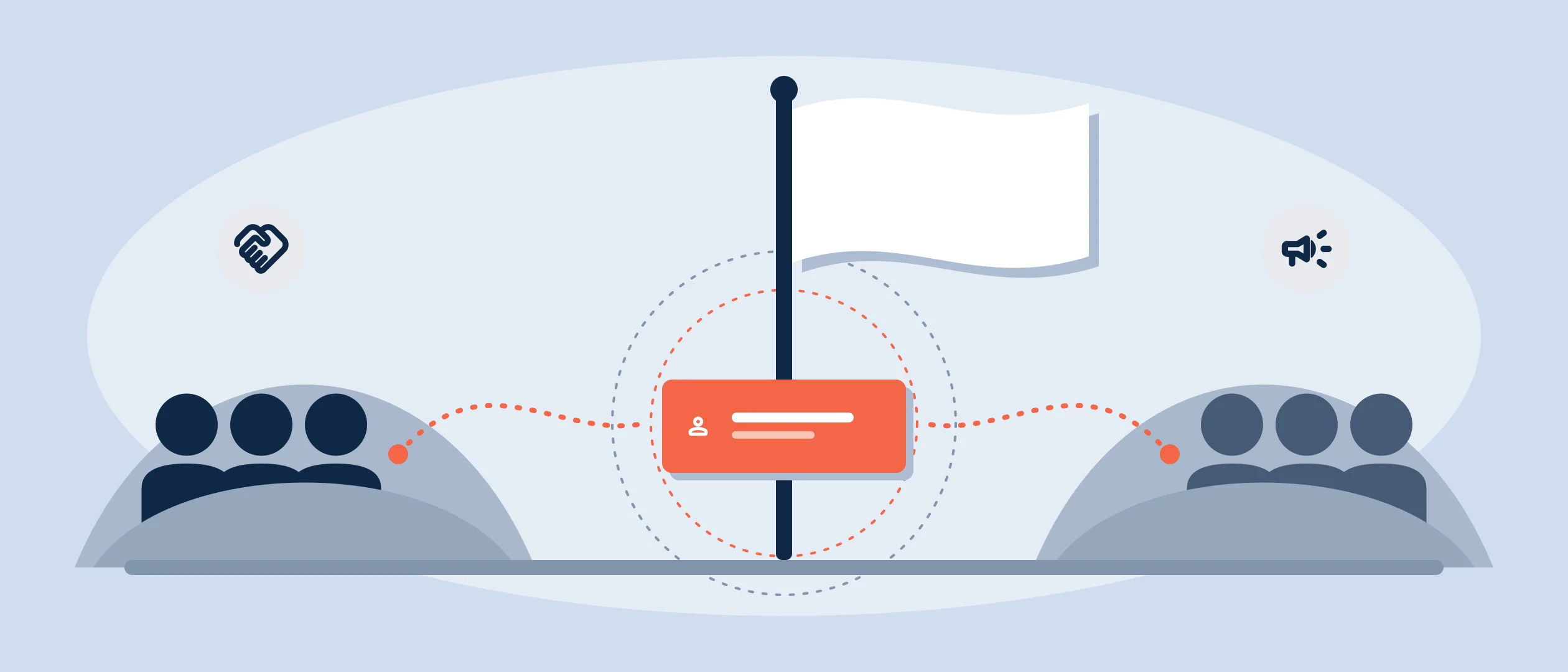
But Sales and Marketing are two units of the same fighting force. So run up the white flag and call a parley.
Picture your sales team as infantry making a beach landing, with Marketing firing covering artillery from the ships. You would care very much what that artillery was doing. You'd want the enemy positions taken out before you hit the beach.
Sales and Marketing can no longer operate in an “us and them” scenario: the war is against other companies, not other departments.
— Nikolaus Kimla, Leading from the War Room, 2014
Marketing is part of the sales pipeline
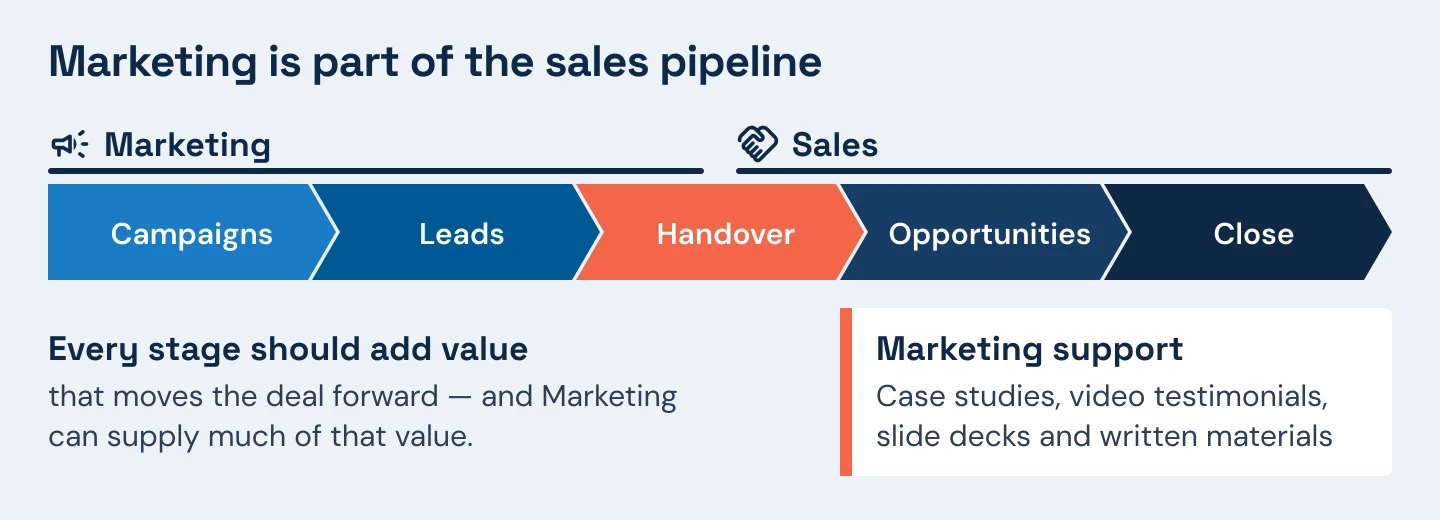
Your sales process already contains marketing steps. Marketing runs campaigns, generates leads, hands them to Sales, Sales turns them into opportunities and closes them. In theory.
In practice, it often breaks down over lead quality. Sales says the leads are terrible. Marketing says the leads are fine and Sales doesn't work them properly. Back on the beach: if the artillery is inadequate, the landing party is in grave danger — and if the two forces can't even agree on the targets, the battle is unwinnable.
Where alignment starts: one definition of "lead"
In the military, this conflict is resolved by the chain of command. In companies, senior executives rarely go that granular. So alignment has to come from the departments themselves — and since it's in your interest to have plenty of high-quality opportunities, take the initiative.
It starts with one simple question: What is a lead?
- Sales might say: "A buyer who is interested and ready to buy."
- Marketing might say: "A buyer who has expressed interest in the product."
That's a gulf. Both teams must agree on a definition that works for both.
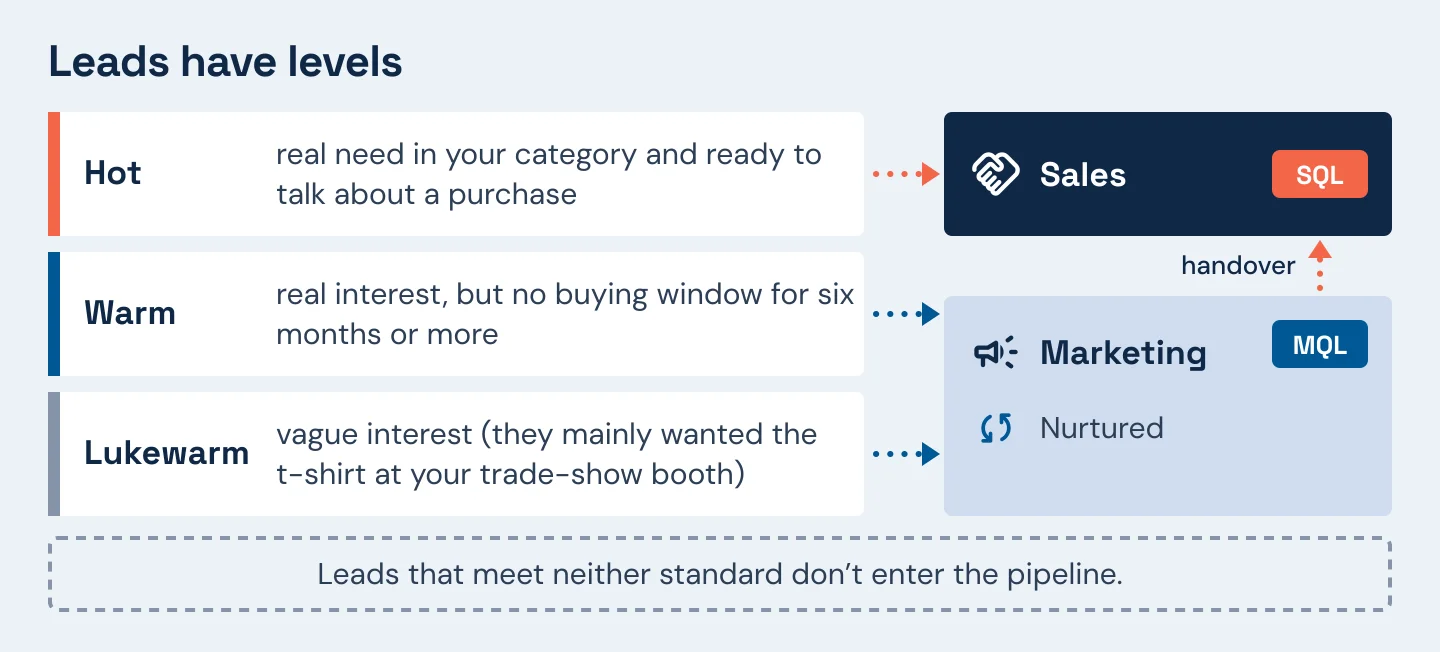
Leads have levels
Agreement becomes much easier once both sides accept that qualification has several levels:
- Lukewarm — vague interest (they mainly wanted the t-shirt at your trade-show booth).
- Warm — real interest, but no buying window for six months or more.
- Hot — real need in your category and ready to talk about a purchase.
Hot leads go straight to Sales. Traditionally, the rest sat in a no-man's-land between departments and went nowhere. The fix is to classify every lead, so none falls through the gap:
- Leads not yet ready for Sales stay with Marketing and are nurtured until they meet the standard both teams agreed. Those are marketing-qualified leads (MQLs).
- Leads Sales vets and agrees to pursue become sales-qualified leads (SQLs).
- Leads that meet neither standard don't enter the pipeline.
Inbound and outbound
This applies to outbound too. Inside sales reps generate leads by calling, emailing and engaging prospects on social media. Some aren't ready to buy — those should also be handed to Marketing for nurturing rather than dropped.
Marketing support through to the close
Just as naval artillery supports the infantry until the beachhead is secure, Marketing can support Sales through every opportunity stage right up to the close.
Sit down together and decide which collateral reps need at each stage. Every stage should add value that moves the deal forward — and Marketing can supply much of that value.
Example: at the proposal stage of a fleet-leasing deal, reps share Marketing-produced materials with decision-makers — showing the benefits of leasing from you beyond price. Case studies, video testimonials, slide decks and written materials are all on the table. Map this content to each stage so reps can always find and use it.
The modern approach
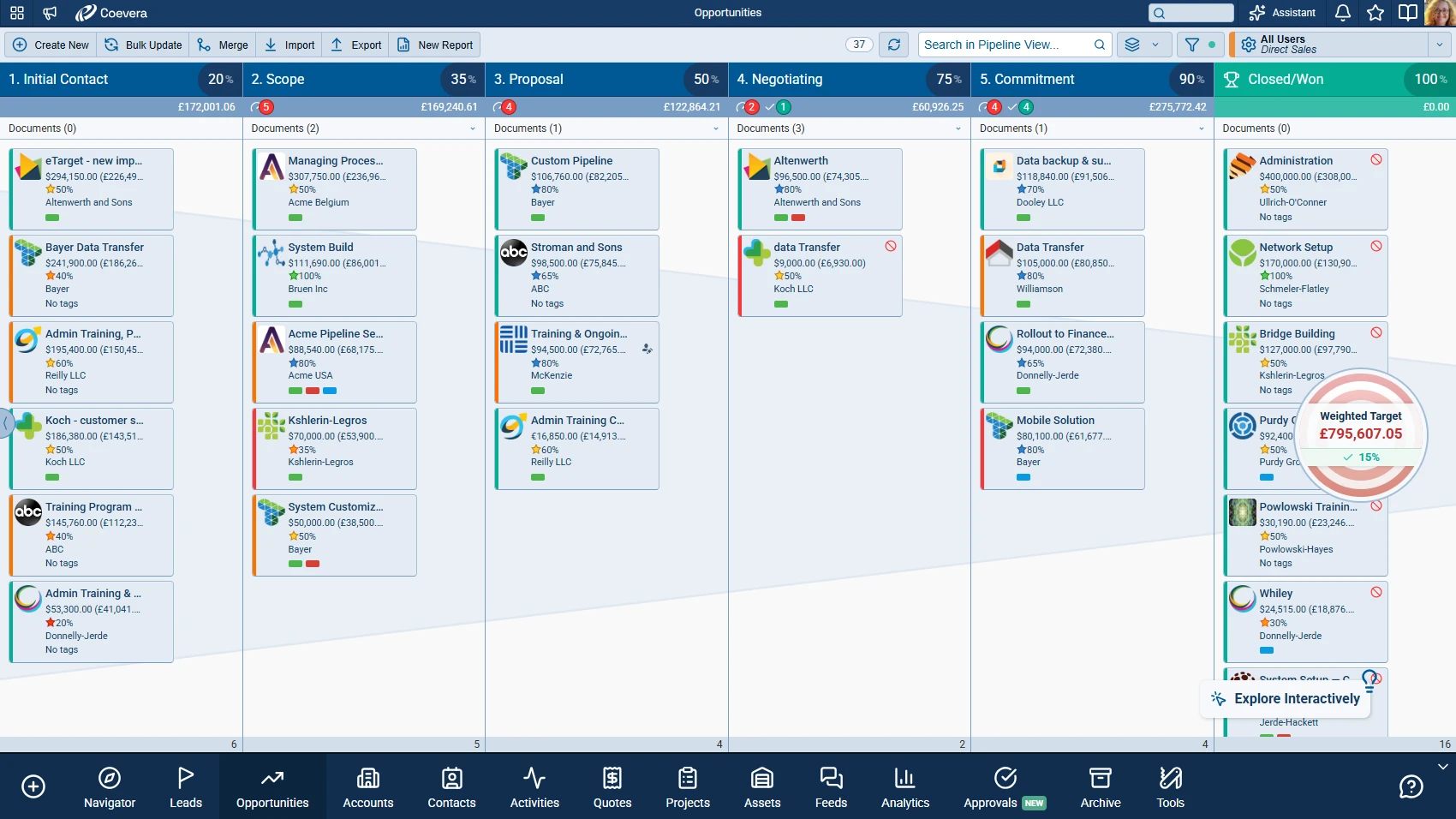
The market has long recognized this convergence: CRM vendors have bought marketing-automation companies, and marketing-automation vendors have launched their own CRMs. If your CRM doesn't include marketing features, integrate it with marketing automation so marketing is embedded in the sales process. Coevera integrates with many leading marketing automation tools.
The era of Sales and Marketing living in separate worlds must end. Marketing is not the enemy — so stop the friendly fire. Use Marketing's full power for lead nurturing and at every stage of the pipeline, and win your battles with coordinated campaigns.
Next in the series: To Win Battles, You Need Great Intel.
Adapted from the Coevera e-book Leading from the War Room: Building a Battle-Ready Sales Force by Nikolaus Kimla. Download the full e-book at coevera.com.