Coevera vs Pipedrive comes down to team size and sales motion. Both center on a visual pipeline but diverge on AI, total cost of ownership, and implementation. Coevera wins for B2B sales organizations of 15 to 2,500 sellers that need agentic AI, embedded coaching, and a lower total cost of ownership once tier upcharges and admin overhead are counted. Pipedrive wins for teams under 10 reps wanting the simplest Kanban.
Coevera vs Pipedrive at a glance
| Feature | Coevera | Pipedrive |
|---|---|---|
| Pipeline views | Kanban, list, chart, bubble, map (5) | Kanban + deal list (no chart, bubble, or map) |
| AI model | Voyager 2 — agentic, approval-based autonomy | AI Sales Assistant — assistive |
| Embedded coaching | Yes — 1,600+ Sales POP! episodes | No |
| Implementation time | four weeks | Days to weeks |
| Required admin FTEs | Zero full-time | May need part-time admin support as the team grows |
| Integrations | 200+ native + open API/webhook | 500+ marketplace |
| Pricing approach | Assistive AI included on every tier; agentic AI as an add-on | Tiered; baseline AI on all plans, advanced AI tools on higher tiers |
| Sweet spot team size | 15–2,500 sellers | 1–10 reps |
How the two visual pipelines actually differ
Both products put a drag-and-drop Kanban at the heart of the CRM, which is why they show up on the same shortlists. The difference is depth.
Pipedrive's pipeline is deliberately minimal: a Kanban board and a deal list, designed so a new rep can move a deal between stages in two clicks and never think about configuration. That restraint is a real strength for a small team that doesn't need more than a board and a list.
Coevera gives you five views of the same pipeline — Kanban, list, chart, bubble, and map. A sales leader can move from rep-level deal activity, to a chart of pipeline by stage, to a bubble view weighted by deal size, to a map of territory coverage, without leaving the page or building a separate dashboard. For a 25-rep team running weekly pipeline reviews and territory planning in the same session, that removes the toggling between disconnected reports.
The trade-off: if your team only needs a board and a list, Pipedrive's focus is a feature, not a limitation. Coevera's added chart, bubble, and map views matter once you have enough reps and territory complexity that a board and list stop telling the whole story.
AI: assistive (Pipedrive) vs agentic (Coevera Voyager 2)
This is the largest functional gap between the two in 2026.
Pipedrive's AI Sales Assistant is assistive. It surfaces deals at risk, suggests next actions, and helps draft emails. The rep accepts or ignores the suggestion. It's useful, and like most assistive layers, the reasoning behind a suggestion is largely hidden — the recommendation appears, and you take it on trust.
Coevera's Voyager 2 is agentic, built on what Coevera calls approval-based autonomy. Instead of a generic "AI suggestion," picture a rep heading into a plant visit: Voyager preps the call brief — pulling the account's order history, open quotes, and last call notes — and shows you exactly which sources it drew from before the rep walks in. When you correct what it surfaced, it learns from the correction. A Super Agent coordinates the other agents across deals, and a real-time sales assistant draws on the 1,600+ Sales POP! episode library to surface coaching inside the deal.
Plenty of CRMs now ship AI agents — that's no longer rare. What's different here is the transparency: Voyager 2 shows which sources it pulled from and asks before it acts, rather than operating as a black box. For a team that wants AI to take real work off reps without losing visibility into how decisions get made, that distinction is the whole point.
What does each cost over 3 years?
Sticker price and total cost of ownership are different numbers, and the gap between them is where most CRM budgets break.
Pipedrive's published pricing in 2026 spans several tiers, with baseline AI features now included on all plans and more advanced AI tools and reporting unlocking as you move up. The headline entry-tier per-seat number is reasonable; the real cost climbs as you add the tiers that bring in the deeper automation, security, and reporting, plus any admin time once the team grows.
Coevera makes Voyager AI available on every tier — the assistive layer included, the agentic Voyager 2 as an add-on — rather than gating AI to an enterprise plan, and the architecture is built to run without a full-time admin. On a 3-year TCO basis, its advantage comes from structure rather than a discount: as a team grows, the factors that widen or close the gap are each vendor's tier upcharges, add-ons, and admin time. Run the comparison with your own rep count and tiers, checking Coevera's pricing against Pipedrive's live pricing page.
See the 3-year math for your team
Start a free trial and run your own reps, tiers, and admin time through the comparison — assistive Voyager AI included on every tier, no credit card required.
Start free trial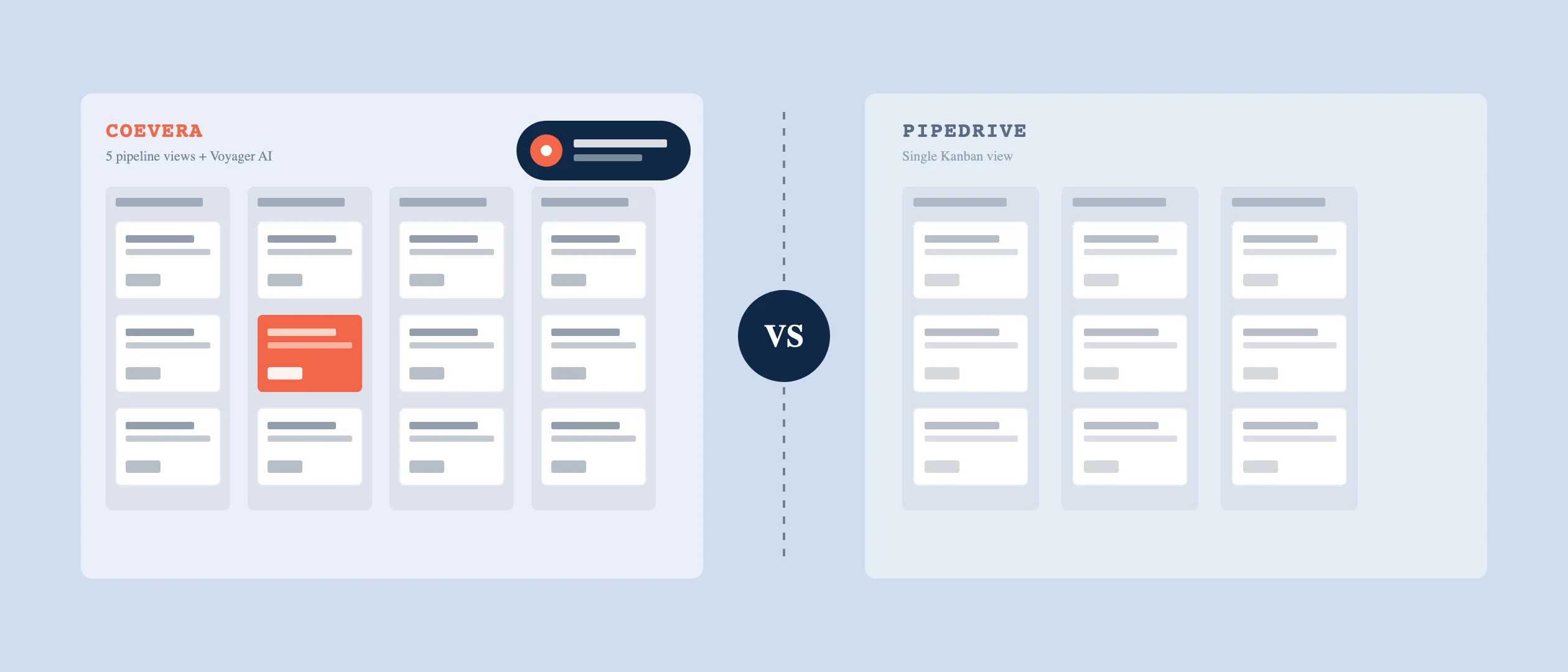
How long does each take to implement?
Both are fast at the small end. A handful of reps can be productive on Pipedrive in days, and Coevera moves quickly too.
Coevera's full implementation — data migration, pipeline configuration, and integration setup — runs four weeks, with no full-time admin required afterward and roughly two hours to onboard each new user. The differentiator isn't raw speed for a 5-person team; it's that Coevera holds that speed and that low-admin model as you scale into the hundreds of sellers, where Pipedrive customers may start needing part-time CRM admin support to manage configuration and reporting.
How do the integration ecosystems compare?
Pipedrive's marketplace lists 500+ integrations and is broader on long-tail third-party SaaS apps. If your stack is mostly SaaS productivity tools, that breadth is a real advantage.
Coevera offers 200+ native integrations plus an open API and webhook architecture, weighted toward enterprise and back-office systems — ERP, calling, calendar, document management — rather than the long tail of consumer SaaS. For a B2B team whose stack includes back-office platforms or custom internal systems, that open architecture tends to be the better fit. For a team that just needs to connect a dozen popular SaaS apps, Pipedrive's marketplace wins on sheer count.
Who should pick Pipedrive
Pipedrive is the right call if your team is under 10 reps and your sales motion is high-velocity and transactional — short cycles, light quoting, fast turnover of deals. You don't need agentic AI, and your stack is mostly SaaS apps you'll wire up through the marketplace. You're buying simplicity on purpose, and Pipedrive delivers it.
Who should pick Coevera
Coevera is the right call if you run a B2B sales organization of 15 to 2,500 sellers, you want agentic AI without paying enterprise-tier pricing, you need multi-view pipeline analysis for forecasting and territory planning, you want embedded sales coaching through The Collaborator, and your 3-year TCO matters more than the month-one sticker price — especially if you run longer, considered B2B cycles like capital equipment, multi-stakeholder quotes, or territory-based field sales, where deal history and forecasting depth matter more than raw speed.
How to migrate from Pipedrive to Coevera
Coevera's migration team handles the field mapping — deals, contacts, activities, notes, custom fields, and automations — and rebuilds your pipelines and integrations before day one. The part most teams actually worry about is history: years of closed-deal records and the custom fields your forecast depends on. Those migrate too, mapped one-to-one so your reporting baseline and historical pipeline stay intact rather than resetting to zero on launch day. Most Pipedrive-to-Coevera migrations are fully operational within four weeks, with the configuration matched to your existing sales process.