Every CRM now claims to have AI. The useful question is not whether a tool has AI, but what job it does and whether it shows its work. The best AI sales tools for your CRM fall into a few clear groups: assistants built into the CRM, conversation intelligence, forecasting, and prospecting or enrichment. Pick by the job you need done, not by the loudest demo. This is the practical tool list. For the concepts behind it, see our complete guide to AI in CRM.
The best AI sales tools for your CRM in 2026 depend on the job. For built-in AI, Coevera Voyager leads with agentic help that asks before it acts, alongside Salesforce Einstein, HubSpot Breeze, and Zoho Zia. For conversation intelligence, Gong is the standard. For forecasting, Clari. For prospecting and enrichment, Apollo and Clay. For email coaching, Lavender. The full ranking, with pricing and who each fits, is below.
How to choose AI sales tools
Answer two questions first. What job do you need done: drafting and summarizing (assistant), understanding calls (conversation intelligence), predicting the quarter (forecasting), or finding and updating contacts (prospecting and enrichment)? And do you want it built into your CRM or bolted on? Built-in AI is easiest to adopt because it lives where reps already work. A specialized add-on goes deeper on one job but adds cost and another login. Either way, favor tools that show their reasoning, because AI you cannot check is AI you cannot trust.
Best AI sales tools at a glance
Pricing is directional and was checked in July 2026. Per-user prices are annual-billing rates unless noted, and several enterprise tools are quote-based. Watch the tier the AI sits on, not just the entry price. Confirm on each vendor's live pricing page before you buy.
| Tool | Type | Best for | Pricing |
|---|---|---|---|
| Coevera Voyager | Built-in | Agentic CRM AI | Included, plus agentic add-on |
| Salesforce Einstein / Agentforce | Built-in | Enterprise AI and agents | Enterprise; Agentforce 1 Sales ~$550/user/mo |
| HubSpot Breeze | Built-in | AI for HubSpot teams | Assistant in every tier; agents gated by plan, plus AI credits |
| Zoho Zia | Built-in | Value AI | CRM from ~$14/user/mo; Zia AI on higher paid tiers |
| Gong | Add-on | Conversation intelligence | Custom (enterprise) |
| Clari | Add-on | Forecasting and revenue | Custom (est. $100+/user/mo) |
| Apollo | Add-on | Prospecting and enrichment | Free; from ~$49/user/mo |
| Clay | Add-on | Enrichment and research | Free; from ~$185/mo |
| Lavender | Add-on | Email coaching | Free; from ~$27/mo |
| Outreach | Add-on | Sales engagement | Custom (est. $100-140/user/mo) |
How we evaluated
We scored each tool on the job it does best, how well it works with a CRM, transparency (whether it shows its reasoning), and cost. The list mixes built-in CRM AI, which is easiest to adopt, with specialized add-ons that go deeper on a single job. Order reflects fit for mid-market B2B teams, but each entry says exactly who it suits. Coevera publishes this guide and ranks its own product first, so check the figures yourself. Every price and capability below is taken from the vendor's own public pages, and we hold Voyager to the same criteria and the same sourcing standard as every other tool listed.
1. Coevera Voyager: best built-in CRM AI
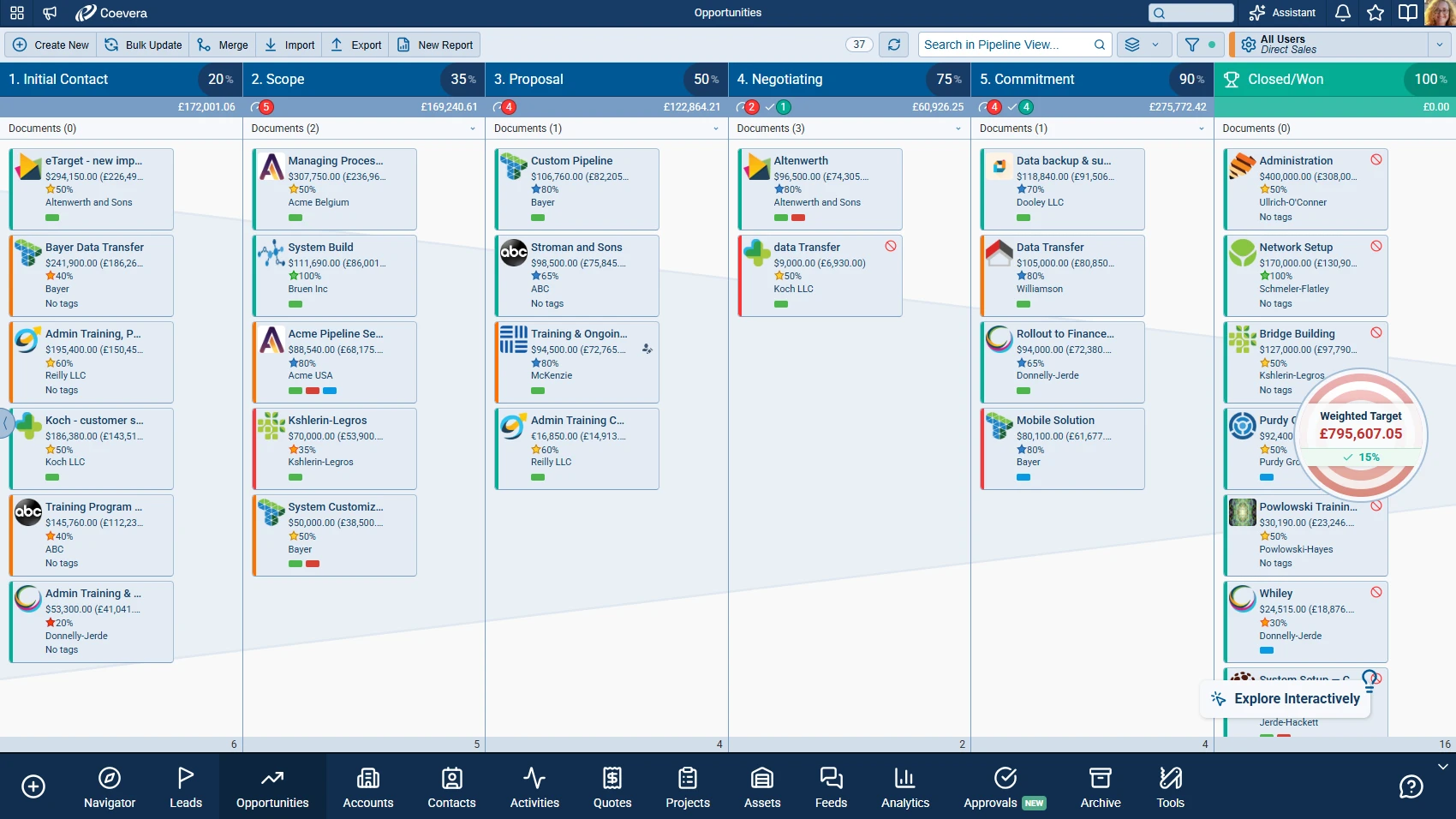
Voyager is Coevera's built-in AI, and it leads because it pairs capability with transparency. Voyager 1 gives every plan free assistive help like email drafts and call and opportunity summaries. Voyager 2 adds agentic help: call preparation, contextual guidance, report creation, automations and forms, and a real-time assistant drawn from more than 1,500 Sales POP! episodes. Coevera builds Voyager around approval-based autonomy: it shows its reasoning, asks before it acts, and learns when you correct it. Plenty of tools on this list ship AI agents, so the question to ask any of them is the same one we ask of ourselves — can you see how it reached the answer, and can a rep overrule it?
Where it fits: B2B teams that want agentic AI inside the CRM without an enterprise contract. Watch-outs: the agentic tier is a paid add-on. Coevera starts around $85 per user per month billed annually, with a 14-day free trial. See the product tour and the pricing page.
2. Salesforce Einstein and Agentforce: best for enterprise
Salesforce pairs Einstein's predictive AI with Agentforce autonomous agents, giving large teams deep, customizable AI across the platform. The trade-off is cost and complexity.
Where it fits: enterprises already on Salesforce with admins to configure it. Watch-outs: the most capable AI sits at high tiers, with the Agentforce 1 Sales edition at about $550 per user per month billed annually, as of July 2026. Budget for setup and admin time.
3. HubSpot Breeze: best for HubSpot teams
Breeze is HubSpot's AI layer, spanning an assistant for content and research and autonomous agents for prospecting. It works cleanly for teams already living in HubSpot.
Where it fits: teams on HubSpot that want AI in the same workspace. Watch-outs: the assistant and embedded AI features come with every edition, including the free one, but the agents are gated by plan — prospecting and data agents from Starter, customer agent from Professional, and the full set only on Enterprise. Agents are also metered on HubSpot Credits, so usage adds cost on top of the seat. Paid plans list at $20 per seat per month, with a promotional rate of $7 showing as of July 2026.
4. Zoho Zia: best value built-in AI
Zia is Zoho CRM's AI, with prediction, lead and deal scoring, an assistant, and Zia Agent Studio for building your own agents. It is the most affordable way to get built-in AI, provided you buy the right tier.
Where it fits: budget-conscious teams and current Zoho users. Watch-outs: the AI is not in the entry plan. Zoho CRM starts around $14 per user per month billed annually, but Zia's prediction, scoring, and Ask Zia assistant are not included at that entry price. The tier each Zia capability requires varies, so check Zoho's current edition comparison before you budget.
5. Gong: best for conversation intelligence
Gong records and analyzes sales calls and emails, then surfaces deal risks, next steps, and coaching insights. It is the category standard for understanding what actually happens in conversations.
Where it fits: teams that want to coach reps and de-risk deals from real call data. Watch-outs: pricing is quote-based and enterprise-oriented, with per-seat licenses plus a platform fee based on the number of users supported, so total cost runs high. Ask for all-in pricing before you commit.
6. Clari: best for forecasting and revenue
Clari focuses on forecasting and pipeline inspection, with a Copilot module for conversation intelligence. It gives revenue leaders a clearer read on the quarter. Clari completed a merger with Salesloft in December 2025, so engagement features are joining the platform.
Where it fits: RevOps and sales leaders who need forecasting rigor. Watch-outs: pricing is custom and modular; third-party estimates run about $100 or more per user per month for the core platform, as of July 2026, and higher with add-ons.
7. Apollo: best for prospecting and enrichment
Apollo combines a large contact database (230 million-plus verified contacts as of July 2026) with AI email writing and CRM enrichment, so reps can find, contact, and update prospects in one place. It has a usable free plan.
Where it fits: outbound teams that want prospecting and enrichment together. Watch-outs: credits and add-ons can raise the real cost. Paid plans start around $49 per user per month, with Professional at $99 billed monthly, as of July 2026.
8. Clay: best for enrichment and research
Clay pulls data from many providers in a single "waterfall" and adds Claygent, an AI research agent that gathers information the databases miss. It is powerful for building enriched, up-to-date lists that sync to your CRM.
Where it fits: RevOps and growth teams that want deep, automated enrichment. Watch-outs: pricing is credit-based rather than per seat, which takes planning. Plans run free, then around $185 per month (Launch) and $495 (Growth), with annual billing about ten percent lower.
9. Lavender: best for email coaching
Lavender scores sales emails in real time and suggests improvements as you write, with an AI writer and personalization prompts. It helps reps write emails people actually answer.
Where it fits: reps and teams that want to lift email reply rates. Watch-outs: it coaches email specifically, not the whole deal. A free plan covers five emails a month, with paid plans from $27 per month billed annually ($29 monthly) and team plans at $89 per seat per month billed annually ($99 monthly), as of July 2026.
10. Outreach: best for sales engagement
Outreach runs multi-step outbound sequences with AI for timing, content, and deal and forecast insights. It suits high-volume teams that live in a sequencing tool.
Where it fits: SDR-heavy teams that want AI woven into engagement. Watch-outs: pricing is quote-based and enterprise-oriented, combining seat-based access with consumption-based AI credits; third-party estimates put it roughly at $100 to $140 per user per month before add-ons, as of July 2026.
How to build your AI stack
You do not need ten tools. Start with the AI already in your CRM, because it is the easiest to adopt and often covers the basics. Then add one specialized tool for your biggest gap, whether that is call insight, forecasting, or enrichment. Pilot it against a real problem for a few weeks, measure whether it saves time or just adds noise, and insist on seeing how it reaches its recommendations before you trust it with a deal.