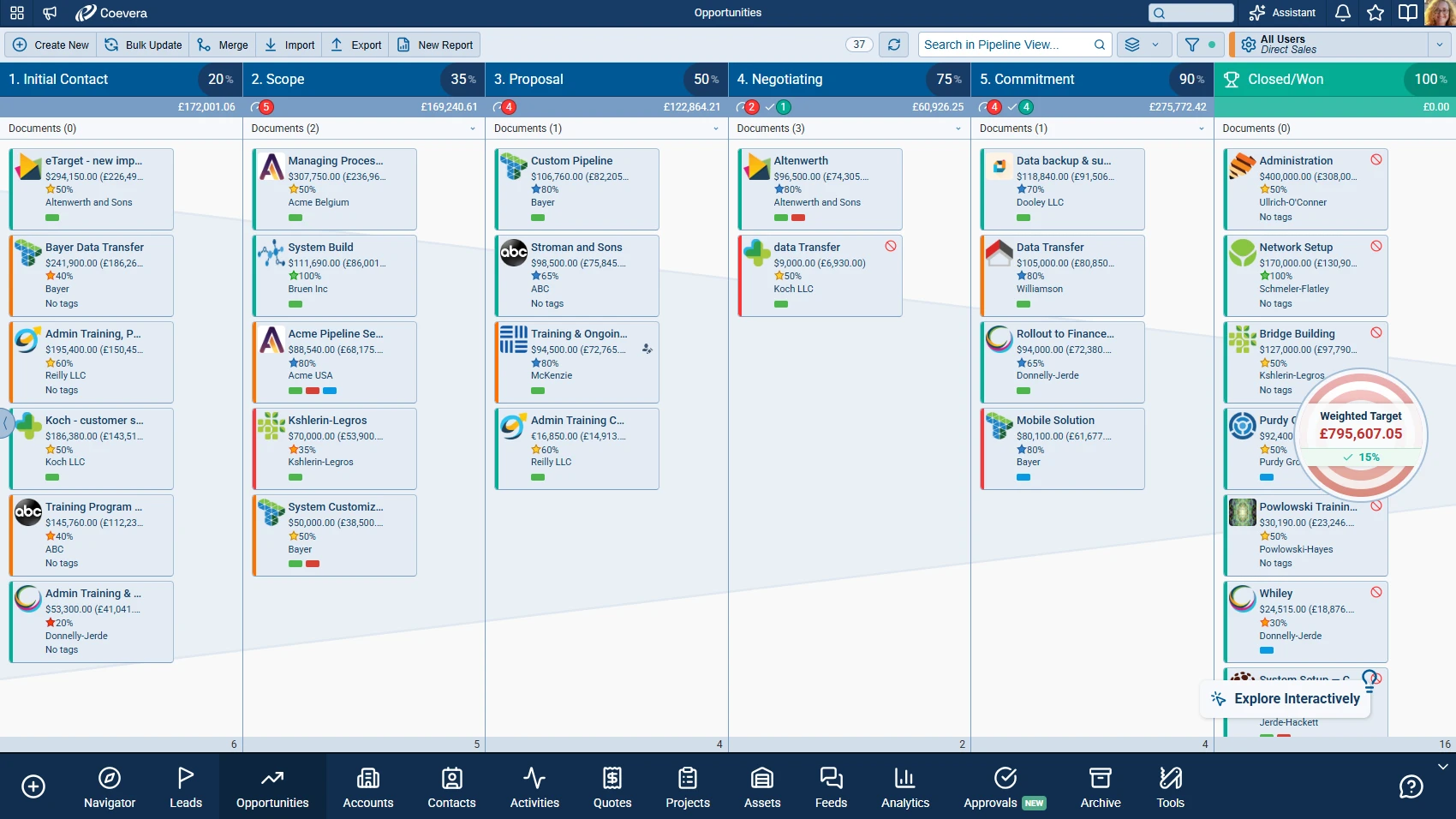
Sales forecasting is a crucial process for businesses to predict future sales and revenue. However, it can be challenging to accurately forecast sales, especially when relying on subjective evaluations and historical data. Subjective evaluations are based on personal opinions or perceptions, which can be biased and lead to inaccurate forecasts. Historical data, on the other hand, may not always provide an accurate representation of future sales trends as market conditions and consumer behavior can change over time.
To overcome these challenges, businesses can utilize the right tools and methodology to make sales forecasting a more objective and measurable process. One such tool is the use of data analytics and machine learning algorithms to analyze large amounts of historical sales data, identify patterns and trends, and make more accurate sales predictions. By leveraging data-driven insights, businesses can make more informed decisions about sales strategies, inventory management, and resource allocation.
In addition to data analytics, businesses can also use a variety of forecasting methods such as quantitative and qualitative techniques. Quantitative methods involve statistical analysis and mathematical models to forecast future sales based on historical data. Qualitative methods, on the other hand, rely on expert opinions and market research to predict future sales trends. By combining both quantitative and qualitative methods, businesses can gain a more comprehensive understanding of their sales forecast and make more accurate predictions.
Overall, sales forecasting can be a complex and challenging process, but with the right tools and methodology, businesses can make more informed decisions about their sales strategies and resource allocation. By embracing data analytics and combining different forecasting methods, businesses can make sales forecasting a more objective and measurable process.
In practice: rather than gut feel, the article points to concrete deal-health signals a CRM can read — low engagement, a slipping closing date, value decrease, missed tasks, lack of follow-up and declining rep rankings — as the early-warning markers that a deal is quietly at risk.
Here are five tips for improving sales forecasting:
1. Use a CRM tool that incorporates measurable factors: Traditional CRM tools may not be equipped to handle the complexity of sales forecasting. Look for a CRM tool that incorporates measurable factors such as low engagement, closing date, and value decrease.
2. Involve all stakeholders in the process: Make sure to involve all stakeholders in the forecasting process, including sales reps, managers, and executives. This will ensure that crucial metrics are not missed and that everyone takes ownership and responsibility for their forecasting.
3. Incorporate automation for tracking activities: Automation can help track activities and provide objective metrics to assess the health of a deal. Look for a CRM tool that automates the tracking of sales activities.
4. Evaluate the underlying activities and processes: Pay attention to warning signs such as missed tasks, lack of follow-up, and decreasing rankings from sales reps. These can be indicators of a deal that is at risk.
5. Don’t rely solely on historical data: While historical data is important, it should not be the only factor considered. Evaluate the health of a deal and decide whether to include it in the forecast.
By following these tips, you can improve your sales forecasting and achieve better business outcomes. Consider using a comprehensive tool like Coevera, which incorporates all of these factors and offers a more scientific approach to forecasting.
For an in-depth exploration of Forecasting, watch this webinar replay hosted by Don Araldi, a veteran sales leader, and forecasting expert:
 play_arrow