Our previous article acted as an introduction to a new series on the subject of mega-threats to the sales industry. The series is inspired by the fascinating bestselling book by Nouriel Roubini entitled MegaThtreats: 10 Dangerous Trends that Imperil Our Future, and How to Survive Them.
Let’s examine the first mega-threat—which deals with the salespeople themselves.
The Mega-Change
A little less than 11 years ago, when I first transferred my business from Austria to the U.S., I discovered an excellent book entitled To Sell Is Human: The Surprising Truth about Moving Others by Daniel Pink. I happened to refer back to it while researching this article, and was startled by how much has changed since the book was published. Many factors addressed in the book are no longer relevant, mainly due to the incredible advance of technology.
Some amazing statistics about the adoption of technology appeared in a recent article I was reading. Facebook and other social media technologies took approximately a year to be adopted by 1 million users. But how long did 1 million users in the current culture take to adopt the artificial intelligence chatbot ChatGPT? Five days. That is quite an incredible escalation in adoption time!
This rapid adoption reflects not just excitement but a broader shift in how people are interacting with technology—especially when it comes to information access and content creation. Generative AI is now shaping how we search, write, and even make decisions. If you’re curious how this trend compares across platforms, you can read more about DeepSeek vs. ChatGPT vs. AI Overviews here.
In his book, Daniel Pink takes a quote from the famous play Death of a Salesman by Arthur Miller. The quote is in a scene where one of the characters says to Willie Loman, the “salesman” of the title: “The only thing you got in this world is what you can sell. And the funny thing is that you’re a salesman, and you don’t know that.” This quote serves to show how important a real salesperson is—or at least once was.
Salespeople were certainly important in 2012 when To Sell Is Human was published. Pink cited the U.S. Bureau of Labor Statistics in the book—sales had almost 15 percent of the U.S. workforce, and manufacturing had 12 percent. Today we can see that in this $2 trillion U.S. economy, these two figures are very likely to switch, with factory workers occupying a much larger portion of the labor force.
In his book, Pink brings up the case of the software company Atlassian, developer of the issue-tracking product Jira that we use in development at Coevera. Atlassian claims to have collected around $100 million in sales without a single salesperson. Pink asked Atlassian CEO Mike Cannon-Brooks how that was possible, and Cannon-Brooks replied that, in a way, everyone in the company is a salesperson. That is also no longer true.
We are, in short, in the middle of the most significant change in history. And yes, this is a mega-threat for salespeople.
The Spread of Specialization
However, I don’t want to be a spreader of doom and gloom, claiming that sales jobs will be no more. I want to take a few steps back and point out that the real issue is that we won’t have enough people who really know how to sell, based on the direction businesses have been taking with their sales teams for the last few years. This trend follows the direction of many other industries—there are only specialists that are knowledgeable in one specific aspect of their profession.
Let’s take an example from another field, medicine. When I was a child, the role of general practitioner was very common, but today is practically nonexistent. Over hundreds of years, the GP delivered correct diagnoses and truly helped people. Today, a patient must run from one expert to another.
Is this a positive change? I don’t believe it is. I understand the need for an expert when it comes to a major organ transplant, such as a heart, kidney or long. But the professional that could make a holistic diagnosis is practically no longer with us.
A similar trend in sales has occurred within the last decade, and today it has reached an extreme. There is the SDR—the Sales Development Rep—which warms up leads for sales reps. There is the customer success rep, which focuses on existing customers. There are appointment setters, product presentation specialists, and many others. The real profession of being able to view sales holistically is fading away.
Worth knowing: The author cites software company Atlassian, maker of Jira, collecting around $100 million in sales without a single salesperson — its CEO explaining that, in a way, everyone in the company sells — though the author argues even that is no longer true today.
A Genuine Salesperson
Bringing a deal to fruition requires a holistic salesperson. One of my core principles is that a good sales contract, at the end of the day, hurts both sides just a little bit—not too much on one side or the other, but just a little bit on both. This is the very definition of fairness.
A seller shouldn’t attempt to crush a buyer like a lemon, and the buyer should not try to get the salesperson to lower the price by denigrating the product being sold. Criticism of such behavior goes back thousands of years and can even be found in the book of Proverbs in the Bible.
A genuine salesperson is honest and ethical. The most crucial aspect of working with people is how you communicate and collaborate. In today’s world, we often meet someone twice. If you’ve treated them well the first time, that reputation will benefit you the second time. The opposite is also true—if you didn’t treat them well that first time, the second time your reputation will precede you and cause an adverse reaction.
You cannot learn ethical behavior straight from a book. Much of it must be learned through life experience.
As an example, a sales career attracts many who desire a job with freedom, in which they can set their own rules and hours. But freedom has a flip side, which is responsibility. One cannot exist without the other.
One characteristic a salesperson must possess is a calm demeanor—a “cool head.” When someone gets impatient or “hotheaded,” they often make wrong decisions and ruin a deal.
Another characteristic required is the fortitude to be brave. They must be courageous enough to make a good deal and confidently ask for the close. Such a thing isn’t done out of fear—the salesperson is creating a better future where none currently exists for both themselves and the customer.
All salespeople should demonstrate the quality of trust. This characteristic is vital within a company, especially when selling to prospects.
AI Replacing Salespeople?
According to some, especially sales automation software vendors, salespeople will eventually be completely replaced by AI. AI is better and faster. If AI also replaces buyers, then there will only be machines talking to each other one day.
Unfortunately—or fortunately—AI could never replace a real salesperson. AI cannot differentiate between the different shades of emotion. A machine cannot establish a long-term relationship—for example, recognize that a particular buyer might be a real ambassador, advocate, or door opener for the seller’s product, and therefore should be given a special price.
Social intelligence and ethical qualities such as these cannot be “programmed.” And if they could be, who should do so? The programmer could be biased in one way or another or require real education in dealing with buyers.
Let AI assist real selling, not replace it
Coevera puts AI to work for genuine salespeople, not against them. Start a free trial and see how Voyager AI and the Automatizer handle busywork so you can focus on running deals end to end — no credit card required.
Start free trial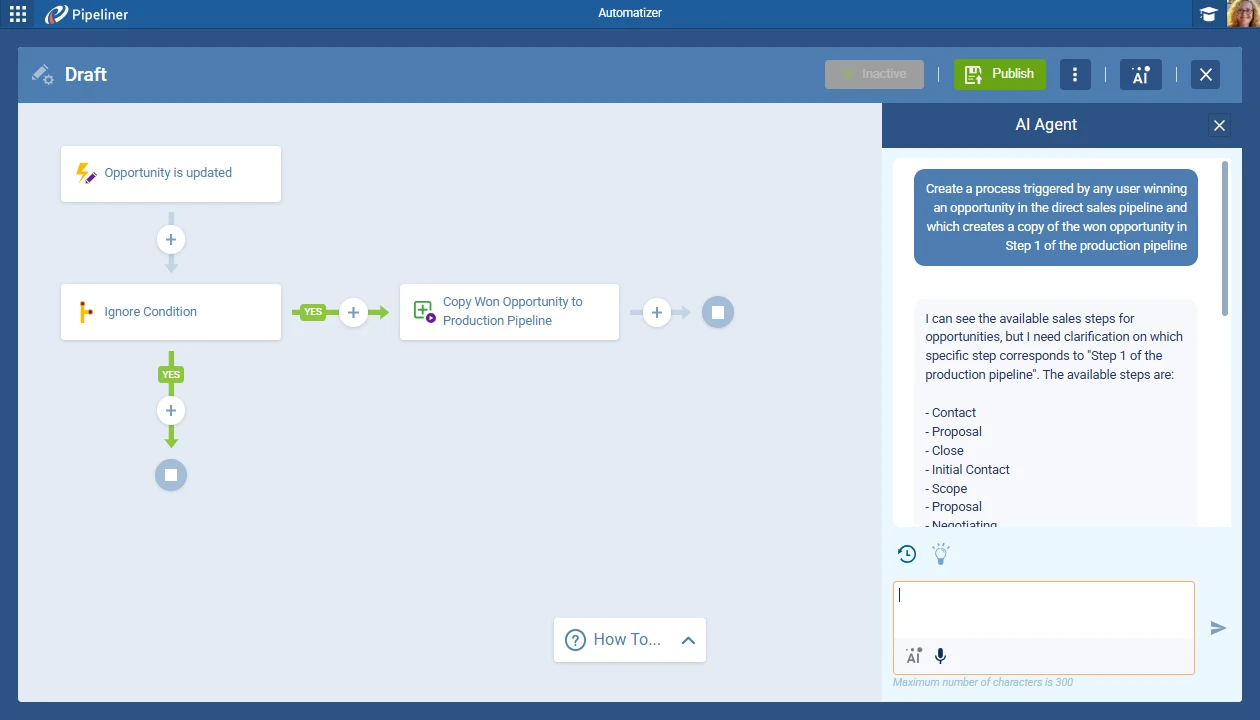
Educating Salespeople
Education of a genuine salesperson cannot be done overnight. It took us hundreds and thousands of years to realize that true sales has a life component. For example, a salesperson could sell a piece of jewelry to someone as an anniversary gift for their spouse. The buyer has a limited budget but has been married for 20 years and wants something special. The salesperson would need to take the time and care to show the customer some real possibilities that yet fit within the customer’s budget.
This skill set includes the perception of emotional nuances, which cannot be taught when the sales job is sliced into five different segments. The person might be great at their one little specialty but wouldn’t know how to get in front of a person, begin a sales cycle, and run it all the way through. Or, in a B2B setting, such a person could never walk into a room full of people they’ve never met, contacted, or address them. They don’t know how to relate and be authentic.
The Sales Machine
Specialization has resulted in a lack of training of today’s up-and-coming salespeople. They will emerge into the business world as mere machines—appointment setters, product presenters, or customer success reps. But no one looks at a prospect and sees the potential from start to finish. And I see that as a mega-threat.
The mechanical approach compares to a bureaucracy in that it is rule-based and very cold. I have recently been in Europe. When I was leaving, I had to go through the airport at Frankfurt. There are no longer human passport controls—it’s all mechanized. You place your passport on a scanner and then have to stand in a precise position so that your face can be scanned to match up to your passport. In such a situation, there is no in-between. Either you’re in, or you’re out. You can’t approach the station and say, “Oops, wait, I forgot something.” Or, “Oh, this picture is old.” You either make it, or you don’t.
My fear is that this is the direction sales is heading today—knowledge of real sales is fading away.
Management of Accounts
It’s not lost on me that when a company has many customers, one may require the care of support. A continuing customer may need to be regularly contacted by customer success so that the company can remain in contact with them. But when a company has major accounts, the real salespeople take care of them through building and continuing relationships.
Another skill disappearing from enterprises is real account management. In today’s business, the ultimate goal is only “growth, growth, growth!” until there are hundreds or thousands of customers and a customer becomes only a number that is no longer cared for.
We have experienced this right here at Coevera. We were customers for several different services for five or six years and then decided to change. When we did, nobody called from the companies we left behind. It was like no one even noticed. In the old days, when you brought a company in the area of $100,000 over five years, you would be important to them. They would contact you to find out why you were leaving and see what they could do about it. But no longer.
Restore Real Sales!
To sum up, a mega-threat to sales is the vanishing of genuine, authentic selling. As young salespeople enter their careers, they should be educated as relationship-forming true salespeople.
I will continue to explore this topic and examine possible solutions. Stay with me!