Do you have a team of sales representatives, a huge base of prospective customers, and an excellent product, but the sales results aren’t going as expected? Many businesses encounter this kind of situation across industries.
It’s not about the product or the professionalism of your sales team; it’s more about the optimization of sales processes. This article provides some hints on how you can improve your sales approaches and what tools can help you with that.
What is the sales process lifecycle?
We usually imagine sales as a one-time event that occurs either in a physical location or an online store. However, many preparatory steps and behind-the-scenes operations precede the actual sales deal.
In the digital environment, a sales process lifecycle is known simply as a sales cycle. It implies a set of steps to take in order to find prospects and convert them into paying customers.
Here’s a breakdown of the common stages in the sales process lifecycle:
- Prospecting. Perform market research to develop your ideal customer profile and decide where you can find and reach them.
- Qualifying. Assess leads and think whether they make a good fit for you. To qualify your potential customers, you need to understand their current needs and how much money they are ready to spend.
- Product presentation. Companies usually offer demo sessions to present products to their leads. At this stage, potential buyers get acquainted with the value proposition and tailor it to their current needs.
- Pre-sale. When prospects are really interested in your product, they might ask additional questions before making an actual purchase.
- Closing the deal. When a buying decision is made, you need to be clear about further instructions on the product use and maintenance.
- Post-sales and customer retention. Building a progressive relationship with the customer is necessary for ensuring ongoing purchases and business referrals.
The specific stages and their order can vary depending on the industry, product complexity, and sales methodology used. However, such classification of sales funnel stages helps salespeople to organize their workflows properly and optimize the processes full of roadblocks.
Why is it necessary to improve sales processes?
Refining your sales process is necessary for several reasons. The first and most important one is standardizing all sales procedures. When every employee knows what and how to promote, it’s a good starting point.
Secondly, a well-structured sales process helps identify and nurture leads more effectively. This results in higher conversion rates as prospects are more likely to move through the sales funnel when everything is clear.
Improved sales processes also result in better data analytics and tracking. Businesses can derive customer behavior patterns, sales trends, and process bottlenecks.
Overall, improving sales processes helps businesses achieve more predictable and stable revenue streams. Deliberate sales efforts assist advanced forecasting and planning, which is crucial for sustained growth.
Strategies for sales optimization
It’s obvious that regular review and improvement of sales processes are inevitable for business growth. So, here, we’d like to present some of the effective strategies for optimizing your sales approaches.
1. Collect data
CRM systems are the most popular solutions, helping to collect all the necessary data about prospects and sales representatives’ actions. Keeping all these data in the same system is necessary for understanding your target audience.
You might think that small businesses in the manufacturing industry are your potential customers, but collecting and analyzing data about your prospects and sales deals might reveal that your target customers are mid-size companies in the logistics sector.
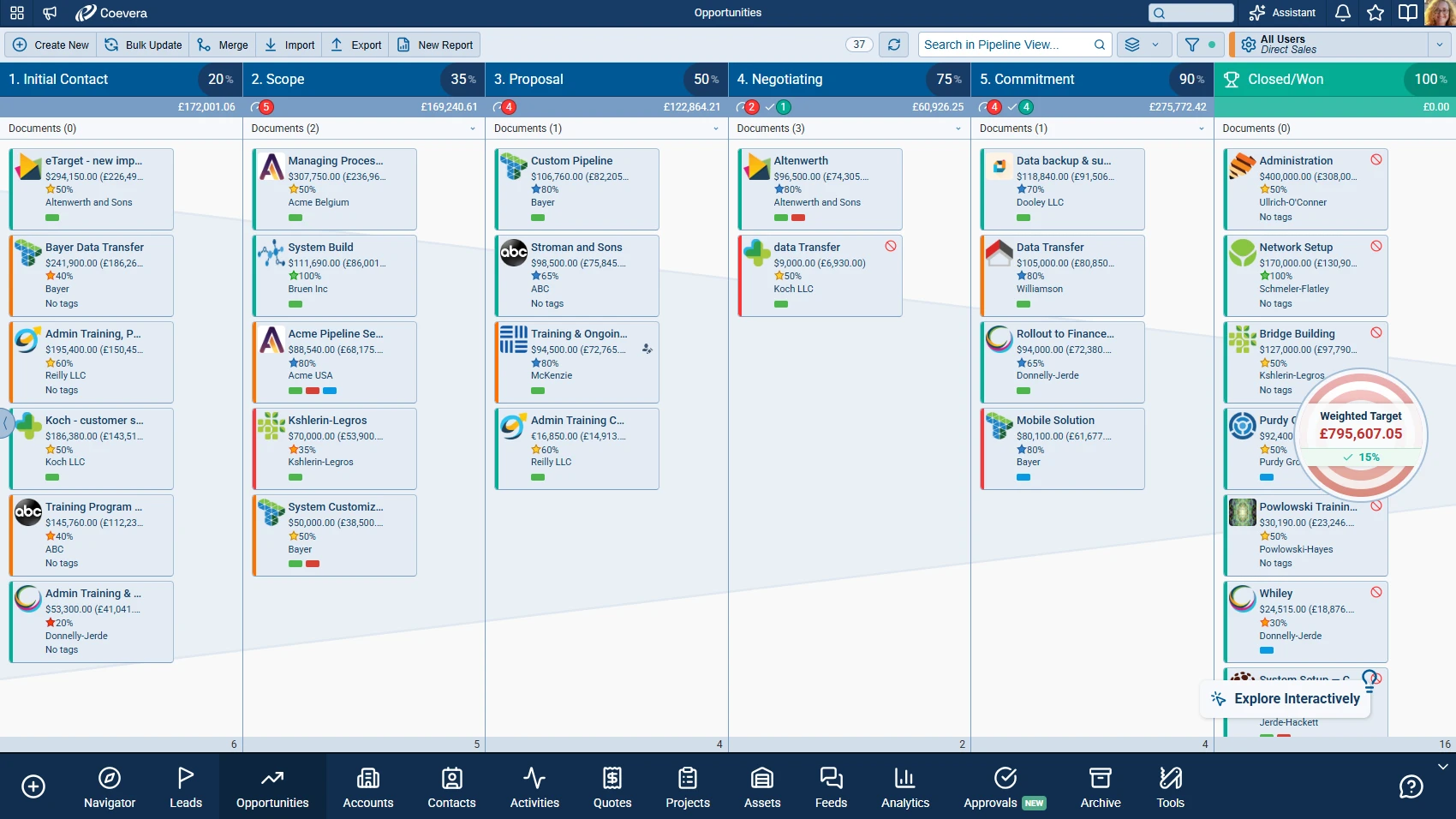
There are multiple CRM systems available in the market nowadays, but how to know which one is the best option for you? Note that Coevera has everything necessary for managing and optimizing sales processes.
2. Develop your ideal customer profile
At this stage, you might need the help of the marketing team and executives. They can extract the list of customers that bring the most profit and conclude which characteristics they have in common. This will help you to qualify the leads and concentrate on those that match the ideal customer profile.
3. Sales automation
Innovative software can significantly help in streamlining and optimizing sales processes. For instance, you might want to get more information about your prospects, and CRM enrichment with Skyvia can help you a lot. Moreover, Skyvia can help you integrate data to your CRM from other company data sources to get a complete 360 overview of your leads and sales performance.
4. Shorten sales cycle
In some industries, the process of discussion and other pre-sales activities might take months. This might be determined by the complexity of the product. However, in most cases, there’s no need to overcomplicate the sales process and make it last for weeks. That’s why think of how to reduce the number of steps or improve communications. Get some ideas on how to simplify the sales process to make it more attractive for your customers.
5. Analyze everything
CRM is a gold mine that can serve you as a base for profound and detailed sales process analysis, becoming your single source of truth (SSOT). It’s possible to derive the average time to close a sales deal, the average cost for the prospect, the percentage of prospects to gain customers, and so on.
Data integration with Skyvia for sales optimization
Skyvia is a universal cloud platform designed for a wide range of data-related tasks. You can perform data integration, backup, workflow automation, OData endpoint creation, and data querying.
Let’s have a look at several examples of how you can benefit from using Skyvia together with Coevera.
Enrich CRM Data
1. Log into your Skyvia account or create a new one.
2. Create the Coevera connector.
3. Go to the +Create New -> Import in the top menu.
4. Select a CSV file or a cloud app/database as a source.
5. Select Pipedrive CRM as a target.
6. Click Add task to set up everything needed for smooth integration. This includes the objects you want to enrich your records with and detailed mapping settings.
7. Save the task.
8. Name and save the integration scenario.
9. Click Run to start enriching your CRM data right away.
Query Coevera Data
- Log into your Skyvia account or create a new one.
- Go to the +Create New ->Query -> Builder in the top menu.
- Select the Coevera connector in the left panel.
- Drag the fields that you’d like to see in the query results and specify the filtering criteria.
- If you want to write SQL statements manually, switch to the SQL tab.
- Observe the results and download them in the preferred format.
Measuring the success of the new strategies
Assessing new sales strategies is not rocket science since you already rely on some metrics when evaluating your current strategies. The main thing here is that you stay consistent in the metrics used to measure the results before and after the new strategy implementation.
Here are some widely used metrics to measure success of the sales strategies:
- Sales conversion rates. It indicates the percentage of prospects that turned into paid customers. If this metric increases, it means that the optimized sales processes work well.
- Average sales cycle. It shows the average amount of days/weeks spent on the customer acquisition. The shorter the sales cycle is, the better.
- Average deal size. Measuring a new sales strategy is also important from the point of view of the company’s revenue. Even if conversion rates grow, though the deal size decreases, this might be a good reason to review your current sales strategy.
- Individual quota attainment. This metric shows the performance of each sales representative. Obviously, the more deals a salesperson closes, the better. This means that the sales process was redesigned properly.
Summary
Even when a business is doing well, improving sales is inevitable. It helps present your brand on the market, gain prospective customers, and better understand the target audience.
In most cases, sales make up a considerable share of the company’s profit, so it’s necessary to constantly improve it to get stable revenue streams. For that, it’s highly recommended to install and use the CRM system, use automation tools, reduce the sales cycle, and perform an in-depth analysis of the given data.
Coevera, together with Skyvia, can show outstanding results in improving and optimizing sales processes. You can enrich your CRM data to better understand your prospects and query Coevera data to extract the lead groups corresponding to certain criteria.