A sales manager already juggles countless roles without having their tools work against them. A CRM that creates complex reports and administrative burdens is a liability, not a solution.
As a sales manager, you face countless problems. Your salespeople complain that they can’t close enough deals because they lack leads, or the leads aren’t good enough. They complain that some feature of your product or service isn’t good enough, that the product or service itself isn’t good enough, or that the company itself isn’t good enough. They say you’re overbearing because you push them to sell.
You are responsible for segmenting customers, designing territories, setting goals, generating reports, managing information, and overseeing a constantly changing go-to-market strategy.
As Jason Jordan writes in his excellent book Cracking the Sales Management Code, today’s sales manager is expected to be a manager, marketer, CFO, trainer, and more. You are responsible for segmenting customers, designing territories, setting goals, generating reports, managing information, and overseeing a constantly changing go-to-market strategy.
Let’s face it: You have to be a superhero! You have to deal with all the above and more and hope that, at some point, AI will reduce this burden at least somewhat.
On top of all that, you have pain points stemming directly from your CRM system. Such as:
Your CRM doesn’t provide precise guidance
An efficient CRM system should function like the navigation system in your car. With that system, you input your destination, and it gives the route, travel time, and arrival time. It tells you when to turn and which streets to avoid due to traffic. It also provides alternate routes. Without it, it takes you much longer to get there.
Your CRM system should guide you with the same efficiency and precision.
Inaccurate Forecasting
Forecasting is often inaccurate because your current system doesn’t utilize all the critical data.
This may occur because sales reps who object to using a CRM solution in the first place aren’t inputting all the necessary information. The CRM system may be so complex that reps don’t fully understand it. Alternatively, the CRM system may not be appropriately configured to capture all critical data.
Any of these problems will result in inaccurate forecasts.
You don’t have a clear picture of what your team is doing
Your CRM system doesn’t provide the key performance metrics of your team. You can’t track salespeople through the system, so you’re constantly following up with them to find out what they’re doing. Who is the best performer? Who is the worst? This lack of information also makes coaching impossible without personal contact.
You can’t check on your team’s adherence to the sales process
Your company’s sales process is the most efficient route from lead to closed deal. It’s undoubtedly a pain point if you can’t monitor your sales team to ensure they’re following that process.
Creating reports is complex and problematic
Reports are always necessary for company management and for you. With everything else on your plate, you shouldn’t have to spend extra time creating an accurate report or analysis.
A complex tech stack
You are afraid to move your team to a new system because it is complex. You would need to learn the new system simultaneously with your sales representatives. While this mind-boggling change is happening, you still have to reach your quota.
A new tool is, quite simply, disruptive and adds to your workload. While it may help you in the long run, you must implement it with the least possible confusion for your team.
Administering the system
Even if you found a new system that might work, who would administer it so you could use it effectively? How much time would it cost you or a team member? What kind of person would you need to manage the new system?
What if one incredible platform could solve all these pain points and many more?
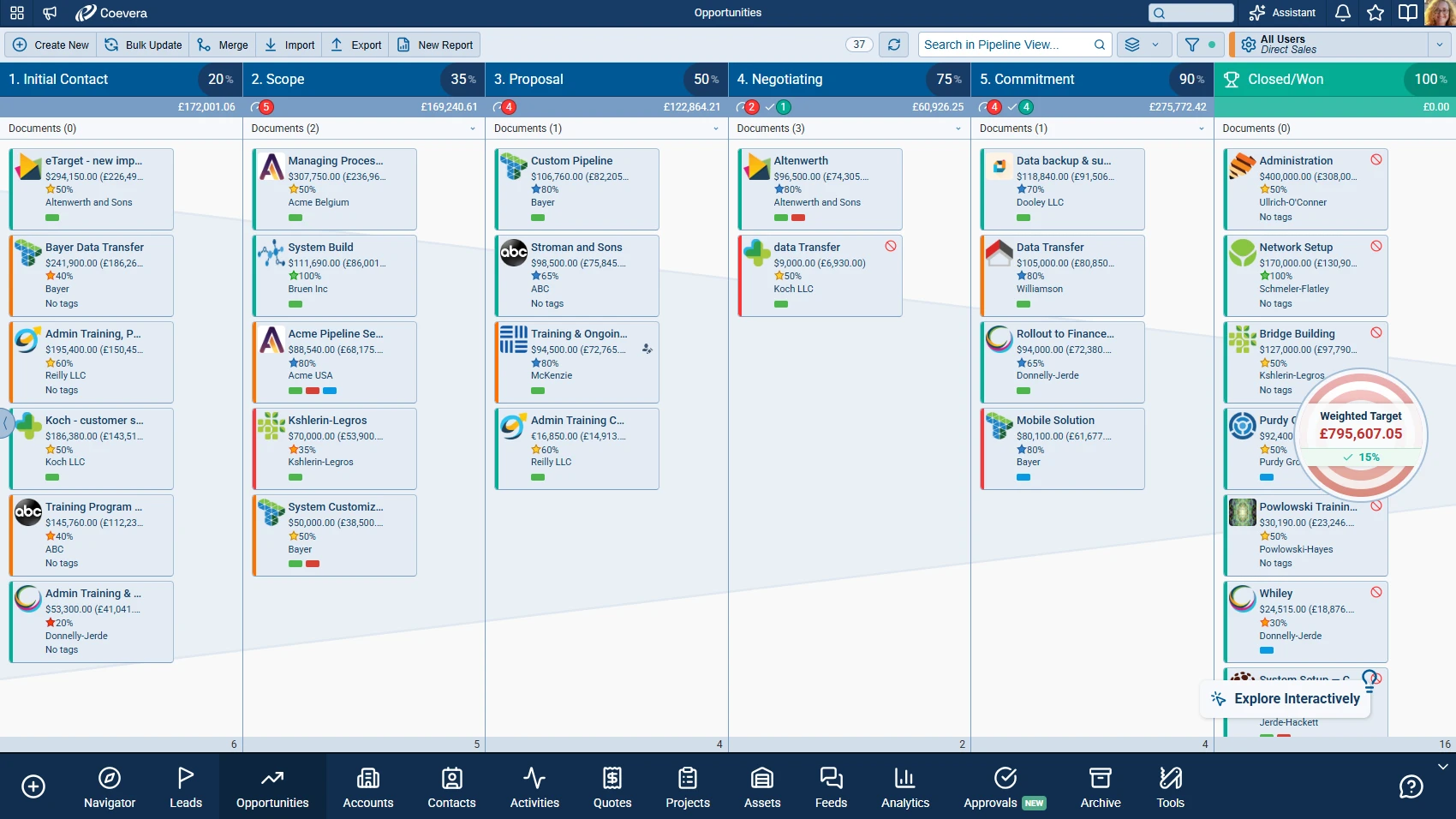
It’s time to check out Coevera.
Coevera support is not just about solving problems, it is also an opportunity for us to advise and educate our customers. This kind of collaboration between support and customers is one way we deliver on our “Win Together!” promise.
— Nikolaus Kimla, Founder & CEO, Coevera