An understanding of Coevera features needs to be considerably deeper than mere technical descriptions. Just understanding mechanical functionality doesn’t necessarily mean you’ll really grasp the product and all that it means, which is why I’m now writing this series on the concepts behind Coevera functionality.
To start, three distinctly different Coevera user types all require different approaches. Let’s first clearly define these different types.
The Regular User—The Salesperson
The salesperson is generally the “regular” Coevera user, although other regular users might be in other roles, such as accounts receivable. There are several ways the basic user can learn about Coevera—from training, from our YouTube videos, and the extensive help functionality available in the program. For a user to learn Coevera is a matter of hours instead of the days, weeks, or months that other CRM applications require.
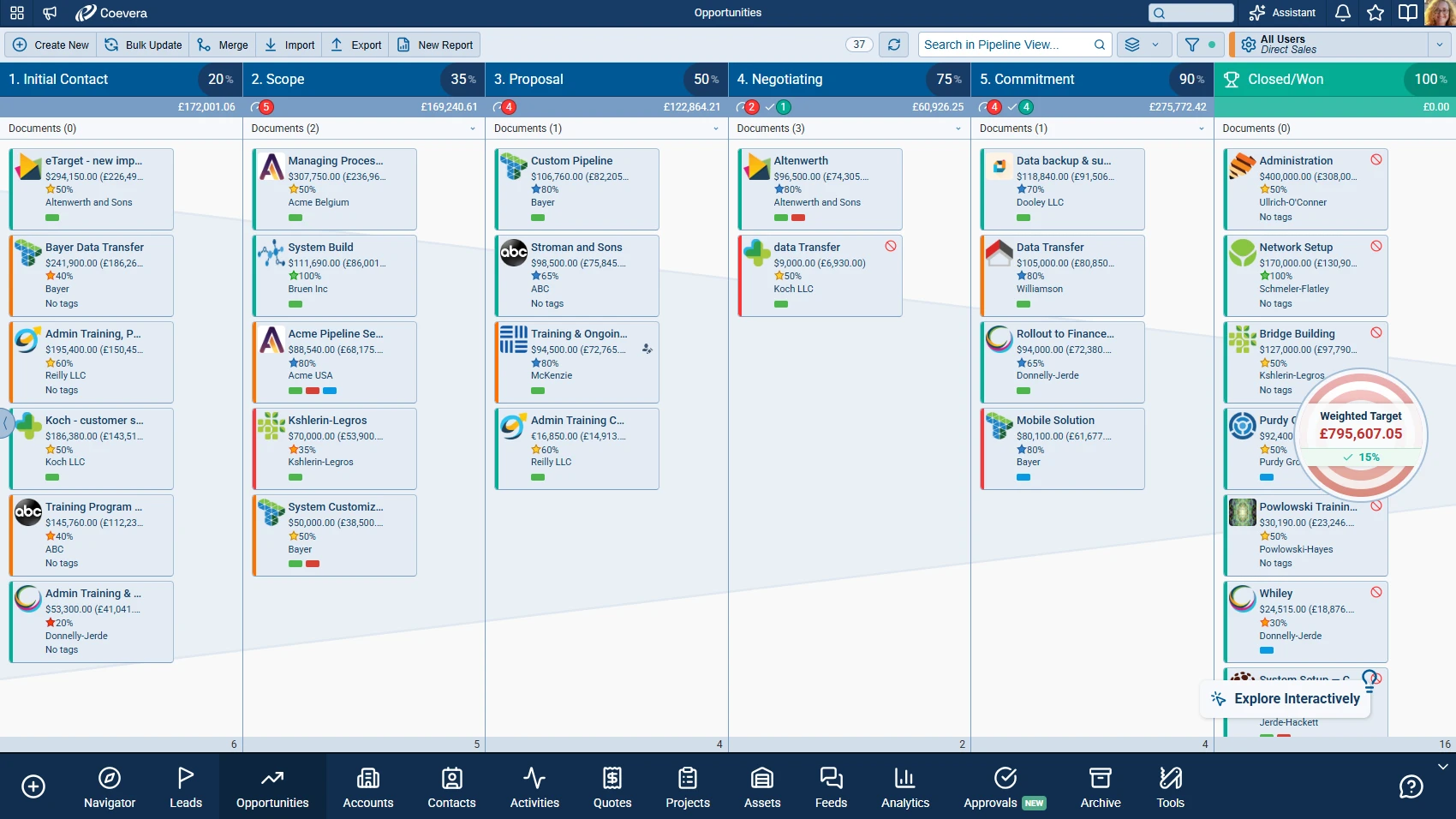
One significant Coevera aspect setting it apart from any other CRM is that users generally love it…and as anyone knows, what you love, you use! This love is down to Coevera’s totally visual approach—in fact, Coevera is the most visual CRM in the world. In that the mind perceives pictures 60,000 times faster than words, this makes for a much faster operation as well. Because users happily and fully interact with Coevera, they enter complete data, and sales management actually gets the information they need from CRM.
Also based on Coevera’s totally visual approach is its clear, unified navigation system. Our user interface is not only state-of-the-art, but elegant, slick, and clean. The navigation system is the frame that holds and unifies the entire picture.
Support is provided, when needed, through extensive help embedded in the program, user chat, our help support website, and our Coevera community. These are all available through the “graduation cap” symbol in the program.
There is a necessary prerequisite to user training, and that is a complete application setup within the user’s company. By setup, we mean full customization and all other things needed for Coevera to fully back up that particular organization. Otherwise, users won’t be training on the application, but simply on features without relating them to the user’s company and products.
Correctly done setup means very high user adoption rates—again, unlike many other CRM products, especially the traditional enormous ones.
In practice: the author likens the architect administrator to a factory engineer who studies the production line and reworks it for efficiency — creating things like rollup fields and streamlined processes anywhere in the company, not just sales, all without any programming knowledge.
The Next Type: The Advanced User
The advanced user is also part of the user category. Advanced users would include sales and other managers who oversee other users, and C-level executives. These generally need to have access to advanced reporting, insights, and statistics.
The advanced user is set apart from the regular user by the fact that they not only need to view their own data but data from other users as well. Therefore the advanced user will want to learn all about Coevera’s advanced filtering and profiling capabilities so that data can be rapidly viewed in the exact way they need to see it, and utilized within advanced reporting.
Advanced users will require these advanced features–but they are not complicated.
When required, specialized roles can be targeted with particular training as needed.
Administrators: Two Types
When it comes to Coevera, administrators fall into two distinct categories. The first is the one people would typically think of—the administrator who enables needed features to the product when requested, adds new users, provides user support and enables customized fields and other similar tasks. With traditional CRM applications, even these everyday administrative functions would require weeks or months of learning. It took us many years of programming, but we finally arrived at the point that regular Coevera administration can be learned by any computer-literate person within a couple of hours. That means that the “CRM expert” or consultant previously required for CRM administration is no longer needed.
This first administrator type is not a full-time job, normally only requiring a few hours per month. This saves the company a whole extra salary for the “expert.”
We refer to the second administrator type as the architect administrator. This role operates on more of a conceptual level of the organization’s business processes and should be someone who, right from the beginning, is assisting the company with streamlining processes. They continually find ways to create and streamline those processes within Coevera. As an example, the creation of a rollup field, and the different factors that would contribute to it. These functions would not only be created for sales—they could very well be anywhere else in the company.
You could compare the architect administrator to someone who creates new functions within a factory so that it functions more efficiently. They analyze the line and find ways to improve it and make it more effective.
Please note that programming knowledge is not required for this or any other Coevera function. We provide all the needed tools for an administrator. Our back-end administration, while consisting of a complete toolset, is simple to learn and operate.
Just as with the first administrator type, the architect administrator is not necessarily a full-time position. In fact, the two different types of administrators could even be one person, but they’re generally not.
This series of articles will take us through the concepts behind these different administrator types, as well as units, roles, and other essential aspects from a conceptual approach. Stay with us!