In our previous article on account management, we discussed why account management is so important, that maintaining and expanding an existing account is far less costly than obtaining new accounts.
Now, if we take a look at the primary way that accounts are kept, we find that it’s innovation; you’ll be able to hang onto accounts only so long as you are innovating in a way that’s important for your customers. In fact, Austrian economist Peter Schumpeter put forth that innovation is a process of industrial mutation, and is right at the center of economic change. Schumpeter coined the term “creative destruction” to demonstrate that economic structures would be constantly undergoing destruction for the creation of new structures.
Innovation is often viewed in a shallow way—that a basic idea is, in itself, innovation. This isn’t true, however, because a basic idea has no power at all if it doesn’t get done. Schumpeter says, “The basic idea is not adequate by itself to lead to implementation. It must be taken up by a strong character—the entrepreneur—and implemented. It is not the power of ideas, but the power to get things done.”
We have certainly taken that to heart at Coevera, and have always innovated with a view to accomplishment. This accomplishment has always been applied to customer satisfaction and account management.
The Nutella Comparison
I’m turning 60 this year, and one product I’ve loved since I was a boy is Nutella, the sweetened hazelnut cocoa spread. My son is now growing up with it, too. Through its entire existence—over 55 years—Nutella hasn’t changed at all.
In the software industry, though, this could never work. If you’re not constantly innovating, you’re done. If we left Coevera alone and didn’t change it for 55 years, people would have long ago stopped using it. Innovation is the only way a software product will continue to have a positive impact on the customer, and therefore keep customers on board.
In the last few years the term “churn rate” has come into being with the SaaS business. It means the rate at which you are losing customers. When you are constantly losing clients, that means you constantly have to win more. Account management, expertly and efficiently done, keeps those customers from leaving, and in addition, keeps your customer base expanding.
In practice: Coevera began on on-premise technology and had to transform its entire core to run in the cloud, then migrate existing customers from one foundation to the other — and the author credits the powerful features built into the product for the fact that those customers followed it across.
Coevera Innovation
All of this has been no secret to us at Coevera. We have been constantly innovating since the beginning, and we have certainly encountered some challenges along the way. Probably the primary challenge was that the core technology we began with, which was on-premise, had to be totally transformed to be based in the cloud. A few years back we had to smoothly transfer our existing customers from one core technology to the other. Very fortunately, the powerful features we had innovated into Coevera meant that our customers followed us to the cloud.
There are some standout examples of companies that didn’t innovate quickly enough to keep their customer base. One example was BlackBerry, which in the first decade of the 21st century was the market leader worldwide, thanks to their innovation of bringing email to mobile devices. They didn’t continue to innovate, however, and were completely overtaken by Android and iOS devices. Today nobody is using BlackBerry.
Probably the most stellar example is AltaVista, which was at the turn of the century the far-and-away search-engine leader. AltaVista didn’t continue to innovate, though, and almost overnight Google overtook them and has been the search engine giant ever since.
Innovation is a core part of what we do as a practice of account management—and as well, we’ll be introducing, in the next couple of months, some amazing and never-before-seen advances in account management for CRM.
Roles and Views
First of all, we’ve greatly expanded our back-end Account Management capabilities in the areas of roles and user rights. We’ve provided many different fields which allow companies to add or prohibit users in viewing and working with specific accounts or specific types of accounts.
In the Administration section of Coevera, we list out different roles. But in addition, you can now provide full, read or no access to these roles over the API to other applications. This is often a complex issue for other software products, and many cannot offer this kind of flexibility.
As you probably know, different roles within a company view account information differently. You’ll now be able to, in Coevera, manage different views of data for different roles. For example, the Customer Success view sees data one way, while the Marketing view sees data a different way. This methodology is based on the fact that no one role needs to see all aspects of data—too many fields lead to distraction instead of production. These views allow the necessary focus for each role. No other CRM offers this kind of functionality today.
Expanded Card View
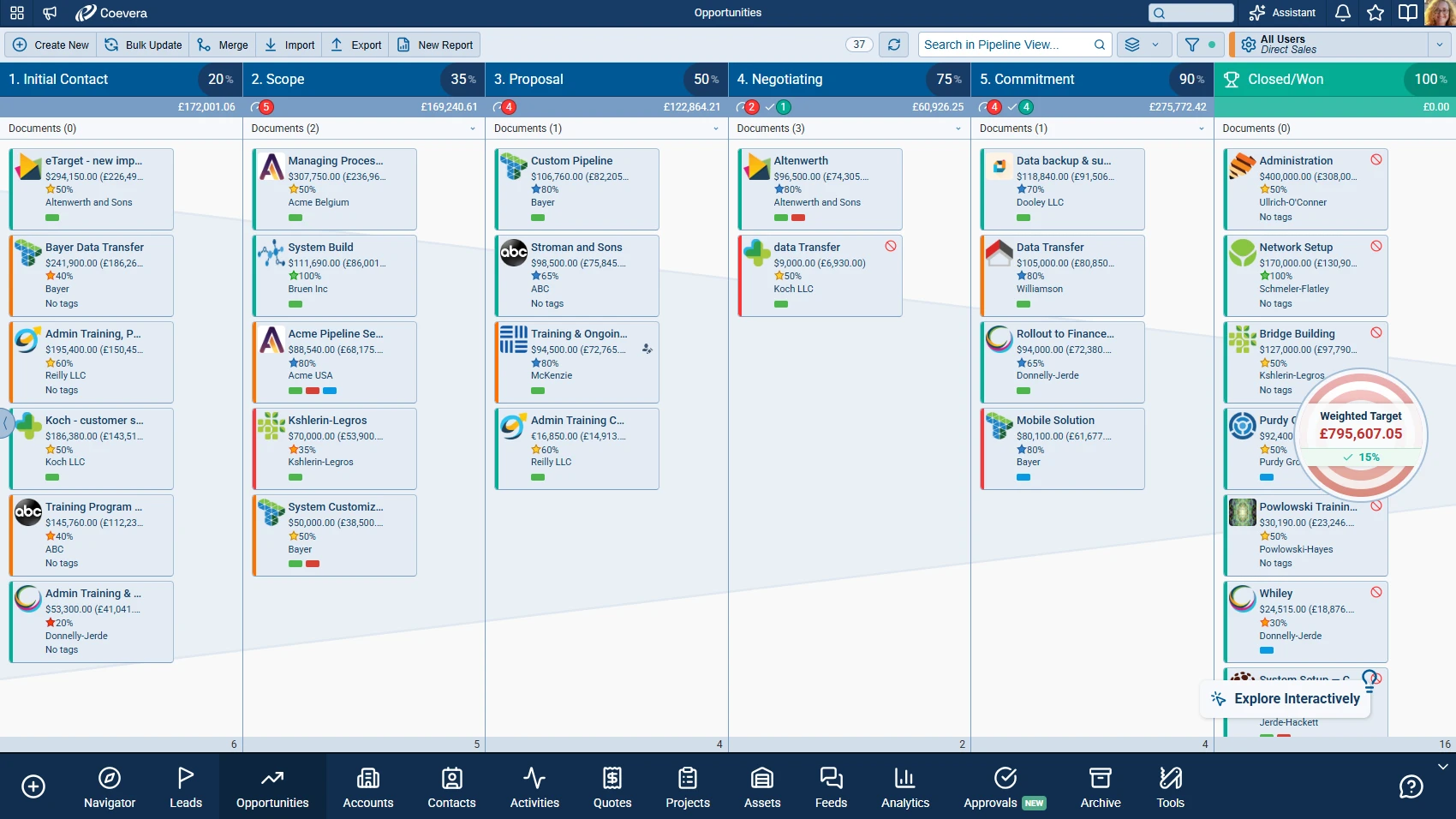
In Coevera, the Card View allows you to mouse over an account in a pipeline or list view, and see vital information about that account. Previously, there were 6 fixed fields that would display in the Card View. Now, however, we’ve expanded that to 12, and provided you the option of customizing these fields as not every company—nor every role in every company—requires the same information. Therefore this mouse-over functionality can be customized based on the requirements of what needs to be seen.
Account Matrix
Another very exciting innovation we have made with Coevera is the Account Matrix. The Account Matrix provides you with 2 axes—“X” and “Y” and you can customize both of these axes to provide a unique view of your accounts. For example, one axis could be the “won amount” and the other could be the date. Or, one axis could be customers, and another could be revenue.
As with all of Coevera’s new visual features, you can drill down on any opportunity in the Matrix to obtain details on it.
In our next article, we’ll begin exploring the deeper principles and theory behind account management. Stay tuned!