A salesperson is a knowledge worker twice over: you build the expertise you carry, and you create value by passing it on — to the customer, and back to your own company. Do it well and you end up holding a web of knowledge that's genuinely unique to you.
But here's the catch. The knowledge you most need from a customer is scattered, subjective, and half of it unspoken. Friedrich Hayek described all human knowledge as fragments of "imperfect and often contradictory knowledge, which all the different individuals possess separately." Your job isn't to already know it. It's to collect the fragments and organise them into something useful.
We can know more than we can tell
That line is Michael Polanyi's, and it's the whole game. The customer can hand you their requirements, their budget, their timeline. But the knowledge that actually runs their business — the habits, the judgement calls, the way the good people just know what to do — is tacit. They can't write it down because they're not even aware they have it.
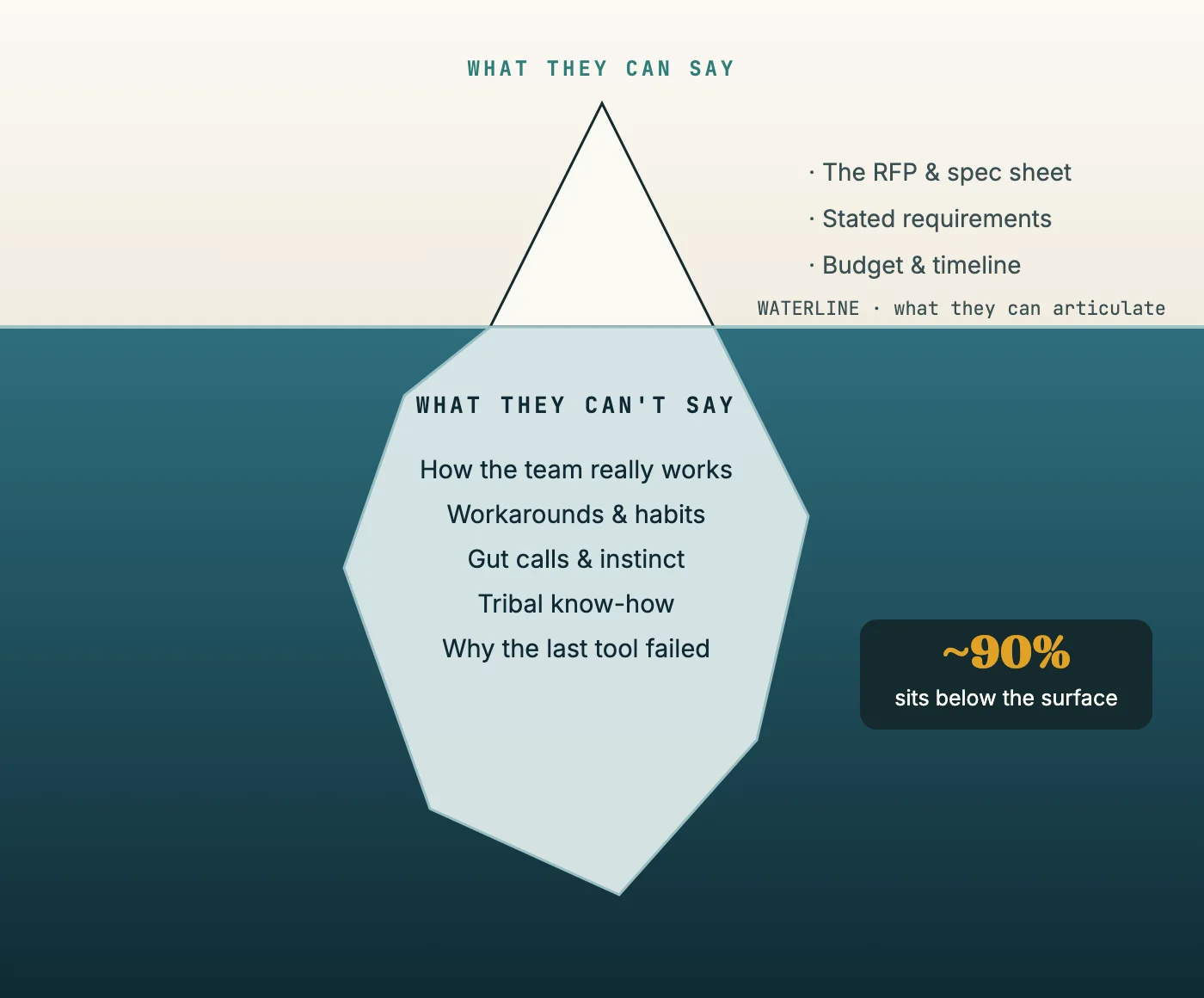
Think of teaching someone to ride a bike. You can ride — but try writing the instructions for balancing and watch how useless they are. The skill lives in the doing, not in words. Every customer's operation is full of bicycle-riding: real expertise that no document will ever capture.
You're not a spy. You're a translator
Here's the trap: thinking your job is to extract the customer's know-how. You can't, and you shouldn't try. You'll never replicate their production process after a few meetings — that's the nature of tacit knowledge, and frankly they have no reason to hand a competitive secret to an outsider.
What you can do is work one level up. You translate their silent knowledge into something abstract and useful: an understanding of how their world works, what it costs them, and what they actually need — even when they've never said it.
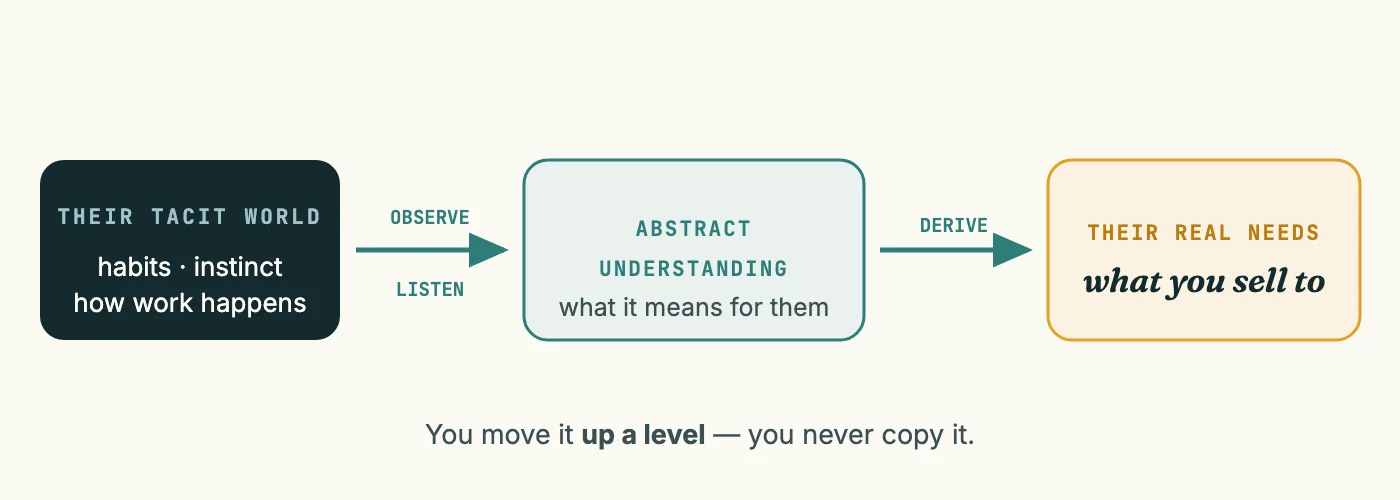
You move it up a level. You never copy it.
Almost everyone holds knowledge of their own particular time and place that no one else has — and can use it well, if the decisions are left to them.
— after Friedrich A. von Hayek
Listen for the work, not just the words
You can't camp out beside the customer's foreman for a month. But you can observe sharply and ask the right way. Tacit knowledge moves between people through interaction, repetition and trust — the same way a master passes craft to an apprentice — not through a list of bullet points. So conduct your discovery "with active listening and empathy," until you can see their working world through their eyes.
Surfaces silent knowledge
- Watch the work happen — don't just read the requirements.
- Ask for stories and walkthroughs, not opinions.
- Listen for the workaround — that's where the real need hides.
- Earn enough trust that they show you the messy parts.
Shuts it down
- Launching your demo before you've seen how they operate.
- Treating the RFP as the whole truth.
- Yes/no questions that just confirm your assumptions.
- Fishing for their secret sauce — they'll close right up.
Five questions that pull the unspoken into the open
These don't ask the customer to explain what they can't explain. They ask them to show you the work — and the tacit knowledge surfaces on its own.
- "Walk me through a normal Tuesday — the real one, not the ideal one."
- "Where does your team work around the system you have now?"
- "What does your best person do that the others somehow don't?"
- "Last time this went wrong — what actually happened, step by step?"
- "What matters here that you'd never bother putting in a spec?"
How deep you dig should match how much the hidden knowledge matters to this deal. Part of the skill is sensing where the silent stuff is decisive — and where the surface answer is enough.
Aim for the ring, not the core
There's a line you're not meant to cross — and it's healthy. At the centre of every customer sits know-how that's theirs alone: their edge, their secret, the thing they shouldn't and won't give away. Don't reach for it. Reach for the understanding that surrounds it.
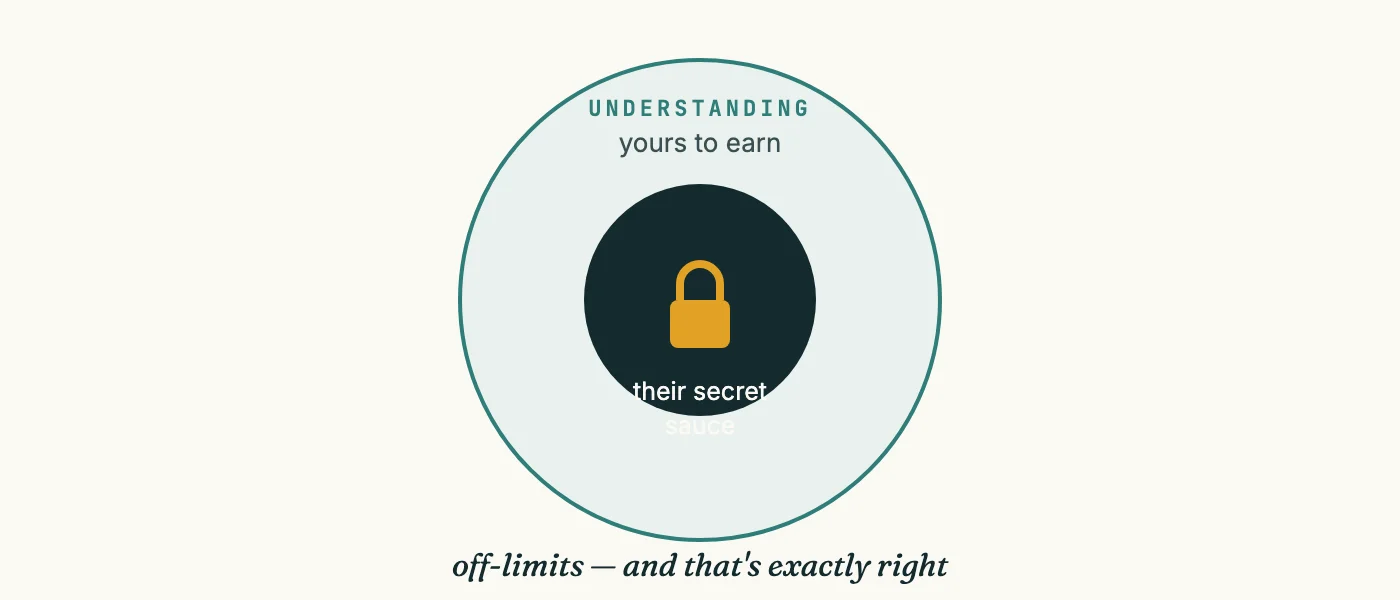
You'll never imitate the customer's craft, and you don't need to. Recognising that the silent knowledge exists — and grasping what it means for them — is enough to find their real need. That's the whole job.
The art of the salesperson: to hear the knowledge a customer can't speak — and never mistake understanding it for owning it.